
By Tahrir Hamdi
Tahrir Hamdi examines Palestine’s growing global solidarity movement, confronting Western complicity, Arab repression and the silencing of resistance across academia.
The third year of the genocide in Gaza has come to a close, and we are now entering its fourth year, marked by daily bombings, the forced starvation of the population and the denial of access to medicines, all imposed by the genocidal Zionist entity, imperialist power bases and their conveniently complicit lackeys.
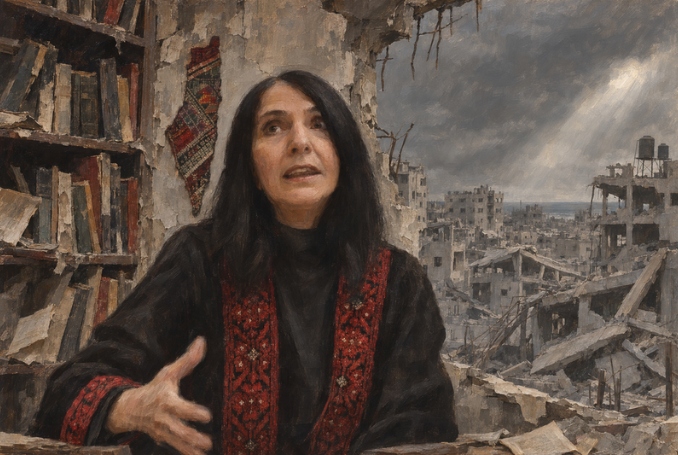
Unlike the perpetrators of genocides of the past, the genocidal Zionist entity has used the latest in AI technology to literally slaughter families in their tents in the rubble—rubble which now comprises most of Gaza, where hardly any buildings remain standing.
A recent, horrifying aerial view of Gaza shows the grim reality of this genocide, made even more unconscionable by the use of advanced AI technology (such as “Lavender” and “Where’s Daddy”), in a sophisticated campaign to exterminate a people, their history, culture, hospitals, educational institutions and knowledge systems.
Meanwhile, most of the “free” world and its Arab puppets look away, all the while enabling the continuation of the genocide—conveniently, silently. Although the current political climate is not much different from what we have been witnessing within the Palestinian context over the past eight decades, this does not mean that nothing has changed. It has.
Palestine is now a global cause. Yes, the tide has turned, and there’s no turning back. Palestine is now the cause of the people of the world—university students and academics, singers, entertainers, sports heroes, and everyday people who have been watching this horrific genocide for three years on social media (before the videos are taken down). Meanwhile, legacy media are “both-siding” a live-streamed brutal genocide and even blatantly and unashamedly taking the side of the Zionist killer.
Legacy media and the powers that be in the hegemonic colonial center hoped to play up the third anniversary of the October 7 attack a few weeks ago in an attempt to reverse the turning of the tide.
Headlines from legacy media giants, such as the BBC and The Guardian, included: “Israelis mourn 7 October attack victims three years after deadly Hamas raid,” and “World leaders pay tribute to victims as Israel marks three years since 7 October attack by Hamas—as it happened”.
Underneath this heading in The Guardian, another one appeared: “All I want to do is cry: trauma of 7 October survivors three years after the attacks.”
World leaders paying tribute to “Israeli victims” (something that “world leaders” never felt obliged to do for Palestinians) lends a serious, solemn and official tone to the headline, while the second Guardian headline, “All I want to do is cry…” is meant to manufacture the readers’ consent for the continued genocide by appealing to emotion and empathy, thus humanizing Israelis who are “like us” in the West.
Palestinian cries, echoing across a completely flattened Gaza, continue to be silenced and doubly buried: first, by the hypocrisy of Western powers and then again under vast piles of rubble, stretching as far as the eye can see.
The devastating human toll of this systematic destruction remains conveniently ignored by hegemonic Western powers and their Arab allies as corpses decay beneath Gaza’s rubble and children survive amputations, many of them designated WCNSF (wounded child, no surviving family).
Despite these attempts at silencing the truth and reality of the Palestinian past and present, the peoples of the world continue to protest in solidarity with the Palestinian people. University staff are setting up Palestine solidarity groups globally (an example is the Open University Palestine Solidarity Group—OU PSG).
Contemporary writers, such as Sally Rooney and Isabella Hammad, have expressed strong support for the Palestinian cause; Rooney’s novels can no longer be sold in the UK due to her support for Palestine Action.
The NFL player Aziz Al-Shaair was fined for writing the names of martyred Palestinian children on his eye black during NFL games, while Western musicians, such as Macklemore, Roger Waters, Bob Vylan, Eric Clapton, Kneecap and others, have shown public support for Palestine at their concerts.
These examples are just a very small part of the global solidarity with Palestine and its people. Palestine has indeed become a global cause, perhaps marking the beginning of a larger struggle for global freedom from the imperialist, Zionist project.
However, this tidal wave does not seem to be effecting change in the Arab world. Arab populations must learn to break the chains of their oppressive silence.
While it is true that Arab populations are silenced by the more aggressive policing of political thought and other activities, which can result in arrest and indefinite imprisonment in different Arab countries, Arab populations have unfortunately also fallen prey to deliberate efforts by the media and other state apparatuses to manufacture consent for sectarianism.
This is especially the case when sectarian discourse targets certain Islamic groups or madahib that have historically supported the Palestinian resistance, including its armed resistance, over the last few decades.
These sectarian discourses, designed and supported by imperialist and Zionist forces, must be countered with serious intellectual projects (free of government intervention) that aim to educate educators at Arab universities. Educators in the Arab world are in desperate need of political education, and I do not say this lightly.
Palestine is almost completely absent from their courses and seminars; seminars on Arab university campuses are closely “watched” to ensure that certain terms, such as “resistance” within the Palestinian context, are never used.
Unfortunately, and unforgivably, this state of affairs is the reality across the vast majority of countries in the Arab world. Thus, the Palestine exception extends beyond official and hegemonic Western power centers to Arab governments, academia and cultural institutions. Educators throughout the Arab world are well aware that discussions of Palestine have become paths untrodden, territories into which neither instructors nor their students dare venture openly and publicly.
The Palestine exception must be broken. Yes, the tide is turning, but this change must continue to grow—people the world over must continue to resist. Armed, cultural and economic resistance are legal and moral rights of colonized peoples; one can resist with a word, a song, a dance—or boycotting the expansionist Zionist settler colony.
As Ghassan Kanafani wrote in “Letter from Gaza” in 1956: “…This small feeling must grow into a giant deep within you. It must expand, you must seek it in order to find yourself….” The world has reached a point from which there can be no return to the old status quo—global resistance must continue to grow to break the chains of oppression imposed by the Zionist settler colonial project.
– Tahrir Hamdi is a professor of postcolonial literature at Arab Open University in Jordan. Her work explores resistance literature, anticolonial theory, geography, exile and Palestinian national identity.