
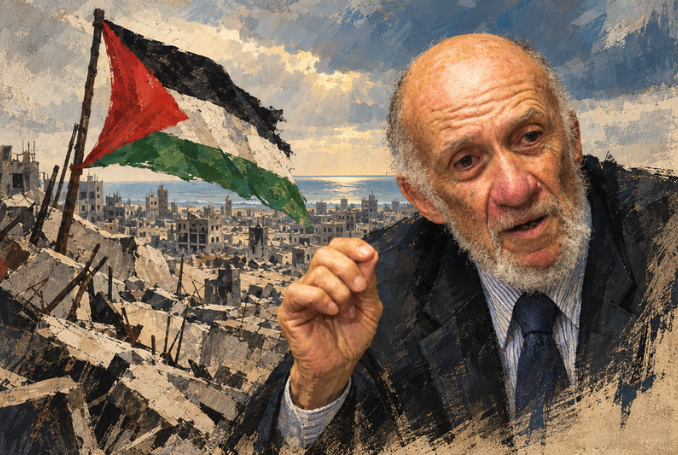
By Richard Falk
Richard Falk examines Gaza’s longstanding oppression and escalating genocide, exposing Western complicity and the failures of international law and institutions.
Pre-October 7 Continuities
There is a risk that by viewing the Gaza ordeal from the perspective of these ghastly last three years, we indirectly validate Israel’s view that all was fine in the Gaza Strip until the attack on some Israeli villages occurred on October 7. Israel’s skillful mastery of state propaganda and public discourse suppressed the relevance of preexisting conditions. During prior years in Gaza, Israeli policies of blockade were designed to put the entire Gazan population ‘on a diet’, and such euphemisms for large military operations adopted genocidal language, such as ‘mowing the lawn’, to sanitize major military incursions.
Even the conservative pro-Israeli British Prime Minister, David Cameron, described the Gaza Strip as a ‘prison camp.’ More pointedly, in 2010 Cameron prophetically told the House of Lords: “Everybody knows that we are not going to sort out the problem of the Middle East peace process while there is effectively a great open prison in Gaza.”
Also, long before October 7, there was a civil society consensus that Israel pursued policies and practices in violation of the 1973 International Apartheid Convention. The apartheid assessment was endorsed in the period 2017-2022 by a series of well-documented reports issued under the reliable auspices of the UN organ, the Economic and Social Commission for West Asia (or ESCWA), as well as human rights NGOS Human Rights Watch, B’tselem, and Amnesty International.
The pre-October context is most vividly portrayed by the widely acclaimed Palestinian author and Gaza resident Heider Eid in his brilliant book Banging on the Wall of the Tank: Dispatches from Gaza (2025). While acutely aware of the Gaza Genocide of the last three years, Eid’s convinces objective readers that Gaza had, long before 2023, been subject to ‘incremental genocide,’ the term attributed to Ilan Pappé.
On this basis, the October 7 attack should be interpreted to take account of lengthy and cruel Palestinian oppression in their homeland and not treated as a sudden outburst of Palestinian terrorism as claimed in the Israeli narrative. The Gaza attack should be understood as a provoked reaction of resistance sometimes analogized to a justifiable prison uprising, slave revolt, or resistance to state terrorism.
The Last Three Years: Discontinuities in Perspective
From the perspective of international law, it amounted to a genocidal retaliation against the October 7 attack, articulated from the outset in the chilling words of Netanyahu and the then Defense Minister Yoav Gallant.
Netanyahu invoked as a model for Israel’s retaliation the Bible story of the total annihilation of the Amalek people, including women, children, and even the cattle, sheep, camels, and donkeys under their domain.
Gallant gave a graphic account that accused Palestinians of acting as ‘human animals’, which justified treating them accordingly, by denying Gazans the necessities of life, including food, water, fuel, and medical supplies. The combat tactics of the IDF carried into practice these sentiments of Israeli leaders, adding sexual violence, prisoner and detainee abuse, and the bombing of hospitals, UN shelters, sacred and heritage sites, residential neighborhoods, schools, and electricity transmission systems despite such targets being prohibited by long-standing prohibitions of international law.
The behavior of complicit states, especially the US, was a further aggravating feature of the genocide. It should be appreciated that complicity is a separate crime according to the Genocide Convention, but complicit states have not only enjoyed impunity, but the US, despite being the anchor of complicity, has outrageously taken over efforts to design Gaza’s future in ways that favor the perpetrator of genocide, a travesty that further punishes the victim. And yet shamefully gained unopposed encouragement at the UN.
One result of such behavior is to discredit the role of the five veto members of the UN Security Council as responsible guarantors of global security conclusively. Another is to exhibit the craven deficiencies of the UN when it comes to genocide prevention, and the irrelevance of international law if its norms collide with the hegemonic designs of the liberal democracies of the West.
Whether Israel’s dramatic loss of civil society legitimacy and vindication of Palestinian solidarity initiatives will make a difference for the Palestinians or the character of world order is not yet clear. The above pattern of discontinuities has not yet gelled in relation to Palestinian prospects for national self-determination or more systematic reforms of the UN and geopolitical behavior.

– Richard Falk is Albert G Milbank Professor Emeritus of International Law at Princeton University and Research Fellow, Orfalea Center of Global Studies. He was also the United Nations Special Rapporteur on Palestinian human rights.