
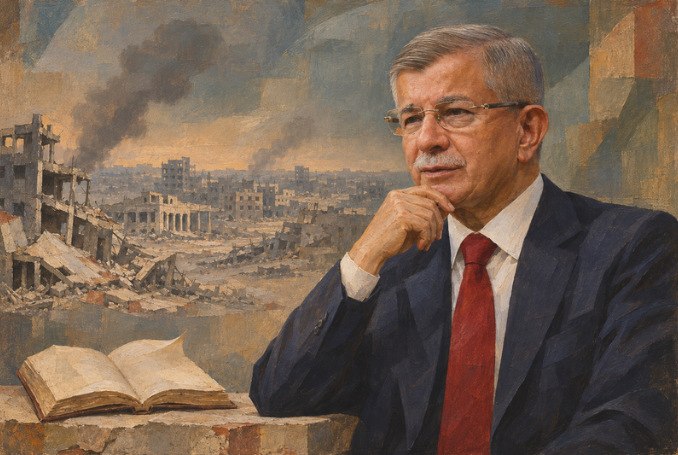
Ahmet Davutoğlu examines how Gaza’s suffering has awakened humanity’s conscience, uniting people worldwide against genocide and exposing political leaders’ complicity.
In Gaza, we have witnessed a level of barbarity almost without precedent in human history. The leaders and soldiers of a genocidal state, stripped of fundamental human values, have massacred defenseless children and women, destroyed hospitals and places of worship, and reduced an entire city and region to ruins in their ruthless pursuit of domination.
Yet, through the innocent blood shed in Gaza, humanity has learned a profound and unforgettable lesson.
Initially, the tragedy was perceived by many as a war between Hamas and Israel. But with every passing day, its nature and meaning changed. As the world witnessed the devastating consequences of Israel’s genocidal policies, a new moral awareness emerged:
This is not a war between Israel and Hamas, Israel and Gaza, Israel and the Palestinians, Israel and the Arabs, or even Israel and Muslims. It is a confrontation between Israel and the conscience of humanity itself.
What distinguishes human beings is their capacity to exercise free will and make moral choices. Throughout this genocide, everyone, from the most powerful world leader to an ordinary person on a remote Pacific island, has faced an unavoidable choice between political expediency and human conscience.
At first, opposition to the genocide was largely confined to those directly concerned with Palestine, while much of humanity remained passive. Many Western leaders, influenced by the historical narrative of Jewish suffering since the Second World War, either openly supported Israel or sought refuge in neutrality. American and European decision-makers traveled to Tel Aviv almost as though undertaking a sacred pilgrimage, declaring solidarity with Israel while Gaza was being devastated.
Courageous voices, such as UN Secretary-General António Guterres, who reminded the world that October 7 “did not happen in a vacuum,” faced extraordinary pressure. Yet leaders including South Africa’s Cyril Ramaphosa, Brazil’s Lula da Silva, Spain’s Pedro Sánchez, Colombia’s Gustavo Petro, Norway’s Jonas Gahr Støre, and Ireland’s Leo Varadkar, alongside judges of the International Court of Justice and International Criminal Court, emerged as significant voices of humanity’s conscience.
Time is the fairest of all judges.
As the genocide continued, the circle of those defending it gradually narrowed, while the circle of humanity resisting it expanded. Even some who initially stood alongside the Netanyahu–Trump axis began reconsidering their positions under the growing pressure of public opinion and their own conscience.
From the streets of major capitals to university campuses and football stadiums, millions raised their voices in different languages but with one shared moral conviction:
“Free, free Palestine!”
“¡Paremos el genocidio en Palestina!”
“¡Viva, viva Palestina!”
“You will never walk alone!”
Different languages, cultures, religions, and histories converged in one universal demand: justice for Palestine and an end to genocide.
Perhaps never before has humanity’s conscience approached such a broad consensus across geographical, cultural, and ideological boundaries. Those who supported the genocide will be remembered with shame. Those who remained silent to protect their interests will face the enduring moral warning expressed in words associated with the legacy of Alija Izetbegović, who resisted the genocide in Bosnia: “In the end, we will remember not the words of our enemies, but the silence of our friends.”
The greatest lesson Gaza has taught humanity is this: “Wars are not ultimately won at the barrels of guns, but in the depths of the human conscience.”
Today, every lifeless body of an innocent child in Gaza stands as a victorious commander in humanity’s conscience. Every extinguished life has awakened countless hearts, challenged indifference, and reminded the world that military superiority can never confer moral legitimacy.
The perpetrators may destroy cities, silence innocent lives, and impose their power through overwhelming force. But they cannot extinguish humanity’s conscience or erase the moral truth written in the blood of Gaza’s children.
While the perpetrators of genocide will be remembered with condemnation until the end of time, the radiant innocence of Gaza’s children will illuminate humanity’s future.
History’s ultimate judgment will belong not to those who wielded the weapons of destruction, but to those who kept the conscience of humanity alive.
– Ahmet Davutoğlu is a Turkish academic, diplomat, and politician who served as the 26th Prime Minister of Türkiye from 2014 to 2016.