
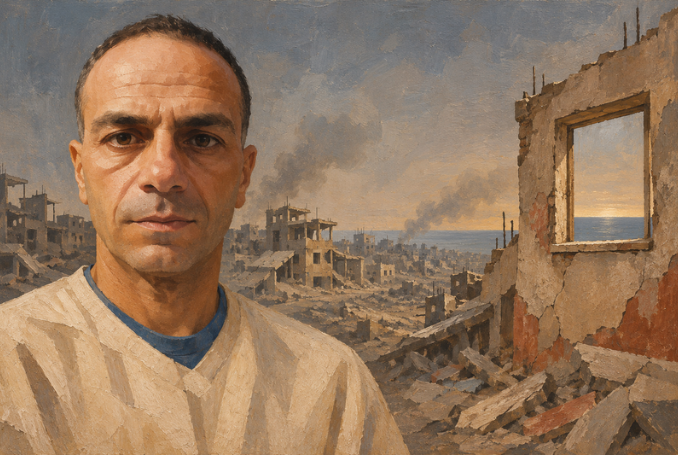
Writing from Gaza, Hani al-Salmy examines how Palestinians tell their own stories while global awareness fails to deliver meaningful protection.
Three years ago, the world knew Gaza through the images that reached it after the bombing. Today, the world is almost inside Gaza. There is a phone in every tent, a screen in every hand, and a Palestinian face reaching the world before a news camera can.
Something important has changed: the world is no longer searching for Gaza; Gaza is searching for the world. Yet the paradox is that the world entered Gaza through phone screens, but never entered through the doors of rescue. To me, this is one of the strangest transformations of the past three years.
Palestinians in Gaza have become their own journalists, photographers, translators, reporters, historians, and sometimes even editors of their own funerals. The child who should have been carrying a schoolbag now knows how to film a destroyed home. The mother who should have been worrying about feeding her children has learned how to write a post in English so that her voice can reach someone in a distant city. And the writer no longer writes only for readers; he writes to prove that something actually happened.
Even death has changed its form. In the past, Palestinian death reached the world as a news item: the number of dead, the names of the victims, the location of the bombing. Today, death carries a face, a voice, a memory, and a final message. We are no longer merely numbers in news reports; we are leaving behind an enormous archive of photographs, recordings, and messages.
But what has this archive achieved? It has changed the language more than it has changed reality. People around the world now know words they may never have known before: Nakba, occupation, siege, refugee camp, displacement, Gaza. Palestinians can now speak directly to millions of people without passing through a newspaper, television channel, or political office.
This is a real victory, but a strange one: a person can now make his voice reach millions while still being unable to reach a safe place with his own body. And this, I believe, is where the greatest change has taken place—in the relationship between Palestinians and the world. In the past, we waited for the world to tell our story.
Today, we tell it ourselves, and watch the world listening. We no longer need anyone to tell us that Gaza exists. The problem is that Gaza now exists everywhere except where it most needs to exist: in the decisions that protect people’s lives.
After three years, the question is no longer: Does the world know what is happening in Gaza? It does. Nor is the question: Has the world seen? It has. The harder question is: What does the world do with everything it has known and seen?
I write from Gaza, and I know that writing is not food, that a poem cannot produce water, and that a story cannot open a border crossing.
But I know something else: throughout these three years, we have tried not to allow genocide to kill our names as well. Perhaps that is what has truly changed. We no longer ask the world to speak for us. We speak for ourselves. Now, it is the world’s turn to answer.
– Hani Al-Salmi is a Palestinian writer from the Gaza Strip. He has published more than twenty novels and children’s stories and has received literary awards throughout the Arab world. Al-Salmi remains in Gaza, where he and his family continue to endure the realities of war, displacement, and siege. He contributed this piece to The Palestine Chronicle.