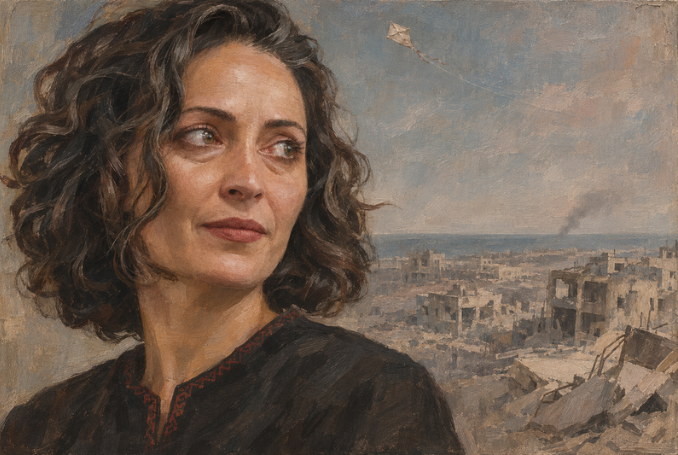
Lubna Speitan examines how the Green Party’s rejection of Zionism challenges Western taboos and centers Palestinian rights and political agency.
Three years into the genocide, alongside an unbearable death toll and unspeakable suffering, a significant change is taking place; we are witnessing the collapse of a carefully constructed linguistic and political architecture.
For decades, the West enforced a consensus: criticism of Israel was partially permissible, but the ideological foundation of the Israeli state, Zionism, remained untouchable. That taboo has now been broken, not from the halls of the United Nations, but from within a mainstream British political party.
The historic motion, ‘Zionism is Racism ’, passed by the Green Party of England and Wales (GPEW), drafted by Palestinians and allies, explicitly defines Zionism as racism and supports a single democratic Palestinian state in all of historic Palestine*. This is not merely a symbolic gesture. It is a direct return to the political clarity that the Oslo framework sought to bury, and confronts the same arena that gave birth to settler colony Israel with Balfour’s Declaration.
The motion is rooted in the Thawabet, the Palestinian national constants of self-determination, Jerusalem as capital, the right of return, and the right to resistance. For three years, the world has watched Gaza be destroyed while governments debated the semantics of “proportionality.”
The motion passed by the GPEW rejects that semantic game. It states plainly that an ideology requiring an ethnonationalist Jewish state to the exclusion or domination of the non-Jewish population is, in its practical application, a form of racism (at its bare minimum).
The backlash was immediate and predictable. From internal to external opposition. Smear campaigns, typical vilification and victim-blaming tactics, and attacks, including threats to my life and safety as the lead proposer of the motion. All of this was anticipated, as it is in any confrontation with oppression.
But what matters is not the institutional discomfort of the British establishment. What matters is that the Overton Window has shifted so dramatically that a motion rooted in the Thawabet could be debated and passed by a European party at all. Three years ago, such a motion would have been unthinkable. Today, it is policy.
This is what has changed. The genocide did not merely destroy; it clarified. It stripped away the illusion that a “two-state solution” was being pursued in good faith, and it exposed the rhetorical machinery that equated anti-Zionism with antisemitism. The Green policy explicitly rejects that equation. By centering Palestinian voices, not as victims to be pitied, but as political actors with defined national constants, it restores agency to a people who have been spoken about for decades but rarely listened to.
The shift is fragile and contested. But it is real. Three years into the genocide, the political horizon has reopened, not through the generosity of the powerful, but through the refusal of Palestinians and their supporters to abandon the Thawabet. The task now is to hold that ground and build upon it until it is realized.
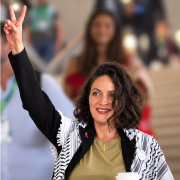
– Lubna Speitan is a British Palestinian artist, activist and grassroots organizer based in London. She founded Greenwich Palestine Alliance and serves as Equality Officer for Unite Community GLaB. She helped draft the Green Party of England and Wales’ 2026 “Zionism is Racism” motion. Her work centers Palestinian political agency, international solidarity and decolonizing discourse on Palestine.