
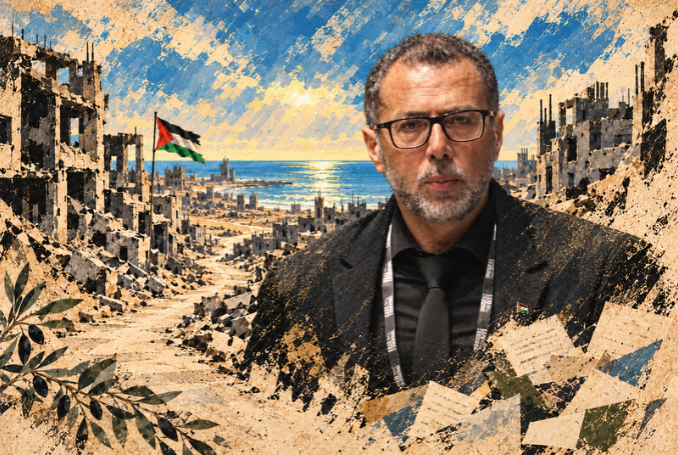
By Ramzy Baroud 
Ramzy Baroud examines Israel’s collapsing narrative, urging Palestinians to turn global awareness into accountability, solidarity and resistance to Zionist ideology.
Three years into the Gaza genocide, Israel has exposed what its advocates spent more than a century trying to conceal: the violence underlying its claims of victimhood.
The story of that concealment stretches back to the beginnings of organized political Zionism. The First Zionist Congress was held in Basel, Switzerland, on August 29–31, 1897. In the decades that followed, the Zionist movement, and eventually Israel, largely managed to hoodwink the world about Palestine and its people.
From the slogan “a land without a people for a people without a land,” popularized in a similar form by Israel Zangwill, to Golda Meir’s declaration that “There was no such thing as Palestinians,” to Benjamin Netanyahu’s insistence that Israel has no Palestinian partner for peace, the language changed, but its purpose remained: to deny Palestinian existence, rights, or agency.
Zionist advocates excelled in this realm of deception. Their discourse consisted of lies stacked one on top of another, creating a fantasy reinforced by Hollywood and mainstream media, until it came to substitute for the reality of Palestine.
In this narrative, the victim became the aggressor, the refugee became the terrorist, and the colonizer became the hapless victim fighting for survival.
The success of this inversion was not the outcome of the intellectual superiority of Zionist and Israeli advocates—a misconception even embraced by some Palestinians and Arabs. It was the outcome of coordinated efforts to present Zionist lies as truth while obfuscating, demonizing, and erasing the Palestinian narrative and silencing those who narrate it.
That silencing has never been confined to words. Israel has historically killed those who challenge its account of Palestine. During the Gaza genocide, its direct assassinations of journalists, alongside its killing of intellectuals, historians, teachers, bloggers, and social media influencers, were meant to eliminate the storyteller; in Israel’s eyes, eliminating the storyteller means eliminating the story itself.
Israel, however, miscalculated. Collective narratives of liberation, resistance, and the quest for justice are not an elitist enterprise dependent on an individual, or two, or even a thousand. They belong to a people. Killing those who tell the story cannot extinguish the collective experience from which it emerges. The more Israel killed, the more deeply the Palestinian narrative penetrated global consciousness.
Israel’s own conduct compounded this failure.
In the past, Israel would launch well-funded public relations campaigns to repair its image after footage of its wars against Palestinians or the Lebanese reached global audiences. This time, the power of the Palestinian narrative, particularly that emerging from Gaza itself, and the extent of Israel’s crimes in the Strip have made whitewashing genocide nearly impossible.
Israel will try, however, backed by still-unapologetic mainstream media institutions and allies within Western societies who continue to justify its crimes.
But the lines are now drawn more clearly: you are either against the genocide or with it. Denial offers no escape from that choice; it requires dismissing the evidence before the world’s eyes.
This makes our task clearer as well.
In the past, we fought against more than a century of a carefully constructed Zionist narrative that largely went unchallenged in dominant Western institutions. Today, although the institutional balance remains unequal, Israel’s monopoly over the narrative has been broken.
Israel still has its mainstream allies and apologists across ideological camps. Palestinians, however, have reached a global public increasingly critical of Israel. Pew Research Center’s spring 2026 survey found that, across 36 countries, a median of 67 percent of adults held an unfavorable view of Israel.
This reveals how far Israel’s standing has deteriorated—and the opportunity Palestinians now have to turn greater awareness into sustained solidarity and accountability.
The truth has always been on the Palestinian side. What has changed is our ability to communicate it to a global audience increasingly willing to listen.
What needs to change now is how we build on that achievement.
First, Palestinians must ensure that their righteous cause is not manipulated, abused, or used as political capital by any politician, party, or individual with a self-serving agenda. Greater visibility must not come at the expense of Palestinian ownership of their own struggle.
Second, they must avoid apologizing for their cause in the name of political compromise. Such apologies concede ground without securing rights. They also risk splintering our movement, turning political differences into divisions over the legitimacy of the struggle itself.
Third, Palestinians must not confuse the pursuit of political solutions—which mean nothing to an enemy that continues to commit genocide—with the central task of exposing Israel, holding its war criminals accountable, and confronting the ideology underlying its crimes.
Fourth, they must recognize that no future of peace, justice, or accountability can be achieved in the shadow of Zionism.
This last point connects the present genocide to the longer history from which it emerged. Even when Netanyahu is long gone, and government power moves from one political camp to another, Zionism will remain.
Indeed, the ethnic cleansing of Palestinians did not begin with Netanyahu, nor does its ideological foundation depend on his political survival.
Zionism is the overriding principle, and Israel is the state that puts these plans into practice.
Exposing Zionism will also help further globalize the Palestinian struggle, as this ideology wreaks havoc beyond Palestine, from the wider Middle East to Washington. Like imperialism, fascism, and Nazism, it must be confronted as an enemy of humanity.
We want to believe that Israel will never be able to turn back the clock and again play the role of the victim, the face of civilization, or the so-called “villa in the jungle.” But the institutions that sustained those claims are still working to restore them.
Exposing Israel’s crimes is only the beginning. Defeating apartheid, racism, and genocide requires sustained, selfless work to uproot the Zionist ideology that drives them. Greater global awareness must translate into action that secures Palestinian rights and freedom.
We owe it to Gaza, to Palestine, and to humanity not to abandon this fight.

– Dr. Ramzy Baroud is a journalist, author and the Editor of The Palestine Chronicle. He is the author of six books. His forthcoming book, ‘Before the Flood,’ will be published by Seven Stories Press. His other books include ‘Our Vision for Liberation’, ‘My Father was a Freedom Fighter’ and ‘The Last Earth’. Baroud is a Non-resident Senior Research Fellow at the Center for Islam and Global Affairs (CIGA). His website is www.ramzybaroud.net