
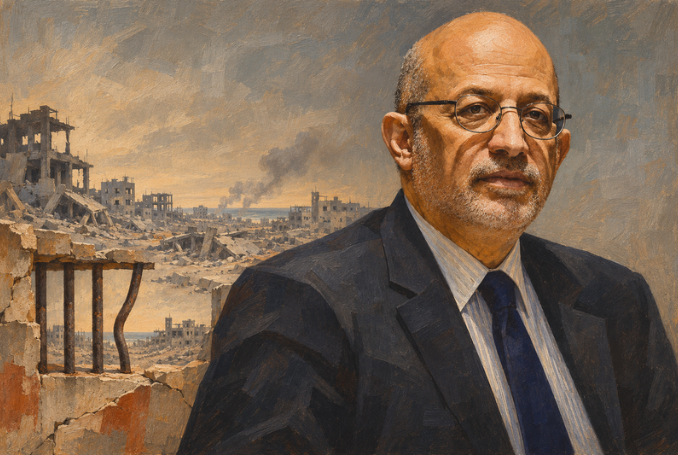
Sami al-Arian examines Zionism’s strategic foundations, urging coordinated resistance that transforms shifting global discourse into Palestinian justice, freedom and self-determination.
Three years into the Gaza genocide, the question is no longer whether the world knows what has happened to the Palestinian people. Taking advantage of the October 7 attacks, the Zionist regime launched a genocidal campaign aimed at destroying Gaza and forcibly displacing its population in an attempt to resolve its demographic dilemma. The more consequential question is what has actually changed since then.
The global discourse on Palestine has shifted dramatically, yet Western policies remain locked in place. Israel’s international standing has deteriorated, but the political, military, economic, and institutional structures sustaining the Zionist project are still largely intact.
Still, tectonic shifts have occurred. Most significantly, Palestinian voices have seized control of narrating their own struggle. For decades, Palestinians were spoken about more often than heard—their experiences filtered through Western media, Israeli security narratives, and diplomatic frameworks that erased their agency. Palestinian journalists, physicians, academics, writers, teachers, and ordinary citizens broke this monopoly by documenting the destruction of Gaza and telling their own stories at enormous personal sacrifice.
Social media dismantled the traditional media monopoly. Palestinian testimonies and images bypassed Western gatekeepers entirely, reaching hundreds of millions. While mainstream coverage still falls back on familiar biases in its language, framing, and source selection, Israel no longer commands absolute dominance over Western public discourse.
More fundamentally, the genocide has validated my analytical framework of the twelve strategic imperatives that have sustained the Zionist project over generations[1]: Jewish exclusivism, Palestinian exclusion, territorial expansion, the creation of irreversible facts on the ground, the garrison state, overwhelming military superiority, nuclear monopoly, intelligence and security dominance, dependence on great-power protection, mobilization of international Jewish institutional support, fragmentation of adversaries, and regional alliances with minorities and authoritarian states to secure hegemony.
The systematic destruction of Gaza, paired with relentless settlement expansion and repression in the West Bank, demonstrates how these imperatives operate in tandem. American military assistance and diplomatic protection once again proved the indispensable role of the great-power benefactor, while international institutions exposed their own impotence when confronted by entrenched power.
Yet this brutality has also laid bare critical vulnerabilities. Israel’s legitimacy has suffered catastrophic damage. Growing numbers of Jews are rejecting the conflation of Zionism with Jewish identity. Younger generations across the West have broken with historical orthodoxies, and the premise that regional normalization could permanently bypass Palestinian rights is now utterly untenable.
These developments confirm a core proposition: Zionism cannot be defeated through isolated campaigns or temporary political pressure. Its interconnected structures require an equally comprehensive counter-strategy.
That demands coordinated resistance across political, diplomatic, economic, legal, technological, academic, cultural, and media fronts. It means restoring Palestinians to the center of their own liberation—not as passive recipients of humanitarian aid or sympathy, but as the principal architects of their political future.
The measure of change will not be how many people recognize Palestinian suffering, but whether the indigenous people of the land can finally secure justice, freedom, equality, the right of return, and self-determination.
Footnote
[1] See Sami Al-Arian, “Towards a Global Solidarity Movement for a Free Palestine,” in Our Vision for Liberation: Engaged Palestinian Leaders and Intellectuals Speak Out, ed. Ramzy Baroud and Ilan Pappé (Clarity Press, 2022), 140–61.
– Sami Al-Arian is the Director of the Center for Islam and Global Affairs (CIGA) at Istanbul Zaim University. Originally from Palestine, he lived in the US for four decades (1975-2015), where he was a tenured academic, prominent speaker, and human rights activist before relocating to Turkey. He is the author of several studies and books.