
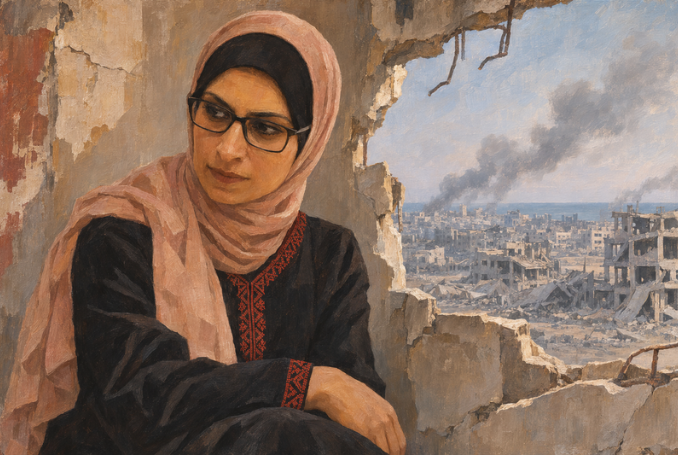
By Shaimaa Eid
Shaimaa Eid examines how Palestinian journalists preserve Gaza’s humanity and reach global audiences, asking whether witnessing will lead to action.
Throughout three years of genocide, Gaza has been trying to tell its story to a world that has been unable to witness it firsthand. Since October 2023, Israel has barred foreign journalists from entering the Gaza Strip independently, leaving Palestinian journalists to document the war while living through it themselves.
This restriction has made the role of Palestinian journalists more important than ever. We have not simply covered a war unfolding around us. We have documented the destruction of our neighborhoods, the displacement of our families, and our daily struggle to survive, often while facing the same dangers as the people whose stories we tell.
As a Palestinian journalist from the Gaza Strip, I have come to understand that journalism is not simply about recording events. It is also about preserving their human meaning, so that it is not lost amid statistics, headlines and political debates.
Behind every death toll are human beings whose lives had value and meaning. Behind every destroyed home is a family with memories, plans and a future it once dreamed of. Human-interest journalism gives these lives the space to be seen beyond the moment of suffering alone.
Yet telling these stories has never been easy. Working as a journalist in Gaza means gathering information amid displacement and bombardment, with unreliable communications and a shortage of basic necessities.
Journalists are forced to find ways to gather information, stay in touch with sources and get their work out to the world, all while facing the same uncertainty that shapes everyone else’s lives. It becomes difficult to separate professional responsibility from the demands of survival.
In this reality, social media has become an essential means of bringing Gaza’s story to the world. For Palestinian journalists, these platforms are no longer simply places to publish reports. They have opened up a direct line of communication with audiences, without us having to rely entirely on international newsrooms to decide which stories deserve attention.
Photographs, videos and personal testimonies travel from Gaza to audiences around the world, carrying the voices of people living through the war to those who might otherwise have little opportunity to learn about their daily realities.
As Palestinian journalists, we see this direct connection as one of the most significant changes of the past three years. It has allowed us to bring people’s stories and experiences to the world and help shape a narrative rooted in their own realities and voices, rather than solely in what is said about them.
But reaching a global audience does not necessarily mean that the message has been understood, or that the testimonies journalists share will lead to tangible change. A video may go viral while the context needed to understand what it documents is lost. And as scenes of suffering are repeated and circulated continuously, they risk becoming fleeting images amid the constant stream of daily content.
Three years on, one change cannot be ignored: Palestinian journalists and ordinary citizens have found ways to bring their experiences to a global audience, despite the restrictions on access to Gaza. But a deeper question remains: is the world prepared to do more than watch?
For my fellow journalists and me, journalism means ensuring that the people of Gaza are not reduced to images of the dead in a narrative written by others. It means preserving their voices and dignity.
Palestinian journalists have helped the world see Gaza. The question that remains is whether the world will listen to them, defend their right to do their work, and take seriously what they have spent three years documenting.
– Shaimaa Eid is a Palestinian journalist from the Gaza Strip specializing in news, field reporting and human-interest stories. She documents life under siege and war, visiting displacement shelters to gather firsthand testimonies of suffering and survival.