
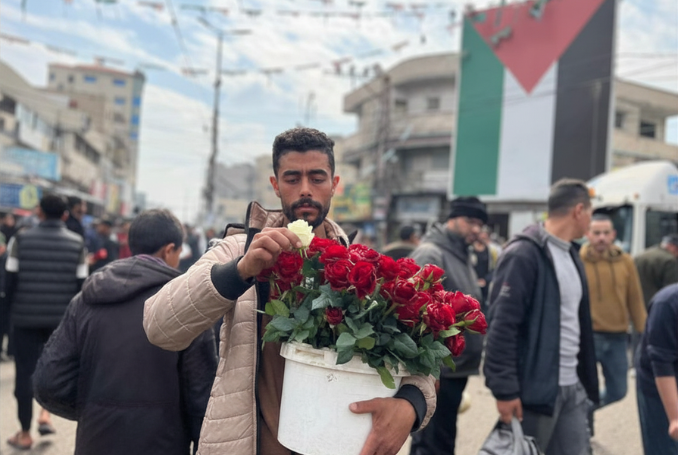
Whose grief is heard and valued? When is mourning global? And which memories are dignified?
I am writing to Gaza, often described as “the Strip,” as if a tear brought to earth from another metaphysical universe rather than part of Palestine, a country with a perpetual name. I am writing to Gaza City, which my soul recognizes when my eyes settle on its massive inshore calcareous rocks, beach lilies, and rare sea daffodils. Gaza, no mere “Strip” to those born within and never permitted to live beyond, is a cradle turned enclosure, a place where the sky itself becomes a ceiling, and movement is denied before it could ever be lived or become a memory. This place is a breath we Gazans hold in the middle of the night, a coffin, poem, grape grove.
Many know it through its sad orange fields, old cemeteries, calamities; others through the persistence of its people, embodied in a refusal to vanish, forget, be forgotten. And how do you know it? Perhaps through its destruction and death tolls? Or maybe I have presumed and you do not know it at all? But even if you know any, or even all, of this, you cannot know that I have written the previous four sentences and deleted them over ten times, in implicit acknowledgement that I do not have the ability to see Gaza through your eyes, dear reader.
But even here I feel compelled to ask why I have to write such long introductions, or even introductions at all, when speaking of Gaza. Apart from preambles, dear Gaza, I want to speak of a body of loss that no language can fully carry, sorrow that exceeds syllables, silence that follows every scream and shell. Being drawn from you and always being part of you, I know what it means to mourn in increments, weep between airstrikes, and live as though you are always in the middle of your last goodbye.
When I see your rubble, I see layers upon layers of our precious personal and collective belongings, items in an inherited oral inventory that are undocumented but etched deeply into our (collective and individual) memory. Things that once had names, positions, emotional weights, and owners, meanings, and homes. I will never forget my father’s oud crafted from rosewood, a treasured heirloom he inherited from his father, which rested alongside my grandfather’s All-Palestine Government passport and traditional qombaz cloth, and my mother’s embroidered thobe. I will never forget our family’s massive photo album, lovingly assembled by my mum’s cousin while imprisoned in Israel’s colonial jails, a visual archive of memory, resistance, and lineage that contained old Palestinian bank notes, along with documents that I could not read as a child—however, even then, I could understand how important they were to my mother and father.
I still carry the taste of the towering trees that filled our garden—bananas, clementines, dates figs, grapes, guavas, (Jaffa, Seville and Valencia) oranges, lemons, loquats, peaches, plums—an abundance rooted in your land, sweetened by time, where flowers everywhere spilled their colour into each and every memory. Gaza, the fruits your land has given us are our very cells. We will never be able to give you back enough in return.
Your beauty hums in the chambers of my remembering, embodied in the scent of orange blossoms that once filled our garden and drifted through the rooms of our home on Al-Nafaq Street, a place once surrounded by endless orange fields. My tongue still remembers the taste of your water in the jug placed at the entrance of Sayyid Hashim Mosque. I also remember Dier Allatin Church and many other things too sacred to name, yet impossible to forget.
My dear, have you really lost them all?!
These are losses that never had the chance to be coffined and carefully buried on paper with a pen. These were items that were never fully lamented, because even grief over such material items is a luxury we, the Palestinians, cannot afford. We see how grief itself has become stratified, with the latest massacre serving to remind us, yet again, that sorrow is painfully hierarchical and rationed according to the life born into. Whose grief is heard and valued? When is mourning global? And which memories are dignified?
We do not grieve in quiet cemeteries, beside polished stones, but rather in dust, disappearance, the unnamed. And we still grieve, even when grief is illicit and mourning an act of resistance. Our archives buried beneath our homes and museums martyred in advance. What survives is not the item but its story, passed on in whispered breath to those willing to remember and rebuild. Through these memories and the defiance of your people in tents, you will continue to exist constantly.
Dear Gaza, you have become the elegy of the world and yet you still rise. Still written and remembered in the marrow of those who love you, your name is carried across borders that try to erase you. Your voice echoes from the throats of poets who owe you everything. More than survival, you are sacred persistence.
Whenever we mention your name, Gaza, we are asked to contextualize, explain, translate and even defend you. But you are no case study nor crisis. Instead, you are a cradle of life and indigenous Palestinian culture, the scream that wakes the indifferent, final prayer whispered beneath collapsing ceilings, lullaby interrupted by warplanes. Carrying and defying your wounds, you hum lullabies into the cradles of children who never knew a day nor life without siege, teaching them the names of flowers and trees, even in their uprooting. You are like the Mediterranean, massive and beautiful.
You are not rubble. You are what remains despite the rubble.
Can I tell you a secret?
When I was five years old, and about to start school, my mother bought me a black-and-white pinstripe uniform. My friend Afnan had a different one, which was beautiful, and I did not know why. My mother told me it was because I was going to an UNRWA school and she was going to a state school. But still the small, sharp question lingered: Why did I not have a uniform like Afnan’s? And alongside an added sense of injustice and of having been somehow wronged nagged at me: Green was my favourite colour.
Seeing this, my mother drew me into her lap that night, speaking with the kind of care that changes a child’s life. Telling me I had to go to this school because we were not from Gaza, she then gently opened a door into our history, talking of the beauty of Haifa and Hammama, (a city and a village my grandparents were displaced from by Zionist militia, places that lived in our family like a second heartbeat). My mum said to me that if I did not accept that uniform, we would not be able to return to Haifa and Hammama. In her voice I heard the unbearable truth: You Gaza, beloved as you are, are not the beginning of us, the 1948 displaced Palestinians, you are a refuge, not origin. As this sank in, I came to understand that Afnan belongs to you in a way I do not, while tentatively grasping, at a mere five years of age, what it means to love a place that cannot be yours forever.
After this, I tried to live every moment in you Gaza, as if it you were both gift and borrowed time. I carried a look I could not describe, which always said “goodbye.” I began to befriend the trees in our garden, speaking to them softly and entrusting my secrets, promising what I barely understood myself: That one day we would leave, and return to my grandparents’ home.
Gaza, I have loved you without constraint. You did not owe me belonging but held me anyway. You fed sweetness and taught tenderness. You let my devotion gather strength under shade and blossom. Even now, when I speak your name, loyalty and loss mix together in my mouth.
Gaza, you are us, and we are you.
Gaza, you are the mirror of this world’s conscience.
And to you, I send my vow:
To call your name fully, loudly and endlessly.
Enclosed,
Along with this letter, you will find a white rose attached, which is for your rubbles. Look closer, and you will see it is the same rose that William Faulkner gave Emily in A Rose for Emily. It speaks to your pain, my beloved Gaza, and says “goodbye to sorrow.” It refuses to wilt and is carried across checkpoints in the folds of memory. It does not soften your anguish but honours it.
A white rose for the rubble, yes, but much more…a lifetime’s work for what rises from it.
With you and from you always,
In ink, breath, being,Naema
Naema Aldaqsha is a descendant of Palestinians displaced from the city of Haifa and the village of Hammama. She is a PhD researcher, Postgraduate Teaching Associate, and coordinator at the European Centre for Palestine Studies at the University of Exeter, United Kingdom. Her research specializes in diplomatic history, with a particular focus on Palestine and international political representation.
The emotional resonance of Naema Aldaqsha’s writing swept me along today like the rushing of my sacred river and the emergence of this hopeful spring day. It carries the poetry of expression I can recognize only as a treasured gift that connects the essence of what I feel for Gaza, Palestinians, and the Indigenous of past and present who have faced the reality of Western lust to take what is not and never can be theirs to control and bespoil.