
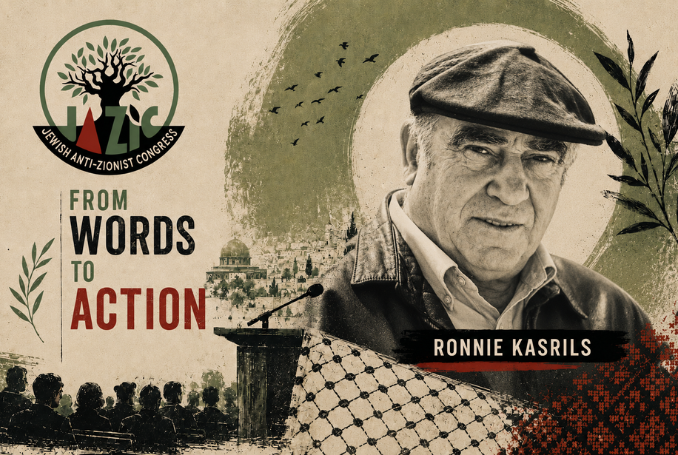
Drawing on South Africa’s liberation struggle, Ronnie Kasrils argued that organized resistance, international solidarity and political action remain Palestine’s strongest tools.
From Defiance to Resistance
Few speakers can bring the authority of lived experience to the discussion quite like Ronnie Kasrils. A veteran of the African National Congress (ANC), former intelligence minister in democratic South Africa and one of the most recognizable figures of the anti-apartheid struggle, Kasrils used his address not to romanticize armed struggle but to explain the long political process that made it unavoidable.
He began with humor.
Recalling a clandestine meeting with anti-apartheid fighters years ago, Kasrils remembered walking into a dark barn filled with armed men wearing balaclavas. Trying to ease the tension, he joked that he had “slept with an AK-47 under my bed more times than I’ve shared the bed with my wife,” drawing laughter before turning to the serious point behind the story: liberation movements survive because they learn to adapt, moving between legality and illegality as political circumstances change.
That adaptability, he argued, defined the South African struggle.
Long before the ANC took up arms, it operated within what the apartheid government presented as a democratic legal order—one that, Kasrils observed, functioned much like Israel’s claim to democracy today. Apartheid South Africa was democratic for whites; Israel, he suggested, claims democracy while excluding Palestinians from equal political rights.
Rather than immediately embracing armed resistance, the ANC initially challenged apartheid through campaigns of civil disobedience, deliberately violating racist laws governing every aspect of daily life.
Black South Africans entered “whites only” railway stations, used segregated public facilities and openly defied apartheid legislation despite the certainty of arrest. As repression intensified, prison sentences increased from months to years, gradually closing the space for peaceful resistance.
Only then, Kasrils said, did the movement conclude that “there was no other alternative but to take up the gun,” stressing that armed struggle emerged only after legal avenues for change had been systematically eliminated.
Law Alone Never Liberates
Although Kasrils defended the importance of international law, he cautioned against believing that legal victories alone could dismantle systems of oppression.
“International law recognizes the right of a people to resist oppression and tyranny with arms,” he said, arguing that while the United Nations remains an important arena for advancing Palestinian rights, decades of ignored resolutions have demonstrated its limitations.
“How many resolutions have been passed and then ignored?” he asked, referring to repeated United Nations votes condemning Israeli policies while little has changed on the ground.
“We can’t simply rely on the law,” Kasrils continued. “It would be a wonderful world if we could simply rely on decent laws. But laws are also very repressive.”
Instead, he returned to the strategy that guided the South African liberation movement. The ANC, he explained, built what became known as the Four Pillars of Struggle, placing organized political mobilization above every other form of resistance.
“The primary pillar—the absolute key—is the people: mobilized and organized in struggle,” Kasrils said, emphasizing that politics always remained “primary.”
Armed struggle, he added, never replaced politics but reinforced it. Alongside it operated clandestine underground networks that organized communities and sustained resistance despite repression, while international solidarity isolated apartheid South Africa politically and economically.
For Kasrils, the same principle applies to Palestine today.
International solidarity, he argued, becomes meaningful only when it moves beyond declarations and into collective action.
“Boycott. BDS. That’s the way. That is what’s vital,” he said, urging participants to transform the Congress theme—From Words to Action—into a practical strategy capable of increasing Israel’s international isolation.
To illustrate what organized solidarity can achieve, Kasrils turned to one of Ireland’s defining moments in the anti-apartheid movement.
He recalled how Mary Manning, then just twenty-one years old and working at Dublin’s Dunnes Stores, refused to handle South African produce after her union instructed members to respect the boycott.
Suspended from her job, she and her colleagues remained on strike for nearly three years. Looking back, Kasrils insisted that history often remembers individuals while overlooking the movements that make such acts possible.
“One person set it off,” he said before immediately qualifying his own statement. “But comrades and friends, it wasn’t just one person.”
Mary Manning’s action mattered, he explained, because it emerged from an already organized international campaign against apartheid. Her refusal became the spark that helped persuade the Irish government to ban the import of South African fruit and vegetables—one of the anti-apartheid movement’s most significant international victories.
“That’s the path we must follow,” Kasrils said, arguing that meaningful solidarity requires organization, persistence and collective action rather than symbolic gestures.
No Bantustans, No Divide-and-Rule
Turning to the present, Kasrils warned that Palestine should be understood within a broader international effort to reverse the gains won by anti-colonial struggles throughout the twentieth century.
He criticized recent statements by senior American officials portraying liberation movements as little more than communist conspiracies and argued that powerful political and economic interests are attempting to restore forms of domination that anti-colonial movements fought to dismantle.
“The counter-revolution” now underway, he said, extends beyond Palestine to countries including Lebanon, Iran, Cuba and South Africa itself.
Drawing on South Africa’s own experience, Kasrils warned against renewed attempts to fragment societies through ethnic division.
He pointed to recent proposals by pro-Israel commentators advocating a return to the apartheid-era Bantustan model, arguing that such ideas reveal a persistent commitment to divide-and-rule politics.
“We’ve got to say, absolutely: no division. No divide-and-rule. No Bantustans,” he declared, adding that even the two-state solution had effectively been rendered meaningless by successive Israeli governments.
Throughout this discussion, Kasrils rejected attempts to portray these dynamics as expressions of Jewish influence, insisting instead that they reflect the power of Zionism, corporate interests and Western political elites.
“When I talk about money,” he said, “I’m not talking about Jewish money. I’m talking about Zionist money. I’m talking about big business money.”
Yet it was in his closing remarks that Kasrils drew perhaps the clearest distinction between South Africa and Palestine.
While comparisons between apartheid South Africa and Israel are often made, he argued that one essential difference must never be forgotten.
“In South Africa,” he said, “there was no genocide.”
The apartheid regime depended upon Black labor and therefore sought domination rather than extermination. Israel’s genocidal war on Gaza, by contrast, belongs to a different historical tradition—one shared with the destruction of Indigenous peoples across the Americas and Australasia.
“It is so barbaric,” Kasrils said. “It is so disgusting.”
For that reason, he argued, Palestine demands not only solidarity but a renewed commitment to the forms of organized resistance that helped dismantle apartheid itself.
The struggle ahead, he concluded, depends on uniting people, raising political consciousness and learning to use international tools such as the Boycott, Divestment and Sanctions movement effectively.
“Because in the end,” Kasrils said, “it is resistance that achieves change. It is the people’s resistance.”