
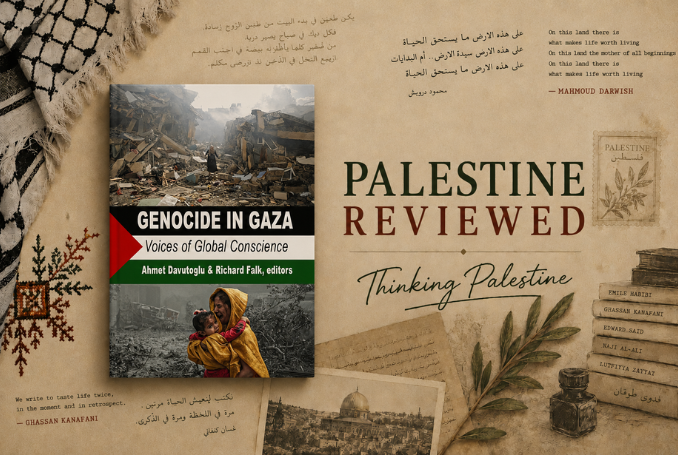
Few books capture the breadth of the global response to Gaza as comprehensively as Genocide in Gaza: Voices of Global Conscience. Edited by Ahmet Davutoğlu and Richard Falk, the anthology brings together prominent scholars, diplomats, legal experts, and activists to examine one of the defining moral and political crises of our time.
At a Glance
Title: Genocide in Gaza: Voices of Global Conscience
Editors: Ahmet Davutoğlu and Richard Falk
Foreword: Mustafa Barghouti
Publisher: Clarity PressISBN: 9781963892024
Publication Date: 2025
Length: 469 pages
The Case for Reading It
A sweeping, multidisciplinary examination of Gaza that combines legal analysis, historical context, political critique, and moral testimony.
In Brief
A wide-ranging anthology that examines Gaza through law, history, politics, media, and human rights. Bringing together voices from across the world, the book explores what its contributors view as a defining moral and political crisis of our time.
Readers’ Guide
Why should I read this book?
Because it offers one of the most comprehensive collections published since October 2023, bringing together leading voices from law, politics, history, media studies, diplomacy, medicine, and human rights. Readers seeking to understand how Gaza has reshaped global debates about international law, accountability, and justice will find an exceptionally wide-ranging discussion.
Why is this book different?
Unlike single-author studies, this anthology presents a genuinely international conversation. Contributors come from different disciplines, political traditions, and regions of the world, creating a multifaceted examination of Gaza that moves beyond conventional geopolitical analysis. It combines scholarly rigor with moral urgency and first-hand testimony.
What are the most important themes in this book?
The contributors repeatedly return to several interconnected themes: genocide and international law; colonialism and historical dispossession; media representation and digital witnessing; the crisis of liberal internationalism; dehumanization and political violence; Palestinian resistance and resilience; and the future of global justice in an increasingly multipolar world.
Who are the book contributors?
Ahmet Davutoğlu
Richard Falk
Susan Abulhawa
Ramzy Baroud
Avi Shlaim
Izzeldin Abuelaish
Abdullah Ahsan
Joseph Camilleri
Chandra Muzaffar
Mohammad Hashim Kamali
Meymune Topçu
Hilal Elver
Sare Davutoğlu
Ferhan Güloğlu
Lisa Hajjar
Basil Farraj
Penny Green
Grace Spence Green
Walden Bello
Sevinç Alkan
Arlene Clemesha
Francesco Schettino
Victoria Brittain
Irene Gendzier
Bilgehan Uçak
Juan Cole
Craig Mokhiber
Phyllis Bennis
Mohammad Javad Zarif
Reza Nasri
Alfred de Zayas
Hans von Sponeck
Meet the Editors
Ahmet Davutoğlu
Ahmet Davutoğlu is a Turkish academic, diplomat, and politician who served as Foreign Minister and later Prime Minister of Türkiye. Before entering politics, he was known for his work on international relations and strategic studies, particularly his influential book Strategic Depth. In recent years, he has been an outspoken advocate for Palestinian rights and a critic of Israeli policies toward Gaza.
Richard Falk
Richard Falk is an international law scholar and Professor Emeritus at Princeton University. He served as the United Nations Special Rapporteur on the situation of human rights in the Palestinian territories from 2008 to 2014. Falk has written extensively on international law, human rights, war, global governance, and Palestine, and is widely regarded as one of the most prominent legal voices on the Palestinian question.
The Review
Genocide in Gaza: Voices of Global Conscience, edited by former prime minister of Turkiye Ahmet Davutoğlu and former UN Special Rapporteur on the Middle East Richard Falk, is not a conventional academic anthology.
It is simultaneously a political intervention, a moral indictment, and a collective intellectual testimony responding to the devastation in Gaza following October 7, 2023.
Bringing together scholars, diplomats, legal experts, journalists, activists, physicians, and writers from across the globe, the volume attempts to document, interpret, and morally confront what its contributors consistently characterize as genocide.
The book’s scale and ambition are immediately evident. Rather than presenting a single authorial argument, the editors assemble a chorus of voices examining Gaza through multiple lenses: international law, political theory, decolonial analysis, media studies, medicine, literature, religion, diplomacy, and human rights advocacy. The result is a sprawling but intellectually coherent work that seeks not merely to analyze events, but to challenge what the contributors perceive as the moral collapse of the contemporary international order.
Richard Falk and Ahmet Davutoğlu frame the collection as a response to what they see as the failure of governments, international institutions, and much of the Western media to adequately confront the scale of destruction in Gaza. In their preface, they openly reject claims of neutrality, stating that while the contributors are “partisan,” they nevertheless aim to remain truthful and evidence-based.
This declaration is significant because it establishes the book’s intellectual posture from the outset: the editors are not attempting detached balance, but rather an ethically engaged critique rooted in solidarity with Palestinians.
The anthology’s greatest strength lies in the diversity and stature of its contributors. Figures such as Cornel West, Mahmood Mamdani, Avi Shlaim, Judith Butler, Craig Mokhiber, Ramzy Baroud, Phyllis Bennis, Juan Cole, and Alfred de Zayas contribute to a genuinely international conversation.
The contributors represent not only different disciplines but also different geopolitical and cultural perspectives, including voices from the Global South, the Middle East, Europe, Africa, and North America. This breadth reinforces one of the anthology’s central themes: that Gaza has become a defining moral issue for a rapidly changing global order.
A particularly compelling feature of the book is its insistence on connecting Gaza to larger historical structures of colonialism, apartheid, militarism, and racial hierarchy.
Many essays argue that the events of 2023–2024 cannot be understood apart from the long history of Palestinian dispossession and occupation dating back to 1948. Mustafa Barghouti’s powerful foreword exemplifies this perspective, framing October 7 not as an isolated rupture but as the culmination of decades of siege, occupation, displacement, and failed diplomacy.
The legal dimension of the book is especially significant. Several contributors examine the South African genocide case against Israel at the International Court of Justice, the responsibilities of states under the Genocide Convention, and the concept of complicity in international law.
Rather than treating international law as neutral or consistently enforced, the contributors argue that the Gaza crisis reveals deep asymmetries in how legal norms are applied globally. This legal critique is one of the anthology’s strongest contributions, particularly because it combines technical legal analysis with broader political and moral questions.
Ahmet Davutoğlu’s opening chapter, “Unveiling the Genocidal Mindset,” is among the book’s most provocative essays. Drawing on philosophical discussions of dehumanization, he argues that genocides become possible when populations are defined as ontologically inferior—“human animals,” “wild beasts,” or “monsters.”
Davutoğlu traces these forms of dehumanizing language historically through colonialism, racism, Nazism, and apartheid, arguing that similar rhetorical structures are visible in contemporary Israeli political discourse.
The book also devotes substantial attention to dimensions of suffering often overlooked in geopolitical discussions. Essays on starvation, disability, imprisonment, motherhood, trauma, and medical destruction humanize the catastrophe in deeply affecting ways.
The contributions dealing with children, medical workers, and journalists killed during the conflict are particularly moving. These chapters prevent the book from becoming abstract or overly theoretical by grounding analysis in lived human experience. The emotional force of the book is undeniable.
The repeated accounts of destroyed hospitals, dead children, displaced families, imprisoned journalists, and shattered infrastructure create an atmosphere of profound grief and outrage. The editors clearly intend not only to inform readers but to provoke moral and political action. In this sense, Genocide in Gaza belongs to a long tradition of activist intellectual literature aimed at mobilizing conscience against perceived injustice.
Another notable contribution is the anthology’s exploration of media and narrative. Several essays argue that Gaza represents one of the first “live-streamed genocides,” where atrocities unfold in real time across social media while traditional political institutions struggle—or refuse—to respond effectively.
This focus on digital witnessing and transnational activism highlights how public consciousness about Palestine has shifted dramatically, particularly among younger global audiences.
The anthology’s emphasis on Global South perspectives is also important. Contributors repeatedly argue that Gaza has exposed the hypocrisy of liberal internationalism and accelerated skepticism toward Western claims about human rights and democracy.
Comparisons between Western responses to Ukraine and Gaza recur throughout the book, reflecting a broader critique of selective morality in international politics. This theme gives the anthology geopolitical significance beyond the Israeli-Palestinian conflict itself.
Importantly, the anthology also raises difficult questions about the future. Several contributors suggest that Gaza may represent a turning point in global politics, exposing the weakening legitimacy of Western-dominated international institutions and accelerating the emergence of a more multipolar world order.
Whether this proves historically accurate remains uncertain, but the book persuasively captures the sense that Gaza has become symbolically central to debates over international law, colonialism, sovereignty, and human rights.
Ultimately, Genocide in Gaza is a powerful, deeply moral, and intellectually substantial collection.
It presents itself unapologetically as a witness against what its contributors regard as one of the defining atrocities of the twenty-first century.
Readers seeking insight into the global intellectual, legal, and moral response to Gaza will find this collection indispensable. It captures not only a political crisis but a crisis of conscience—one that the editors argue implicates not just Israel, but the broader structures of global power and international complicity.
In the end, the book’s central message is stark: Gaza is not merely a regional tragedy but a test of whether international law, human rights, and universal moral principles still possess meaning in a world increasingly governed by asymmetries of power. Genocide in Gaza demands engagement because it forces confrontation with questions many political institutions have struggled to answer honestly.
(The text for this review was provided by Clarity Press and developed by Thinking Palestine Editors.)