
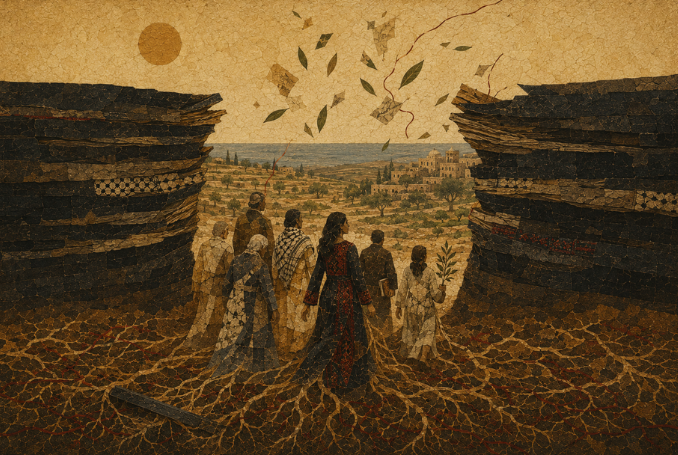
Introducing this issue, the editors confront the taboo surrounding Palestinian armed resistance, restoring its history, political foundations, contradictions and strategic dimensions to serious analysis.
There are moments in history when intellectuals cannot afford to regard any subject as taboo. Yet, even amid the genocide in Gaza, one crucial dimension remains largely neglected: the question of Palestinian armed resistance.
Western institutional powers and media have reduced resistance to a mere synonym for terrorism, creating a climate in which even discussing its history, political foundations and strategic role can invite condemnation, intimidation or criminalization. The result has been a pervasive form of self-censorship, extending even into intellectual and academic circles.
At Thinking Palestine, we believe that the history, dynamics, contradictions, and critical dimensions of Palestinian resistance must be examined if we are to understand the historical moment through which we are living, particularly following the events of October 7 and Israel’s ongoing genocide in Gaza.
This issue begins from a premise that should be self-evident: Palestinian resistance did not begin on October 7, 2023. It did not emerge in an ideological vacuum, nor can it be separated from the history of settler colonialism, dispossession, occupation, imprisonment, siege and repeated massacres that produced it. Resistance has assumed different political, cultural and military forms across generations. Its organizations, ideologies and strategies have changed, but the conditions from which it arises have remained fundamentally unresolved.
To examine resistance does not mean suspending critical judgment. It means restoring history, politics and Palestinian agency to a subject that Western discourse has deliberately stripped of all three. A serious analysis must be capable of confronting strategic failures, internal contradictions and the devastating human cost of armed struggle. It must also reject the intellectual dishonesty of discussing colonial violence as an enduring political structure while treating the resistance it generates as an inexplicable eruption of fanaticism.
Kasrils: Gun and Olive Branch
Ronnie Kasrils brings precisely this combination of political commitment and critical reflection to ‘The Gun and the Olive Branch’. Drawing on his experience in the African National Congress and its armed wing, Umkhonto we Sizwe, Kasrils places Palestine within the wider history of anti-colonial liberation. The comparison with South Africa is neither decorative nor sentimental. It allows him to examine the conditions under which movements turn to armed struggle and the relationship between military resistance, mass mobilization, clandestine organization and international solidarity.
Kasrils reminds us that an armed movement cannot substitute military action for political strategy. As he writes,
“Experience has taught us that liberation cannot be achieved by one method alone.”
Indeed, the ANC’s struggle rested on the convergence of several fronts, with each reinforcing the others. “The advance of all four fronts is essential,” Kasrils explains.
“Weakness on any one front weakens the others. The enemy must be made to feel the pressure from all directions at the same time.”
This framework enables him to address October 7 without either retreating into condemnation or shielding it from scrutiny. In one of the issue’s most direct assessments, he writes:
“Operation Al Aqsa Flood, the 7 October 2023 breakout from the Gaza prison, was tactically brilliant, but the strategic outcome has been horrendous.”
He identifies “a fatal miscalculation concerning Israel’s reaction,” while insisting that history does not end with a setback:
“Errors analyzed, lessons learned, strategies rethought. Those who do not make errors do nothing and therefore are incapable of learning. They just criticize.”
That willingness to confront both necessity and consequence is essential. The question is not whether resistance can be discussed only after it has been purified of every contradiction. No liberation movement in history has met such a standard. The real question is whether a colonized people can be understood as political actors capable of making decisions, developing strategies, committing errors, learning, adapting and continuing their struggle.
Hamdi: Palestine Resists
Tahrir Hamdi’s ‘Palestine Resists: Liberation and Return’ situates armed resistance within a broader culture of refusal. She begins with a question that encompasses the totality of the Palestinian condition:
“How does one resist dispossession and displacement, ongoing genocide, culturicide, scholasticide and epistemicide, and all forms of erasure of a people’s past, present and future?”
Her answer refuses the fragmentation of Palestinian struggle into acceptable and unacceptable forms:
“Resist by all available means—armed resistance, cultural resistance and economic resistance.”
Drawing on Frantz Fanon, Aimé Césaire, Amílcar Cabral, Ghassan Kanafani and Edward Said, Hamdi argues that cultural and armed resistance are inseparable components of national liberation. Culture preserves the historical consciousness that colonialism seeks to destroy; resistance gives that consciousness a political horizon. Across the ideological transformations of the Palestinian movement—from Arab nationalism and Marxism-Leninism to contemporary Islamic resistance—the fundamental objectives have remained liberation, dignity and return.
Baroud: Secret History
This continuity is central to Ramzy Baroud’s Outsmarting the Sky: The Secret History of Gaza’s Subterranean Resistance’. Gaza appears, geographically, to be an impossible place from which to sustain armed struggle: flat, exposed, enclosed and subjected to some of the most sophisticated surveillance technology ever deployed. Baroud nevertheless traces a history of resistance that stretches from the ancient defense of Gaza against Alexander the Great to the Fedayeen, the PFLP’s urban guerrilla networks and the subterranean infrastructure of the Al-Qassam Brigades.
“The siege revealed a lesson that would recur throughout Gaza’s history,” he writes: “where the land offered no natural high ground or cover, defenders had to reshape it.” In modern Gaza, underground warfare developed within a social world created by the Nakba. Refugees expelled from their villages were compressed into camps where personal loss became collective memory and return became a political commitment transmitted across generations.
The tunnels cannot therefore be understood as a merely technical or military phenomenon. They are part of Gaza’s continuous effort to overcome the geography imposed upon it and the technologies deployed against it. Baroud concludes that,
“So long as displacement, statelessness, occupation, and the denial of return continue, bombardment and technological superiority will not extinguish the impulse to resist.”
An analysis that recognizes Gazans solely as victims—or imagines them as instruments of outside powers—will inevitably fail to understand “the roots of their ability to survive, adapt, and fight back.”
Inlakesh: Who Created Hamas?
The denial of Palestinian agency also shapes the persistent claim that Israel “created” Hamas. In “Was Hamas Really Created and Propped Up by Israel?”, Robert Inlakesh examines the historical evidence behind this widely repeated argument. Israeli occupation authorities certainly pursued divide-and-rule policies, tolerated the early social institutions associated with Sheikh Ahmed Yassin’s Al-Mujamma al-Islami and sought to weaken the secular Palestinian left and the PLO. These policies form an important part of the historical record. They do not establish that Israel created or controlled Hamas.
As Inlakesh writes,
“The element of truth is that the Israelis have consistently played the game of divide and rule. This does not demonstrate that Hamas was created, controlled, and even kept alive by the Israelis.”
According to Inlakesh, Hamas emerged from Palestinian society, particularly the refugee camps of Gaza, and developed through the political and ideological transformations that followed the defeats of secular Arab nationalism, the repression of the Palestinian left, the decline of the PLO and the failure of the Oslo process.
Reducing Hamas to an Israeli invention presents Palestinians as incapable of creating political movements of their own. “Without intending to do so,” Inlakesh argues, such explanations “work to undermine Palestinian autonomy and silence their voices.” The popularity of Hamas cannot be understood through comfortable Western formulas that make Israel the author of every Palestinian action. It requires an engagement with Palestinian politics, the history of the refugee camps, and the role that resistance has played in the movement’s support.
Inlakesh: Axis of Resistance
Inlakesh’s second contribution, “The Axis of Resistance: Why a United Islamic Front?”, extends the discussion beyond Palestine. Western and Israeli discourse habitually represents the regional resistance alliance as a network of Iranian “proxies” or as a sectarian “Shia Crescent.” This vocabulary portrays regional movements as foreign implantations and denies their distinct histories in Palestine, Lebanon, Iraq and Yemen.
The essay instead traces the indigenous political trajectories that produced Hamas, Palestinian Islamic Jihad, Hezbollah, the Iraqi resistance factions and Ansarallah. Their alliance with Iran is strategic and ideological, but it does not erase their local origins or political autonomy. “It can be easily demonstrated that the Axis of Resistance exists for two reasons,” Inlakesh writes:
“It is an alliance that is both mutually beneficial and is strung together around an ideological commitment to resisting imperial domination.”
This argument does not require the abandonment of criticism. On the contrary, Inlakesh explicitly recognizes the presence of sectarianism, classism, tribalism, sexism and other contradictions within broad resistance alliances. His warning concerns the standards through which these movements are judged—particularly when sections of the Western left romanticize earlier liberation struggles while imposing impossible purity tests on those resisting colonialism and imperial power today.
Rubeo: Women on the Frontlines
The struggle cannot be understood, however, through histories centered almost exclusively on men, military organizations and formal political leadership. ‘The Other Side of the Struggle: The Untold History of Palestinian Women’s Resistance’, by Romana Rubeo, reconstructs women’s political agency from the first Palestine Arab Women’s Congress in Jerusalem in 1929 to the current genocide in Gaza.
Palestinian women have often been confined within a narrow set of colonial representations: the silent victim, the grieving mother, the oppressed Arab woman awaiting rescue or, when armed, the irrational “terrorist.” Yet women have organized demonstrations, transported weapons, sheltered fighters, resisted arrest, endured imprisonment, treated the wounded, built institutions, preserved communities and participated directly in armed organizations.
Their political work has frequently disappeared under the label of social or humanitarian activity. But, as the essay observes,
“Assisting the families of prisoners, treating people wounded by colonial forces, or raising money for communities targeted by repression could hardly be described as mere apolitical ‘social work’.”
Under genocide, women continue to work as journalists, doctors, teachers and organizers while also participating in the structures of armed resistance.
Recovering this history requires confronting the silences of an archive shaped by colonial power. “The other side of the struggle,” Rubeo concludes, “is not a footnote to Palestinian history, but one of its central threads.”
Despite their diverse nature and analytical approaches, these essays reject the exceptionalism of Palestinian resistance. They place it within the histories of colonialism and national liberation while attending to its specifically Palestinian and regional development. Above all, they restore agency to a people so often represented only through what has been done to them.