
By Romana Rubeo
Romana Rubeo traces nearly a century of Palestinian women’s resistance, restoring organizers, fighters, prisoners, journalists and caregivers to their central place in national history.
In October 1929, hundreds of Palestinian women gathered in Jerusalem. They came from Jaffa and Haifa, Nablus and Akka, Ramallah, Jenin, Safad and elsewhere, at a moment of deep political transformation. Their meeting, held on October 26, became known as the first Palestine Arab Women’s Congress.
The participants assembled to discuss Palestine. The issue had acquired particular urgency. In 1917, the Balfour Declaration had committed Britain to supporting the establishment in Palestine of a “national home for the Jewish people,” while making no comparable recognition of the Palestinian Arab population’s political or national rights. Additionally, under the British Mandate, Zionist immigration increased significantly, accompanied by land purchases and the growth of institutions intended to support the development of a Jewish national project in Palestine.
In its resolutions, the Women’s Congress rejected the Balfour Declaration, opposed Zionist immigration, and demanded the establishment of a representative national government. The Palestinian women later presented these demands to the British High Commissioner and organized a motorcade through Jerusalem, stopping at foreign consulates to deliver their political message.
Among them were Tarab Abd al-Hadi, who hosted preparatory meetings for the congress in her Jerusalem home; Matiel Mogannam, who would later publish ‘The Arab Woman and the Palestine Problem’ in 1937; and Zulaykha al-Shihabi, whose political activism would continue through the revolt of the 1930s and long after the Nakba and the creation of Israel atop the ruins of historic Palestine in 1948.
Women’s charitable, educational and social organizations had already become increasingly politicized during the early years of British colonial rule. However, in 1929 Palestinian women collectively asserted themselves as political subjects within the developing national movement.
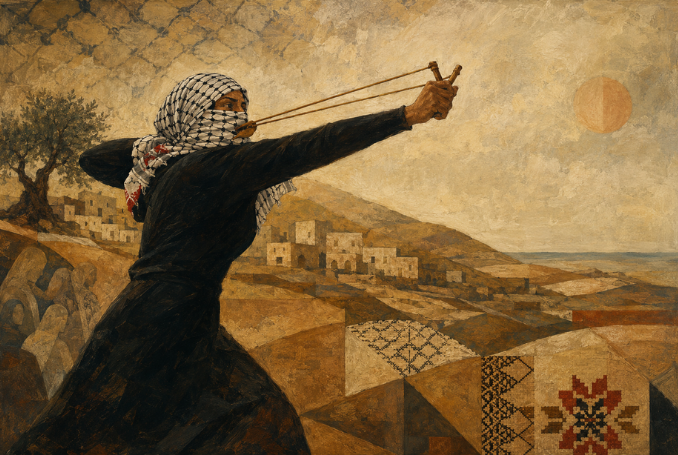
For much of the twentieth century, and continuing into the twenty-first, representations of Palestinian women in Western political and media discourse have frequently resorted to a limited set of archetypes. In the best-case scenario, the Palestinian woman is the hapless victim: the refugee mother, the grieving widow, the woman fleeing destruction. In another register, she becomes the “oppressed Arab woman,” constrained by religion, tradition and patriarchal society, waiting to be emancipated. At certain historical moments, another image has interrupted these representations: the woman with the gun, who has immediately been labeled as ‘terrorist’.
Truth is, passivity was never the historical condition from which Palestinian women had to emerge. It was, rather, a condition repeatedly imposed upon them in representations that struggled to recognize forms of political agency that did not conform to predetermined understandings of Arab women.
As expressed by Jane Hardy and Katie Coles in their essay, Palestinian women’s resistance: from the Great Revolt to the First Intifada (1936 to 1993):
“Orientalist thinking, a current in some ‘feminist’ movements from imperialist countries, has portrayed Palestinian women as lacking agency and being ‘the silent victims of the religious, patriarchal and cultural oppression, as lacking control over self and body’ and in need of rescue. Yet, despite this rhetoric depicting Palestinian women as passive bystanders, with their role in resistance invisible or marginalised, they have consistently been activists in Palestine’s history of struggle, often at the forefront.”
Indeed, Palestinian women organized politically even before the Nakba. They participated in the Great Revolt of 1936–39. Some fought actively, while others transported weapons, intelligence, money, and medicine, helped conceal rebels, and treated the wounded.
In 1948, during the violent expulsion of Palestinian inhabitants from historic Palestine, women participated in the defense of their communities in 1948. After the Nakba, they rebuilt political organizations in exile. They joined clandestine cells and guerrilla organizations, experienced imprisonment and interrogation, organized prisoners, produced revolutionary literature and helped construct the mass institutions that sustained the First Intifada. They participated in popular resistance against the occupation in the West Bank and in the Great March of Return in Gaza. They documented Israeli violence and maintained social and political networks through siege, displacement and war.
This article aims to restore Palestinian women to a political history from which they have too often been analytically separated.
From Women’s Organization to National Mobilization
The emergence of an organized Palestinian women’s movement must be situated within the deep transformations of the late Ottoman and British Mandate periods.
Even before becoming an organized political movement, Palestinian women were active in charitable and educational associations. Although this kind of activity can appear apolitical when removed from its colonial setting, under conditions of revolt, these activities became part of the infrastructure through which political resistance remained possible.
Indeed, assisting the families of prisoners, treating people wounded by colonial forces, or raising money for communities targeted by repression could hardly be described as mere apolitical ‘social work’.
Following the al-Buraq Uprising of August 1929 — a week of uprising sparked by a dispute over access to Jerusalem’s Western Wall, which left over 250 people dead and hundreds wounded — Palestinian women’s political activity expanded dramatically. The October congress in Jerusalem led to the creation of an executive committee and strengthened networks among women’s organizations in different Palestinian cities.
Abd al-Hadi, Mogannam, and al-Shihabi emerged as important nationalist voices. Within less than a decade, that movement would confront a very different political environment.
In 1936, Palestine erupted in revolt.
Women of the Great Revolt
The Great Palestinian Revolt of 1936–39 was one of the defining confrontations of the British Mandate period. Beginning with a general strike and developing into an armed rebellion, it mobilized broad sectors of Palestinian society against British colonial rule and the accelerating Zionist project.
The iconography associated with the Revolt is dominated by men: from the Palestinian fighter carrying his rifle through the hills to the political leader negotiating, issuing statements, or entering exile, women are much harder to see.
Yet Arabic scholarship, Palestinian historical writing and particularly oral-history research have preserved evidence of a much more extensive female presence.
As Matthew Hughes argues in his article, Women, Violence, and the Arab Revolt in Palestine, 1936–39, “The history (…) demonstrates that women played their part in revolt and pacification, both as subjects of attritional imperial control and as active agents of rebellion”
In this context, Fatima Khalil Ghazal’s history is particularly striking. Ghazal was killed in June 1936 during fighting against British colonial forces near Wadi Azzun. Palestinian sources remember her as among the earliest Palestinian women killed in armed resistance to British rule.
Women such as Wadi’a Qaddura Khartabil also operated through organized women’s networks that supplied rebels and supported their families. Zulaykha al-Shihabi helped organize first-aid efforts and mobilized women around Palestinian prisoners, including encouraging attendance at trials as a public demonstration of political solidarity.
The Catastrophe: Women in the Defense of Palestine
The suppression of the Great Revolt had a huge impact on Palestinian political society. Britain killed, imprisoned or exiled large numbers of Palestinian political and military cadres, leaving the population weakened on the eve of the struggle that culminated in the Nakba, the Catastrophe of 1948.
The Nakba refers to the mass displacement and dispossession of Palestinians during the establishment of Israel in 1948, when more than 700,000 Palestinians were expelled from their homes and hundreds of Palestinian towns and villages were depopulated or destroyed.
As Zionist militias escalated their attacks between 1947 and 1948, Palestinian women again participated in the political, medical and military defense of their communities.
One of the most intriguing episodes is associated with the two sisters Muhayba and Nariman Khorsheed and their Jaffa-based women’s organization Zahrat al-Uqhuwan – the Chrysanthemum Flower. Palestinian accounts describe an organization that developed from women’s social activity into more direct forms of resistance as the confrontation intensified. Women reportedly received weapons training, assisted fighters and participated in the defense of Jaffa and surrounding areas.
Other women’s stories survive from the villages and towns attacked during the Nakba, although it is not easy to trace unequivocal historical evidence. Indeed, the Nakba did not merely destroy lives and communities. It also destroyed records. Activities performed within homes, villages, informal networks and family structures were already less likely to appear in formal political archives. Displacement made them still harder to reconstruct.
The destruction of Palestinian society in 1948 changed and fragmented the terrain of political struggle. Women were dispersed with the rest of Palestinian society.
However, the political networks of the national movement slowly re-emerged in exile, and women took part in their reconstruction. Among them, Samira Azzam provides an especially revealing example.
Azzam is mainly remembered as one of the important literary voices of the Palestinian Nakba generation. Through her fiction and broadcasting, she documented the psychological and social world of exile.
She was also involved in politics. In 1961, she participated in the nucleus of a secret Palestinian organization that would become known as the Palestine Liberation Front, and was reportedly the only woman among its founders. She later assumed responsibility for organizing its women’s section.
The Fedayeen Generation
The emergence of Fatah, the Popular Front for the Liberation of Palestine (PFLP)and other revolutionary organizations during the 1960s transformed Palestinian politics.
The defeat of Arab armies in the war of June 1967 accelerated this transformation. Armed Palestinian organizations increasingly presented Palestinians themselves, rather than Arab states, as the principal agents of national liberation.
Among the women who were part of this political shift is Shadia Abu Ghazaleh. Born in Nablus in 1949, Abu Ghazaleh became involved in the Arab Nationalist Movement and later joined the Popular Front for the Liberation of Palestine.
After Israel occupied the remainder of historic Palestine in 1967, she participated in active resistance, helped rebuild underground organizational networks in Nablus and assumed responsibility for the PFLP’s women’s section in the area. She died on November 20, 1968, at nineteen years old, when an explosive device she was preparing detonated accidentally.
Another example is Fatima Bernawi. A Palestinian of African descent from Jerusalem, Bernawi joined Fatah and was arrested in 1967 following an attempted bombing of the Zion Cinema. She is widely remembered within Palestinian history as the first female prisoner of the modern revolution.
“She spent 10 years in prison before being released in a prisoner exchange, like most Palestinians, her time in Israeli detention did nothing but increase her resolve. She eventually worked closely with Yasser Arafat to set up the Palestinian Women’s Police in Gaza,” Elom Tettey-Tamaklo write in her article ‘On Fatima Bernawi, Women’s Struggle, and Black-Palestinian Solidarity’.
Then came Aisha Odeh, Rasmea Odeh and numerous other women whose political activity became inseparable from the history of Israeli imprisonment. Prison transformed the meaning of resistance once again. Although isolated and confined, women prisoners developed forms of collective organization, political education and solidarity.
It is within this historical context that Leila Khaled should be understood. Khaled’s participation in the 1969 hijacking of TWA Flight 840 and the attempted hijacking of an El Al aircraft in 1970 made her one of the most internationally recognizable figures of the Palestinian revolution.
Khaled was part of a much larger generation. Women, including Therese Halsa, Amina Dahbour, Abla Taha, Aida Saad, and others, participated in revolutionary organizations through military, political, and logistical roles.
In 1978, Dalal al-Mughrabi, a Palestinian refugee born in Lebanon, led a Fatah unit in the operation remembered by Palestinians as the Coastal Road operation. Mughrabi was killed, together with other members of the group, during the attack.
Her place in Palestinian political memory has been enormous, with streets, institutions and public commemorations carrying her name.
The First Intifada and the Expansion of Resistance
The First Intifada, which began in December 1987, revealed the full extent of Palestinian women’s participation in popular resistance. Palestinian accounts describe how neighborhood committees distributed food, treated the wounded and organized strikes and boycotts. When Israel closed schools and imposed tight curfews, Palestinians taught children in private homes. Women were central to these networks: they organized demonstrations, distributed leaflets, supported prisoners’ families and kept communities functioning.
Women also literally placed their own bodies between Israeli soldiers and Palestinian boys, confronting troops and physically pulling young people away to prevent their arrest or beating. These interventions took place as Israel pursued the notorious “breaking bones” policy, under which soldiers were instructed to use systematic force and beatings to suppress the uprising. As Khitam Saafin of the Union of Palestinian Women’s Committees later recalled, women would confront soldiers and pull detained boys from their grasp.
Khalida Jarrar emerged from this political world. Born in Nablus in 1963, she became active in voluntary organizations and was detained during an International Women’s Day demonstration in March 1989. She later directed Addameer, advocated for Palestinian prisoners and was elected to the Palestinian Legislative Council in 2006. Israel repeatedly detained her, often without charge or trial. In prison, she taught other women and organized educational activities, turning knowledge-sharing into another form of resistance.
Beyond Oslo: Village and Prison
The Second Intifada, which began in 2000, saw women participate in demonstrations, medical and relief work, political organizations and, in smaller numbers, armed groups. A small number, including Wafa Idris, Ayat al-Akhras and Hanadi Jaradat, carried out suicide bombings, or Istishhad (martyrdom attacks), as is more typically known among Palestinians.
These women were often discussed in Israeli and Euro-American scholarship as damaged, socially deviant, or even manipulated, almost anything other than political actors. As we mentioned above, this is a familiar pattern in interpretations of the Palestinian struggle: the violence is examined in isolation, while the occupation and the broader struggle for liberation fade into the background. In the case of women, this reading also denies them the agency routinely granted to men. As Bilal Hamamra, Rebecca Ruth Gould and Asala Mayaleh argue in their article ‘Against the Depoliticisation of Palestinian Female Shahids’, Palestinian female martyrs were “conscious agents whose final acts underscore their adherence to religious and national discourses of sacrifice.” Their involvement also disrupted two deeply rooted assumptions: the colonial view of Palestinians as people without political agency, and the patriarchal view of armed resistance as an exclusively male domain.
After the Second Intifada, women remained active in struggles against settlements, land confiscation, the separation wall and political imprisonment.
Nabi Saleh became known for its weekly demonstrations against settlement expansion and the seizure of the village spring. Women from the Tamimi family protested, documented military raids and endured repeated arrests alongside the men and children of the village.
Ahed Tamimi became internationally known after her arrest in 2017, when she was sixteen. Yet she was never an isolated symbol. She grew up in a village shaped by collective resistance and within a family in which women had long been politically active.
Nearly a century after Palestinian women mobilized around prisoners during the Great Revolt, the prison remained a central site of women’s political confrontation.
Gaza and the Great March of Return
On March 30, 2018, Palestinians in Gaza began gathering near the fence separating them from the lands from which most of their families had been expelled.
Women joined the Great March of Return from its first day. They organized, marched, treated the wounded and reported on the demonstrations. They brought their children and families to the protest camps. Some approached the fence carrying Palestinian flags.
Among them was 57-year-old Um Khalid Abu Mosa from Khuza’a, who was shot in the shoulder by Israeli forces on March 30.
On June 1, 2018, Israeli forces shot and killed 21-year-old volunteer paramedic Razan al-Najjar as she tended to wounded protesters near Khan Yunis. She was wearing clothing that identified her as medical personnel.
Al-Najjar became one of the best-known faces of the March, but she was part of a much larger medical network. Paramedics worked continuously near the demonstrations, treating people wounded by live ammunition and tear gas. Women helped build and sustain that network.
Female journalists also became essential witnesses to the demonstrations, reporting from the protest camps and documenting Israel’s violence against marchers, medics and members of the press. Among them was Wafaa Aludaini, who reported from the Great March of Return every Friday, carrying the voices and images of Gaza to English-speaking audiences. On September 30, 2024, during Israel’s genocide in Gaza, an Israeli airstrike hit her home in Deir al-Balah, killing Wafaa, her husband and two of their children.
Women’s Resistance to Genocide
Palestinian women are at the forefront of the struggle, and their agency makes Israel see them as dangerous enemies to be eliminated. This is evident in the rhetoric that portrays Palestinian mothers as the source of the “head of the snake”, in the words of former Israeli Justice Minister Ayelet Shaked, who called for mothers to be killed alongside their sons, describing them as “little snakes”.
This view of Palestinian women is further demonstrated by Israel’s effort to erase them during the current genocide. According to UN Women, more than 38,000 women and girls were killed in Gaza between October 2023 and December 2025, an average of at least 47 every day, while around one million have been displaced.
The Israeli genocidal war beginning in October 2023 brought destruction on a scale unprecedented in modern Palestinian history. Entire families were killed, neighborhoods erased and most of Gaza’s population repeatedly displaced. Hospitals, schools, universities, cultural institutions and media offices were destroyed or damaged.
Women endured pregnancy and childbirth under bombardment, the collapse of maternal healthcare, a lack of sanitary products and privacy, and the growing burden of caring for children and elderly relatives. However, despite horrific pain, they did not allow Israel’s genocidal actions to define them and uproot them and theif families from their homeland.
Journalists such as Bisan Owda, Hind Khoudary and Plestia Alaqad reported from inside Gaza while foreign correspondents were largely prevented from entering independently. They worked while displaced, searching for food, protecting their families and mourning relatives and colleagues. This journalism belongs to a much older Palestinian struggle over who has the “permission to narrate” Palestinian life.
Women doctors, nurses and paramedics also continued working as Gaza’s medical system collapsed around them. They treated patients without sufficient medicine, electricity, clean water, anesthesia or functioning equipment. Many were themselves displaced, injured, detained or killed.
Another brutal aspect of Israel’s genocidal policies has been scholasticide: the destruction of hundreds of schools, depriving entire generations of students of access to education. Palestinian women responded by opening makeshift schools in the tents where they had sought refuge. In some cases, these initiatives grew into educational institutions serving hundreds of children.
This is the story of Lamia Hatem Othman, who fastened a piece of canvas to the ground among the tents of displaced families and began teaching children who were starting to forget their letters beneath the constant bombardment. Her initiative became the School of Sumud for the Children of Martyrs and Orphans, with organized classrooms and wooden desks, where boys and girls study literacy and mathematics alongside programming, artificial intelligence and the foundations of engineering. Drawing, games and psychosocial support give them space to play and begin to recover from what they have endured. After spending her days teaching and running the school, Lamia continues studying for her own master’s degree on an old mobile phone, by candlelight when the electricity fails. For her and her co-workers, educating Gaza’s children and preparing them to rebuild their society cannot wait until the genocide ends.
However, it would be unfair to reduce Palestinian women’s role to preserving the social fabric of a society under genocidal attack. Women in Gaza have also participated in armed resistance, including through women’s cells within Hamas’s military wing, the Al-Qassam Brigades, whose existence was already being reported in 2005.
A 2008 report described women receiving military training and serving as fighters within Al-Qassam. Interviewed for that report, Hamas leader Jamila al-Shanti explained that women participated in political deliberations, military affairs and decision-making. “We have our own positions and often we oppose them (the men),” Shanti reportedly said. “We don’t accept their proposals, we plan, we decide, we debate, we say no, and we also implement what we deem appropriate.”
Despite refuting the claim that a women’s armed force existed, Shanti acknowledged that “women receive military training to prepare for emergencies”.
Women’s participation attracted renewed attention during the November 2023 prisoner exchange, when footage of a masked figure accompanying released captives prompted widespread speculation that the fighter was a woman. Although that identification remained unconfirmed, the discussion drew attention to a role that had been reported long before the current genocide.
A far more recent case shows that women’s armed participation is neither confined to the past nor necessarily organized through formal women’s units. On September 1, 2026, Samah al-Khalidi, a 47-year-old mother of three, took up her wounded son’s rifle and opened fire on an Israeli special forces unit that had raided her family’s home in western Gaza City. According to her family, al-Khalidi fought as the soldiers advanced toward her injured husband, Muin al-Arabid. She was killed during the confrontation, while her husband was wounded and captured.
The Other Side of the Struggle
Throughout their history of oppression and dispossession, Palestinian women’s suffering has not canceled their agency. They have endured displacement, siege, military occupation, imprisonment, home demolitions and repeated wars, but they have not lost their political consciousness.
If colonial narratives have long portrayed Arab and Muslim women as helpless figures in need of rescue, the politically conscious Palestinian woman disrupts that story. She insists on naming colonialism, Zionism, occupation and displacement as forces shaping her life.
To write the history of Palestinian women’s resistance is also to confront the conditions under which that history has been written, or left unwritten, because the archive itself was shaped by the same forces of displacement and destruction that Palestinian women have spent a century resisting. Recovering their history therefore means reading against the silences as much as through the sources: asking not only what was recorded, but who had the power to decide what counted as political enough to record.
This is why the women’s names that do survive matter, and why so many more remain unknown.
Nearly a century after the women of Jerusalem passed their resolutions and drove through the city’s streets to deliver them, that choice continues, in press vests and hospital wards, in prison cells and protest camps, in the effort of keeping a people, and its memory, alive. The other side of the struggle is not a footnote to Palestinian history, but one of its central threads.

– Romana Rubeo is an Italian writer and the managing editor of The Palestine Chronicle. Her articles appeared in many online newspapers and academic journals. She holds a Master’s Degree in Foreign Languages and Literature and specializes in audio-visual and journalism translation.