
By Ramzy Baroud 
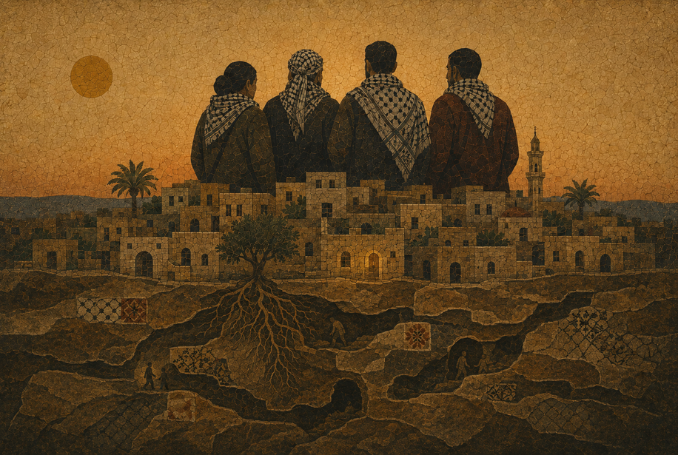
Tracing Gaza’s armed struggle from ancient defenses to modern tunnel warfare, Ramzy Baroud examines how geography, dispossession and Palestinian agency shaped an enduring resistance.
Author’s note: For an extensive historical and structural analysis of the dynamics explored in this essay, see my latest book, Before the Flood.
The Unforgiving Flatland
Gaza is flat—so flat that even the slightest rise in the land is called a hill. Tel al-Muntar, east of Gaza City, and Tel al-Sultan, near Rafah, hold a special place in local memory, even though elsewhere in the Levant they would hardly be considered hills.
It seems an unlikely landscape for an armed resistance with roots stretching back to antiquity. In theory, anyone standing on the smallest rise could see every movement below. How, then, did Gaza’s defenders ever manage to operate?
The question becomes even more pressing today. How has an organized resistance survived for decades against Israel and the advanced military technology supplied by the United States and other Western powers? Satellites watch Gaza from above. Surveillance drones remain in the sky for hours. Thermal cameras track movement, while seismic systems detect underground activity. Precision-guided weapons can strike almost anywhere in the Strip.
The whole territory of the Gaza Strip offers little natural cover. By every conventional measure of warfare, a resistance operating under such conditions should not have been able to survive for so long. Gaza’s history is inseparable from the wider Palestinian experience, with its shared trauma, identity and national aspirations. At the same time, Gaza’s particular geography and history have shaped a character of their own.
For centuries, long before Israel was established, Gaza stood along the Via Maris, the ancient route linking Africa and Asia. Merchants crossed it, but so did invading armies. Its location made Gaza both a gateway and a frequent battleground, where local people repeatedly fought against foreign rule.
Modern Gaza was remade by the Nakba of 1948. Most of its people were not originally from the city or the surrounding district, but were refugees and, later, their descendants. Zionist militias drove them from coastal cities, market towns, and farming villages across historic Palestine—Al-Majdal, Simsim, Hamama, Al-Faluja, Beit Daras, and many others. More than 200,000 displaced Palestinians were forced into a narrow coastal strip only 25 miles long.
That upheaval transformed Gaza’s social fabric and its understanding of struggle. A rooted, largely agrarian population was suddenly compressed into refugee camps such as Shati, Jabaliya, Nuseirat, and Khan Yunis, where loss became a shared, daily reality to be dealt with. In the meantime, siege, confinement, poverty, and statelessness reinforced a culture of resistance centered on the right of return and on sumud—steadfastness.
But demography, geography, and military logistics alone cannot explain Gaza’s endurance. This particular form of courage and sumud was shaped by a variety of factors: spiritual conviction, shared grief, historical memory, and a rooted political outlook.
There is not enough space here to explore those spiritual and psychological dimensions in full, yet they are essential, because without them, Gaza’s military endurance makes little sense.
This point also matters because many commentators, often taking their cues from Israeli media, reach for conspiracies when they cannot account for Palestinian agency. Did Netanyahu know about October 7 in advance and allow it to happen? Were Palestinians merely pawns in an Israeli intelligence scheme? Was the operation—and the genocide and destruction that followed—part of an Israeli plan to reorder the region?
Such readings erase Palestinians as agents in their own struggle. They reduce an entire people to objects of history rather than participants in making it, much as imperial scholarship—and even some older anti-colonial frameworks—once denied colonized peoples a role in shaping their own future. Gazans cannot be seen as passive figures waiting for someone else to write the script. Their tactics, ingenuity, and capacity to endure arise from their own determination to resist colonial erasure.
Only with this context in mind can we turn to the long history of armed struggle in Gaza.
Ancient Defense on a Flat Horizon
Gaza has resisted foreign conquest since ancient times. The territory lies on the coastal route linking the Nile Delta with the Levant and Mesopotamia, and for conquerors—from the Pharaohs, Assyrians, Babylonians, Persians, Greeks, and Romans to the Crusaders and Ottomans—control of Gaza was strategically vital.
With no mountain fortress or wilderness to protect them, Gaza’s defenders relied on fortifications they built themselves, and on their own resolve. The best-known ancient example came in 332 BCE, when Alexander the Great besieged the city: after taking the island fortress of Tyre, Alexander marched south to secure the road to Egypt. At Gaza he found a fortified city on an artificial mound, surrounded by sand and open plains and commanded by a governor named Batis.
Batis organized a determined defense using earthworks, trenches, and underground saps intended to undermine the Macedonian siege engines. For more than two months, Gaza held off one of the ancient world’s most formidable armies, inflicting heavy losses and wounding Alexander himself. When the walls finally gave way, Alexander killed the garrison. According to historical accounts, he then ordered Batis to be tied by the ankles to a chariot and dragged around the city walls, echoing Achilles’ treatment of Hector.
The siege revealed a lesson that would recur throughout Gaza’s history: where the land offered no natural high ground or cover, defenders had to reshape it. Trenches, earthworks, and underground passages became substitutes for the protection geography had denied them.
The Nakba: The Birth of the Camps
The modern history of resistance in Gaza began with the Nakba of 1948. Before that date, the Gaza district was a prosperous coastal region: an urban center surrounded by productive agricultural villages. The war shattered that social and economic world.
During operations including Yoav and Harel, Zionist militias—the Haganah, the Irgun, and later the newly formed Israeli army—cleared, destroyed, and depopulated dozens of Palestinian villages across the southern coastal plain. More than 200,000 refugees fled into the Gaza Strip, which the 1949 Armistice Agreements placed under Egyptian administration. The enclave’s population tripled almost overnight, making it one of the most densely populated places on earth.
The newly established United Nations Relief and Works Agency (UNRWA) set up eight official refugee camps: Jabaliya, Beach Camp (Shati), Nuseirat, Al-Bureij, Maghazi, Deir al-Balah, Khan Yunis, and Rafah. Intended as temporary shelters, they gradually became crowded concrete neighborhoods of narrow alleys, thin-walled homes, and communal water taps.
This demographic reversal permanently politicized Gaza. The residents of Shati and Jabaliya were farmers, fishermen, and townspeople uprooted from places such as Beit Daras, Al-Majdal, and Hamama. Families preserved the iron keys to their stone homes and remembered the boundaries of their orange groves.
In the camps, personal grief, poverty, and dispossession became a shared political experience. For each new generation, returning to the villages and fields beyond the armistice line remained a central political demand.
The Fedayeen Era
By the early 1950s, the anger and despair of the refugees began to spill across the armistice lines. At first, many crossed to harvest abandoned crops, recover belongings, or see relatives from whom they had been cut off. Israel classified every such crossing as ‘infiltration,’ often shooting those it caught and carrying out destructive reprisal raids in Egyptian-administered Gaza.
The Fedayeen—literally, ‘those who sacrifice themselves’—emerged from this cycle of border violence. At first, they were loose, autonomous groups of armed young refugees. They crossed the border to attack military posts, sabotage infrastructure, and ambush patrols.
In 1955, Egyptian President Gamal Abdel Nasser recognized the political force gathering in the refugee camps and changed course. Egyptian military intelligence began organizing, arming, and training Fedayeen units. Under Egyptian direction, Gaza became a base for armed incursions into southern Palestine, now part of newly established Israel.
The Fedayeen marked the first organized post-Nakba shift from Palestinians being treated as recipients of relief to acting as political agents. Israeli fear over the growing raids helped drive its participation in the 1956 Sinai War. During its brief occupation of Gaza, Israeli occupation forces carried out mass killings of refugees and Fedayeen in Khan Yunis and Rafah—an early measure of the stakes of border warfare in the enclave.
The PLA and the Ain Jalut Brigade
Alongside the guerrilla groups, state-backed Palestinian military institutions were also emerging. The Arab League oversaw the creation of the Palestine Liberation Organization (PLO) in 1964, and the following year the PLO established a regular military wing, the Palestine Liberation Army (PLA).
In Gaza, the PLA was represented chiefly by the Ain Jalut Brigade, named for the 1260 battle in Palestine in which the Mamluks defeated the Mongol army. Stationed in Gaza under Egyptian oversight, it consisted largely of young refugees who received conventional military training, including artillery and tactical instruction, from Egyptian officers.
Unlike the autonomous Fedayeen cells, the Ain Jalut Brigade functioned as a structured, uniformed military force with clear ranks, command hierarchies, and heavy weaponry. During the 1967 Six-Day War, the brigade fought tenaciously against advancing Israeli armored columns along the coastal road, suffering heavy losses as Israeli forces overran the Strip.
After the 1967 defeat, the PLA’s conventional structure was largely destroyed or driven into exile, but the Ain Jalut Brigade left an important legacy. Thousands of young Gazans had learned weapons maintenance, military discipline, and battlefield tactics. Under occupation, many of these veterans returned to the camps, carrying expertise that would feed the clandestine guerrilla networks of the 1970s and 1980s.
The Post-1967 War: Why the Leftists Dominated Gaza
After Israel occupied the West Bank, Gaza, and East Jerusalem in 1967, the Palestinian national movement faced an urgent question: how could resistance be organized under direct military rule? Gaza and the West Bank soon followed different paths.
In the West Bank, Yasser Arafat’s movement, Fatah, attempted to establish early armed cells, but faced severe geographical and operational challenges. The open terrain of the Jordan Valley, combined with aggressive Israeli counter-insurgency operations and the eventual expulsion of PLO bases from Jordan during Black September (1970), forced Fatah to relocate its primary command structures to Lebanon, shifting its focus toward external diplomacy and cross-border operations from abroad.
In Gaza, by contrast, Marxist-Leninist factions—above all George Habash’s Popular Front for the Liberation of Palestine (PFLP)—built a strong base and waged a sustained urban guerrilla campaign from within the occupied territory.
Why did the Left build such a strong presence in Gaza while Fatah struggled to establish itself there? The answer can be found, in large part, in Gaza’s social and geographical conditions:
Dense Refugee Camps and a Shared Experience of Displacement:
Gaza’s crowded refugee camps brought together large numbers of impoverished and politically conscious Palestinians who shared the experience of displacement. The PFLP’s Marxist-Leninist ideas appealed to many refugees who felt that the established Arab regimes had failed them.
The Legacy of the PLA:
Many former soldiers and officers from the Ain Jalut Brigade had already encountered secular Arab nationalist and socialist ideas. When they joined the PFLP in Gaza, they brought military training, discipline and experience, giving the movement a strong operational foundation.
Gaza’s Compact Geography:
Gaza’s small size and densely built camps allowed underground cells to move through narrow alleyways and remain hidden. Their ability to operate also depended on residents who knew the area intimately and often helped shield them from Israeli forces.
The ‘Red Square’ and Sharon’s Brutal Crackdown
Between 1969 and 1971, the PFLP gained effective control over parts of Gaza, especially in Jabaliya, Shati, and Khan Yunis. Its best-known local commander was Mohammed al-Aswad, remembered as the ‘Guevara of Gaza.’
Under al-Aswad, the PFLP developed an extensive underground network. Although Israeli soldiers controlled the main roads during the day, at night, the movement held sway inside the camps. Its fighters attacked military vehicles and patrols, enforced strikes, and killed suspected collaborators. Gaza became known in some accounts as the ‘Red Square’ because the Israeli army struggled to operate inside the camps after dark.
In 1971, the Israeli government appointed General Ariel Sharon to head the army’s Southern Command and suppress the insurgency in Gaza. Sharon’s campaign relied on overwhelming military force and the systematic reshaping of the refugee camps themselves.
Armored bulldozers tore wide, straight roads through the narrow, winding lanes of Jabaliya and Shati, demolishing thousands of homes and displacing tens of thousands of refugees. The new roads gave Israeli armored vehicles easier access to the camps and created clear lines of fire through areas where resistance fighters had previously been able to move and hide.
At the same time, Sharon established undercover units whose members entered the camps in disguise and assassinated PFLP fighters. Israeli forces also detained tens of thousands of Gazans and deported entire families of suspected fighters to remote internment camps in the Sinai desert.
In March 1973, Israeli occupation forces cornered and killed Mohammed al-Aswad during a major gun battle in Gaza City. His death, combined with Sharon’s campaign of demolitions, arrests, deportations and assassinations, dismantled much of the PFLP’s armed infrastructure. Gaza emerged from the crackdown exhausted and devastated, while the occupation and its methods deepened the anger that had fueled the resistance in the first place.
The Vacuum and the Silent Growth of the Islamists
The suppression of the PFLP coincided with the wider decline of secular Arab nationalism after Gamal Abdel Nasser’s death and the inconclusive October War of 1973, which opened a political and social vacuum in Gaza. The secular Left had fought with determination, but liberation, return, and an end to occupation remained out of reach.
A quieter movement moved into that space: the Islamic Center (Al-Mujamma’ al-Islami), founded in 1973 by Sheikh Ahmed Yassin, a quadriplegic cleric from Gaza.
Yassin, a refugee from the depopulated village of Al-Jura, proved to be a gifted organizer. Direct armed confrontation was nearly impossible under Sharon’s security regime, so Yassin and his associates pursued a long-term strategy built around da’wah, social welfare, health care, and education.
During the 1970s and early 1980s, Al-Mujamma’ developed a network of clinics, kindergartens, sports clubs, women’s vocational centers, and charities. It also built mosques that became community centers beyond the immediate control of the Israeli military administration.
At this stage, Al-Mujamma’ avoided direct military confrontation and concentrated on social reform while competing with secular PLO factions for influence in universities and professional unions.
Vanguard of Armed Islamism: Palestinian Islamic Jihad
While Al-Mujamma’ concentrated on social work and institution-building, another current was taking shape: Palestinian Islamic Jihad (PIJ). Founded in the late 1970s and early 1980s by Gazan students in Egypt, notably Fathi Shaqaqi and Abd al-Aziz Awda, PIJ set out to bridge an ideological divide. Its founders believed the secular Left had failed to liberate Palestine, while the Muslim Brotherhood had become too cautious by placing religious reform ahead of confrontation with the occupation.
Influenced by both the anti-colonial energy of the 1979 Iranian Revolution and Palestinian national liberation thought, PIJ put armed struggle first. Unlike Hamas, which would later develop broad social, charitable, and political institutions alongside its military wing, PIJ remained a smaller, vanguard movement centered on military action.
In the mid-1980s, its cells ambushed Israeli military targets in Gaza, showing that Islamic politics could be joined to direct resistance. Its early operations contributed to the atmosphere in which the First Intifada erupted in 1987.
PIJ continues to operate alongside other factions in Gaza’s Joint Operations Room.
The Rise of Hamas
The First Intifada erupted in December 1987 after an Israeli military truck struck and killed Palestinian workers near Jabaliya refugee camp. As the uprising spread, Al-Mujamma’ could no longer remain on the sidelines without losing the standing it had built within Palestinian society.
On December 14, Sheikh Ahmed Yassin, Abdul Aziz al-Rantisi, Salah Shehadeh and other leading figures founded Hamas—Harakat al-Muqawamah al-Islamiyyah, the Islamic Resistance Movement. Hamas drew on the Muslim Brotherhood’s established social base while committing itself directly to the struggle against the Israeli occupation.
Its military structure developed gradually. One of its earliest components was MAJD (Munazzamat al-Jihad wa al-Da’wah), an internal security and counterintelligence organization established by Hamas figures including Yahya Sinwar. MAJD sought to identify collaborators and Israeli informants operating inside Gaza’s refugee camps. Sinwar’s role in this campaign led to his imprisonment by Israel for more than two decades. The dismantling of informer networks also gave Hamas the secrecy it needed to build an underground military apparatus.
In 1991, Hamas formally established the Izz ad-Din al-Qassam Brigades, named after the Syrian-born preacher who led an armed revolt against British rule in northern Palestine in 1935. Among its early commanders was Yahya Ayyash, known as “the Engineer,” followed by Mohammed Deif, Marwan Issa and others. During this period, the Brigades attacked Israeli soldiers and armed settlers and captured Israelis in an effort to secure the release of Palestinian prisoners.
The Second Intifada, from 2000 to 2005, brought another shift. Israel deployed helicopter gunships, sniper towers and armored bulldozers against the uprising, while Gaza’s growing isolation made imported weapons increasingly difficult to obtain. Al-Qassam responded by developing weapons locally. Gaza’s engineers produced crude solid-fuel rockets, beginning with the Qassam-1. Although the first models were highly inaccurate, they allowed Palestinian fighters to strike across the border without having to breach Israel’s fortified perimeter.
A new phase began after Israel removed its settlers and ground forces from inside Gaza in 2005. Hamas won the Palestinian legislative elections the following year, after which Israel imposed a sweeping blockade by land, sea and air. Under these conditions, Al-Qassam evolved from a clandestine guerrilla organization into a more structured territorial defense force, with underground warfare at the center of its strategy.
The capture of Israeli soldier Gilad Shalit in 2006 offered an early demonstration of the strategic value of cross-border tunnels. Eight years later, during Israel’s 2014 ground invasion, Al-Qassam fighters used tunnels and Gaza’s dense urban landscape to ambush the Golani Brigade in Al-Shuja’iyya, in a battle known as Al-’Asf al-Makoul. The fighting inflicted heavy losses on Israeli occupation forces and demonstrated how locally manufactured weapons, including the Yassin RPG, could be used against advanced Israeli armor.
This long process of adaptation culminated on October 7, 2023, with Al-Aqsa Flood. The coordinated operation combined attacks by land, sea and air with the use of underground routes, overwhelming Israel’s southern military division. It was the product of years of concealed planning, tactical deception and local weapons production developed under siege.
Confronting the ‘Israel Created Hamas’ Myth
One claim appears repeatedly in international commentary: that ‘Israel created Hamas.’ Critics of Israel sometimes use it to illustrate blowback, while conspiracy theorists invoke it to portray Hamas as an Israeli intelligence asset. Both versions flatten a far more complicated history.
The claim confuses a tactical policy of colonial rule with the organic history of a Palestinian movement.
In the late 1970s and early 1980s, Israeli military authorities in Gaza allowed—and at times encouraged—the administrative work of Sheikh Ahmed Yassin’s Al-Mujamma’ al-Islami. Brigadier General Segev, then the Israeli military governor of Gaza, followed a policy of ‘non-interference’ as its social and charitable network expanded. The calculation was cynical but straightforward: a nonviolent religious organization could serve as a counterweight to the secular, nationalist PLO, which Israel then regarded as its principal enemy.
But tolerating the early growth of Al-Mujamma’s social institutions is not the same as creating Hamas.
Israel did not introduce Muslim Brotherhood thought to Palestine; it had been present since the 1940s. Nor did Israel manufacture Sheikh Yassin’s religious convictions, write Hamas’s charter, or compel young men in Jabaliya and Shati to join Al-Qassam. Hamas grew out of Palestinian refugee life, religious conservatism, and resistance to occupation.
Once Hamas moved from social work to armed struggle in December 1987, Israel outlawed the organization. It later assassinated senior political and military leaders, including Yassin, Rantisi, Shehadeh, and Jaabari; imprisoned thousands of members; and subjected Gaza to a prolonged siege intended in part to destroy Hamas’s governing and military capacity.
For these reasons, reducing Hamas to an Israeli creation is ultimately an Orientalist argument. It denies Palestinians—even those whose ideology one may oppose—the capacity to organize, plan, adapt, and build institutions of their own.
Agency Beneath the Rubble
Gaza’s armed struggle grew out of a long and unresolved history shaped by the ethnic cleansing of 1948, the forced concentration of refugees in overcrowded camps, and decades of occupation, siege, and attempted erasure leading to the current genocide.
From the earthworks used against Alexander the Great, to the Fedayeen crossing the armistice lines at night, to the PFLP’s ‘Red Square’ in Shati, and finally to Al-Qassam’s tunnel network beneath the camps, Gaza’s defenders have repeatedly confronted the same problem: how to survive and fight on an exposed plain against a far more powerful military.
Faced with Gaza’s devastation—entire neighborhoods leveled, hospitals besieged and destroyed, and mass graves dug across the Strip—many observers wonder how its people continue to endure. Their endurance is rooted in sumud: a collective refusal to disappear, passed from one generation to the next.
Gaza’s history suggests that so long as displacement, statelessness, occupation, and the denial of return continue, bombardment and technological superiority will not extinguish the impulse to resist. Any analysis that sees Gazans only as victims, or as pawns in someone else’s design, will miss the roots of their ability to survive, adapt, and fight back.
A Note on Scope: This article traces the geographic and strategic development of Gaza’s armed struggle, from ancient defenses and the Nakba to subterranean warfare. It does not attempt to catalog every resistance faction. Movements such as Palestinian Islamic Jihad (PIJ), the Abu Ali Mustafa Brigades, and the Popular Resistance Committees, among other leftist and nationalist formations, warrant studies of their own.

– Dr. Ramzy Baroud is a journalist, author and the Editor of The Palestine Chronicle. He is the author of six books. His forthcoming book, ‘Before the Flood,’ will be published by Seven Stories Press. His other books include ‘Our Vision for Liberation’, ‘My Father was a Freedom Fighter’ and ‘The Last Earth’. Baroud is a Non-resident Senior Research Fellow at the Center for Islam and Global Affairs (CIGA). His website is www.ramzybaroud.net
Pingback: Palestine Resists: From Fanon and Kanafani to Armed Struggle and Return - thinking palestine