
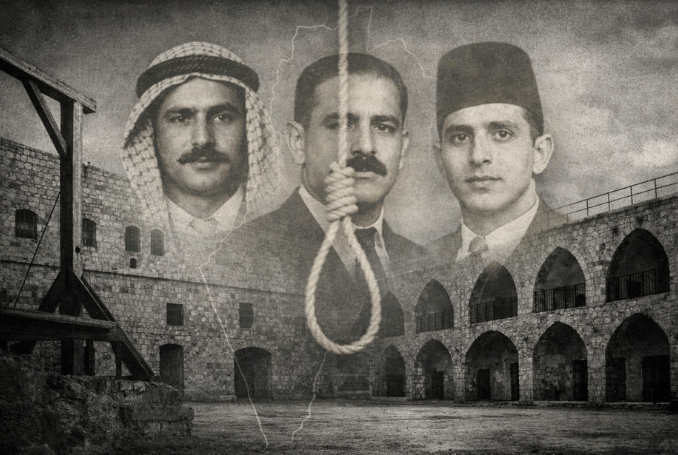
Israel is also confronted by something older than Israel itself: namely, the willingness and ability of the Palestinian people to mobilize and resist in the face of state-sanctioned death.
The authorities cuffed the nationalist detainees, leading them to their death at the gallows, scaffolding and rope that had borne witness to the final moments of dozens of nationalists like them. As they approached the noose with grace and a sacred conviction, they declared their final tribute to the beloved homeland: “Filasteen ‘Arabiyya!” (“Palestine is Arab”), and issued a final, unflinching indictment of her oppressors.
The families and communities of the martyrs gather outside Sijn Akka, dressed in white and adorned with henna as if they were attending a wedding, receiving the martyr’s body among eruptions of ululations and celebratory songs.
This is not a romantic tale, but rather the tradition adopted by Palestinians throughout the British Mandate for Palestine, a colonial regime that saw to the systematic annihilation of an entire generation of Palestinian nationalists.
The Spectacle of the Noose
While this scene played out on many occasions throughout the British Mandate for Palestine, it could conceivably happen tomorrow, as Israel’s Minister of National Security Itamar Ben Gvir’s death penalty bill has been approved by the Israeli Knesset and passed into law. The death penalty law — an amendment to the current Israeli penal code – will result in the execution of those who have allegedly killed Israelis for nationalist purposes (or, more reductively and disingenuously, for “anti-Semitic” reasons).
Further, recent reports have confirmed that the Knesset’s approved legislation will no longer perform the death penalty via lethal injection but rather transform the execution of Palestinian detainees into a colonial spectacle. In other words, the original mode of colonial execution has been restored as the chosen method of capital punishment par excellence.
Now approved, hanging will once more become a colonial spectacle, which is enacted, in the sterile and removed wording of the National Security Committee, with the aim of “cut[ting] off terrorism at its root and creat(ing) a heavy deterrent.”
It is critical that, as we discuss this ‘new’ policy, we recognize that the extrajudicial execution of prisoners has always been Israel Prison Service (IPS) policy.
Ben-Gvir had put forward his proposal, and the Knesset passed the bill into law, at a time (the period since October 7, 2023) when the Israeli authorities have murdered detainees at an unprecedented rate. In April 2023, the Palestinian Commission for Detainees and Ex-Detainees estimated 236 Palestinians had been killed in Israeli custody after 1967, a period of 56 years. In the post-October 7 period, in contrast, almost one hundred Palestinians have died in custody, a killing rate around 10 times the historical average.
A November 2025 report produced by Physicians for Human Rights Israel suggests that this may actually be a substantial under-estimate, by virtue of the (at least) 14,000 Gazans who are still missing, presumed to be dead or abducted at the time of writing.
In referring to “terrorism” and the deterrence it is attempting to manufacture, Israel aspires to the aimed incapacitation of the Palestinian national movement and associated military operations targeting the Zionist state. In this regard and others, Ben-Gvir is essentially proposing a reversion to British colonial practice.
If deterrence or heightened security for the settler is its goal, then history has proven capital punishment not just ineffective but even completely counterproductive, to the point of being incendiary.
Martyrs of the Gallows
And here it seems appropriate and even necessary to reflect on some of the most prominent victims of British capital punishment, including the ‘al-Buraq martyrs’, Mohammed Jamjoum, Ata al-Zeer, and Fuad Hijazi, executed by the British after participating in the Al-Buraq Uprising of 1929. Their names and legacies continue to be celebrated and invoked by Palestinians across the world. Another case was Izz al-Din’s companion, Sheikh Farhan Al-Sa’di, an 81-year-old revolutionary who, after being arrested for firearms possession, was executed on November 27, 1937, while fasting in observation of the sacred month of Ramadan.
They were among the 100–112 prisoners that the British officially executed in the Mandate (1922-1948). It has however been suggested that this is a substantial under-estimate, and that 300 prisoners (only two Jewish) were actually executed in this period.
However, this example is far from exclusive to the Palestine case, as the British meted out capital punishment far more extensively in other colonial contexts, yet still failed to alter the eagerness of the native populations to resist colonial domination. For example, in seeking to suppress the Mau Mau rebellion in Kenya’s war for independence (1952–1960), the British hanged at least 1,090 Kenyans dissenters, not to mention the (at least) 20,000 Kenyans killed in the broader counterinsurgency campaign. Yet, as in Palestine, the revolution continued, eventually culminating in independence.
The Failure of Deterrence
Like the British before them, the Israelis fail to recognize that the use of capital punishment has, in common with the escalation and intensification of colonial measures more generally, historically served to reinforce the Palestinian determination to resist. Nationalist activist and educator Akram Zaiter, in reflecting on Al-Sa’di’s execution, observed that ‘(e)veryone I met today was cursing the
English and praying for the martyr Farhan. The evening newspapers were filled with tributes to Farhan al-Saadi. The Mujahideen issued a statement swearing to avenge him….” And indeed, as Zaiter himself acknowledged, the execution inspired the establishment of a militant Palestine-based resistance organization that bore Al-Sa’di’s name (“The Brothers of Farhan”).
Sheikh Farhan Al-Sa’di reportedly approached the gallows with a smile, declaring: “Welcome to meeting Allah..Ya Allah, make my martyrdom a joy for my nation!”
Many decades later, on October 7, 2024, Abu Obeida, the late spokesman of the Al-Qassam Brigades (Hamas’ military wing), further reiterated the essential point when he said that: “If assassinations were a victory, the resistance against the occupation would have ended after the assassination of Sheikh Izz al-Din al-Qassam in the Ya’bad forests in Jenin ninety years ago.”
Abu Obeida went on to add that “this arrogant enemy does not understand history lessons. And neither the facts of reality nor the culture and heritage of our people and nation.” In even considering the use of capital punishment as a way of quelling popular resistance, Ben-Gvir and the National Security Committee demonstrate their profound ignorance of past historical experience, including the fact that capital punishment actually strengthened the Palestinian determination to resist.
While the policy developments coming out of Netanyahu’s genocidal regime are increasingly extreme and disturbing, and entirely merit the attention and outrage of the world, it should be remembered that the execution of Palestinian prisoners pre-dates Israel. The death penalty law, therefore, simultaneously both an escalation of the institutionalization of brutality and a natural reversion to Israel’s colonial roots. However, Israel is also confronted by something older than Israel itself: namely, the willingness and ability of the Palestinian people to mobilize and resist in the face of state-sanctioned death.

– Zarefah Baroud has a PhD from the University of Exeter’s European Centre for Palestine Studies (ECPS), awarded for research on applications of carcerality under colonial/settler-colonial formations in Palestine. Her work has been published in Al Jazeera, CounterPunch, Middle East Monitor (MEMO), Mondoweiss, The Palestine Chronicle, and other prominent media outlets.
“Palestine is Arab” and always will be in my mind. I am 73 years old this month and the more I learn of the centuries of inhumane treatment of others by colonial invaders, the more I understand why I never had children and prefer dogs as family. I am so weary of seeing what Zionistas are capable of after over two years of witnessing the massacre and cruelties in Gaza. But yet, here I am in a country who did exactly the same thing as celebrating hanging of forced slaves in the South. I am ashamed to be part of any country or group of so called humans who are complicit in these crimes.
Thank you, Jan, for your heartfelt words. I, too, am your age, and for long years have advocated as best I could from my faraway country against the Zionist-led Apartheid regime of Israel. I hope with all my heart that corrupted state will fail and fall before long. And all Palestinians will be free again on their beloved lands of Palestine. #AlwaysWasAlwaysWillBePalestinianLand
I am constantly astounded that as the slaughter of the Palestinian people continues, and as voices are raised in protest, nothing, nothing at all is being done to stop this. All political movement has been a charade and a farse to appease those voices and now they are silent. I am ashamed that my country sits and does nothing. This is criminal. Ezekial 3:17
Thank you for this article and everyone I read in Thinking Palestine. It expanded my awareness and added to the fabric of Palestinian history amassed over the past decades. I’m enriched and enlightened in layers, always in same direction of willing justice, truth and reconciliation wherever Palestinians reside, ultimate in tge recovery of their land, property, and rights.