
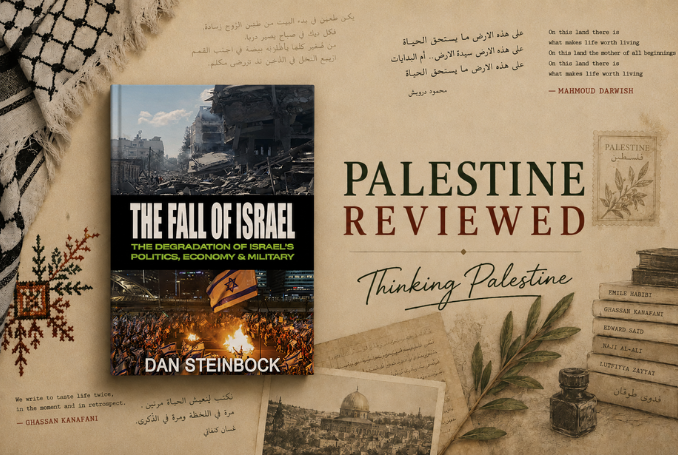
As the genocide in Gaza continues to reverberate across the Middle East and beyond, questions about Israel’s long-term political, economic, and military trajectory have become increasingly difficult to ignore. In The Fall of Israel, Dan Steinbock explores these questions through a wide-ranging study of the historical and structural forces shaping the conflict today.
At a Glance
Title: The Fall of Israel: The Degradation of Israel’s Politics, Economy & Military
Author: Dan Steinbock
Publisher: Clarity Press
ISBN: 9781963892000
Publication Date: 2025
Length: 520 pages
The Case for Reading It
A sweeping examination of the forces reshaping Israel and Palestine, the book argues that occupation, militarization, settlement expansion, and political extremism have produced a crisis that extends far beyond Gaza, with implications for the entire Middle East and the international order.
In Brief
Combining political history, military analysis, economic critique, and geopolitical forecasting, Dan Steinbock traces the historical roots of the Gaza genocidal war and argues that Israel’s current trajectory—marked by permanent occupation, deepening inequality, and far-right political transformation—is ultimately unsustainable.
Readers’ Guide
Why should I read this book?
Because it goes beyond the headlines to examine the deeper political, economic, and historical forces behind the current crisis. Readers seeking a comprehensive account of how Israel arrived at this moment—and what it may mean for the future of the region—will find a detailed and wide-ranging analysis.
Why is this book different?
Unlike many books that focus primarily on diplomacy, military events, or Palestinian history, ‘The Fall of Israel’ integrates political economy, military doctrine, technology, settlement expansion, domestic politics, and global geopolitics into a single framework. Steinbock examines not only the consequences of occupation for Palestinians but also its effects on Israeli society itself.
What are the most important themes in this book?
The book explores occupation and settler colonialism; the Nakba and historical displacement; Israeli political transformation; settlement expansion; militarization and surveillance technologies; economic inequality; apartheid and international law; American influence; the decline of US hegemony; and the emergence of a multipolar world order.
Meet the Author
Dan Steinbock
Dan Steinbock is an internationally recognized expert on global political economy, international business, and geopolitical change. He has written extensively on globalization, emerging markets, technological transformation, and international relations. In ‘The Fall of Israel’, Steinbock brings together decades of research in political economy and geopolitics to examine the historical evolution of Israel, the Gaza war, and the broader regional and global consequences of the Israeli-Palestinian conflict.
The Review
Dan Steinbock’s ‘The Fall of Israel: The Degradation of Israel’s Politics, Economy & Military’ is a deeply researched and highly insightful examination of the historical and contemporary forces driving the Israeli-Palestinian conflict toward a moment of systemic crisis. Spanning more than 500 pages, the book combines political history, military analysis, economic critique, and geopolitical forecasting into a sweeping interpretation of Israel’s evolution from a self-described democratic refuge into what Steinbock characterizes as an increasingly militarized, ethnonationalist, and internally fractured state.
The central argument is uncompromising: Israel’s current trajectory—shaped by decades of occupation, settlement expansion, ethnic displacement, growing religious extremism, neoliberal inequality, and dependence on US military power—is unsustainable. Steinbock contends that the catastrophe in Gaza following October 7, 2023, did not emerge suddenly or inexplicably, but rather represented the culmination of long-term structural forces embedded in the Zionist project and reinforced through regional and international alliances.
One of the book’s greatest strengths is its breadth. Steinbock traces the roots of the conflict back to the expulsions and displacements surrounding Israel’s founding, arguing that ethnic cleansing and territorial transfer were not accidental byproducts of war but foundational elements in the establishment and consolidation of the Israeli state. The opening chapters examine Plan Dalet, the Nakba, the destruction of Palestinian villages, and the continuing displacement of Palestinians across decades. While many of these arguments echo the work of the Israeli “New Historians” such as Ilan Pappé and Benny Morris, Steinbock synthesizes them into a broader framework linking historical expulsions to contemporary Gaza policies.
The analysis of Israeli settlements is especially detailed. Steinbock demonstrates how settlement expansion evolved from strategic buffer zones under Labor governments into ideologically driven projects tied to messianic nationalism and revisionist Zionism. He carefully documents the role of US-based funding networks, charities, and wealthy donors in sustaining settlement infrastructure and the far-right political ecosystem surrounding it. His treatment of the settlements as both a political and economic system—rather than merely a religious movement—is persuasive and illuminating.
The book is particularly compelling in its examination of the transformation of Israeli politics. Steinbock argues that the decline of Labor Zionism and the rise of revisionist and religious-nationalist currents fundamentally altered the nature of the Israeli state. The judicial reform crisis under Netanyahu was not merely a constitutional dispute but a symptom of a deeper struggle over whether Israel can remain simultaneously Jewish and democratic. His chapters on the rise of the far-right, the influence of American neoconservatism, and the growing power of ultra-Orthodox factions provide an important political context often missing from mainstream commentary.
As for the economic dimension of Israeli decline, The Fall of Israel challenges the common portrayal of Israel as an endlessly resilient “start-up nation,” arguing instead that beneath the success of the high-tech sector lie profound inequalities, demographic tensions, and fiscal vulnerabilities. Its discussion of brain drain, housing crises, neoliberal restructuring, and the economic burdens of perpetual militarization is among the strongest sections of the book. The argument that military dominance and technological sophistication have masked structural weaknesses within Israeli society is particularly insightful.
Another major contribution is the book’s treatment of militarization and technology. Steinbock explores Israel’s global role in surveillance technologies, drone warfare, cyberweapons, and AI-assisted targeting systems. The occupied territories are portrayed as laboratories for military experimentation, with technologies later exported worldwide. His discussion of doctrines such as the Dahiya Doctrine and the Hannibal Directive is unsettling but important, especially in the context of the destruction in Gaza. The author’s concept of “AIgocide”—the use of artificial intelligence in industrial-scale targeting—raises urgent ethical questions about the future of warfare.
Steinbock devotes substantial sections to elaborating charges against Israel of apartheid, ethnic cleansing, and genocide. legally and historically, drawing comparisons with South Africa and citing international legal proceedings, including the South African genocide case at the International Court of Justice.
Although Steinbock condemns the October 7 attacks, the overall balance of the book is unmistakably aligned with a structural critique of Zionism and American hegemony. While readers seeking a more centrist analysis may find the narrative one-sided, even critics are likely to acknowledge its extraordinary depth of research. The book is densely documented, packed with historical detail, statistical data, geopolitical analysis, and references to international law. Steinbock demonstrates a remarkable command of political economy and international relations, connecting Israeli developments to larger transformations in global power structures, including the decline of US hegemony and the rise of multipolarity. His discussion of China’s diplomatic role in the Middle East and the emergence of the Global South introduces a broader geopolitical framework often absent in narrowly regional studies.
The writing style is forceful and accessible despite the book’s academic density. Steinbock avoids excessive jargon and structures the material clearly, moving from history and ideology to economics, military affairs, and future scenarios. The extensive charts, figures, and maps strengthen the analysis considerably.
Perhaps the book’s most important contribution lies in its insistence that the Gaza catastrophe cannot be understood in isolation. Steinbock repeatedly emphasizes that October 7 and its aftermath emerged from decades of failed diplomacy, occupation, militarization, and international complicity. He forces readers to confront the historical continuities linking past expulsions, settlement policies, regional interventions, and present-day devastation.
In the end, ‘The Fall of Israel’ is not a neutral chronicle; it is an intervention. Steinbock is openly attempting to reshape how readers understand Israel, Palestine, and the broader Middle East order. The book will undoubtedly provoke fierce disagreement, especially among readers committed to traditional Zionist narratives or US-Israeli strategic assumptions. Yet its combination of historical synthesis, geopolitical analysis, and moral urgency makes it difficult to ignore.
For readers interested in contemporary Middle Eastern politics, international law, political economy, or the future of the Israeli-Palestinian conflict, this is an important and challenging work, forcing readers to recognize the seriousness of the questions it raises: Can Israel sustain permanent occupation and democratic legitimacy simultaneously? Can overwhelming military superiority guarantee long-term security? And can the region escape cycles of violence without fundamentally rethinking the political order established over the past century?
Steinbock’s answer is clear: without profound structural change, Israel’s current path leads not toward security or peace, but toward deeper isolation, internal fragmentation, and potentially catastrophic regional escalation.
(The text for this review was provided by Clarity Press and developed by Thinking Palestine Editors.)