
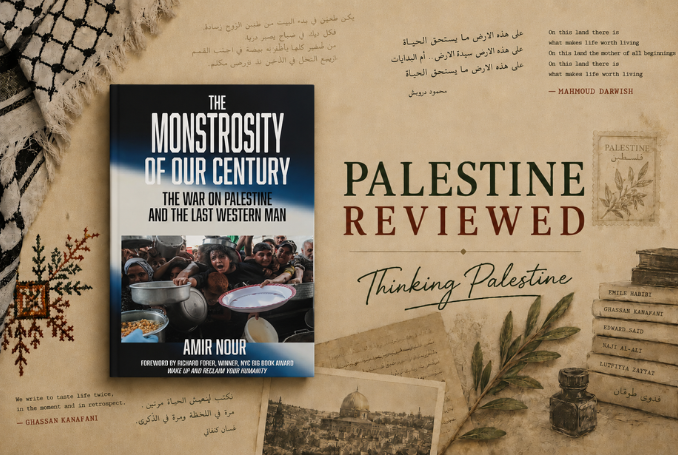
More than a book about Gaza, ‘The Monstrosity of Our Century’ is an examination of the political and moral order that made Gaza possible. Drawing on history, anti-colonial thought, and contemporary geopolitics, Amir Nour argues that Palestine has become a defining test of the modern international system.
At a Glance
Title: The Monstrosity of Our Century: The War on Palestine and the Last Western Man
Author: Amir Nour
Publisher: Clarity Press
Foreword: Richard Forer
ISBN: 9781963892284
Publication Date: 2026
Length: 272 pages
The Case for Reading It
A forceful anti-colonial critique that places Gaza at the center of wider debates about empire, international law, media narratives, and the future of the global order.
In Brief
Part historical analysis, part geopolitical critique, and part moral intervention, Amir Nour’s book argues that the destruction of Gaza reflects not only the realities of Israeli settler colonialism but also a deeper crisis within Western political thought, international institutions, and the contemporary liberal order.
Readers’ Guide
Why should I read this book?
Because it offers a sweeping examination of the Gaza genocide within the broader histories of colonialism, empire, and global power. Readers seeking to understand how Palestine intersects with questions of international law, media representation, and geopolitical change will find a wide-ranging and provocative analysis.
Why is this book different?
Unlike many books focused solely on the so-called Israeli-Palestinian conflict, Nour situates Gaza within a larger critique of Western hegemony and liberal internationalism. The book connects contemporary events to a century of colonial history while examining how media narratives, diplomatic discourse, and global power structures shape public understanding of Palestine.
What are the most important themes in this book?
The book explores settler colonialism, Zionism, Western imperialism, apartheid, international law, media representation, information warfare, anti-colonial resistance, the crisis of liberal internationalism, and the emergence of a multipolar world order. Throughout, Gaza is presented as a defining moral and political question of the twenty-first century.
Meet the Author
Amir Nour
Amir Nour is a writer and political commentator whose work focuses on Palestine, colonialism, international politics, and the shifting dynamics of the global order. Drawing on history, political theory, and anti-colonial scholarship, Nour examines the relationship between Western power, global inequality, and struggles for liberation. In ‘The Monstrosity of Our Century’, he brings these themes together in a sustained critique of the political and ideological structures that, in his view, have enabled decades of Palestinian dispossession and violence.
The Review
‘The Monstrosity of Our Century: The War on Palestine and the Last Western Man’ by Amir Nour is an impassioned and intellectually ambitious indictment of Western power, Israeli settler colonialism, and the moral contradictions of the contemporary international order. Part historical analysis, part geopolitical critique, and part civilizational meditation, with its primary title echoing the words of UN Special Rapporteur Francesca Albanese, the book seeks to explain not only the catastrophe unfolding in Gaza after October 7, 2023, but also the broader political, ideological, and historical structures that made it possible.
At its core, Nour’s argument is stark: the destruction in Gaza is not an aberration, nor merely another tragic cycle of violence in the Israeli-Palestinian conflict. Rather, it represents the culmination of a century-long colonial project sustained by Western military, diplomatic, ideological, and media support. The “monstrosity” of the title refers not only to the violence inflicted upon Palestinians, but to what Nour sees as the collapse of moral consistency within Western liberal civilization itself.
Nour’s introduction, ‘The Insanity of Western Political Discourse’, lays out the intellectual architecture of the work. Borrowing from Samuel Huntington’s critique of Western universalism, Nour argues that Western governments have consistently approached the Palestinian issue through hypocrisy, double standards, and geopolitical self-interest. He contends that Western powers invoke international law selectively, championing human rights in some contexts while enabling violations in others when strategic interests are involved. In this framework, Gaza becomes emblematic of a broader crisis of legitimacy facing the U.S.-led liberal order.
One of the book’s strongest qualities is its integration of historical narrative with contemporary political analysis. Nour situates the present war within a long genealogy extending from European colonialism and the Balfour Declaration through the Nakba, the occupation, Oslo, repeated assaults on Gaza, and the rise of Hamas. He insists repeatedly that October 7 cannot be understood in isolation from decades of occupation, siege, displacement, and failed diplomacy. This historical contextualization is central to the book’s argument and reflects a broader effort to challenge narratives that frame Palestinian violence as ahistorical or irrational.
Nour’s treatment of Western discourse surrounding Israel and Palestine is particularly compelling. He argues that mainstream political and media narratives systematically erase historical context while reducing the conflict to questions of Israeli “self-defense” and Palestinian “terrorism.” In this regard, the book’s discussion of the reaction to UN Secretary-General António Guterres’s remarks about the occupation not occurring “in a vacuum” is especially revealing. Nour interprets the intense backlash against Guterres as evidence that historical contextualization itself has become politically threatening to defenders of the status quo.
The chapter “Before the Flood: From the Nakba to an Apartheid State” is among the most substantial sections of the book. Here, Nour traces the evolution of Israeli policy from occupation to what he, following figures such as Jimmy Carter and Gideon Levy, explicitly characterizes as apartheid. He combines references to Israeli dissidents, Western critics of Zionism, UN reports, and Palestinian testimony to construct a narrative of systematic dispossession and racial hierarchy. His use of Jewish and Israeli critics of Israeli policy—including Gideon Levy, Ilan Pappé, and others—strengthens the credibility of his critique by demonstrating that opposition to Israeli policy is not reducible to antisemitism.
The book is also notable for its global geopolitical perspective. Nour does not treat Palestine as an isolated regional issue; instead, he situates it within the decline of Western hegemony and the emergence of a multipolar world order. He repeatedly argues that Gaza has accelerated the erosion of Western moral authority, especially in the Global South, where many perceive glaring double standards between Western responses to Ukraine and Palestine. This theme gives the book a significance extending beyond Middle Eastern politics.
Another major contribution is Nour’s discussion of information warfare and media control. He argues that social media has disrupted the traditional dominance of Western mainstream media narratives, allowing younger generations to witness events in Gaza directly and organize opposition to Israeli policy. The sections examining student protests, generational shifts, and digital activism are particularly timely, portraying Gaza as a catalyst for political realignment among younger Western audiences.
Stylistically, Nour writes with considerable rhetorical force. His prose is often sweeping, passionate, and polemical, blending historical analysis with philosophical reflection and political outrage. He draws from a wide range of sources, including political theory, journalism, diplomatic history, UN reports, and anti-colonial thought. This gives the book intellectual breadth.
The book’s tone is unmistakably accusatory toward the West. Nour portrays Western liberalism as increasingly hollow, arguing that its professed commitments to democracy, equality, and human rights collapse when confronted with Palestinian suffering. The phrase “Last Western Man” evokes not merely geopolitical decline, but a deeper spiritual and moral exhaustion within Western civilization itself of the self-proclaimed universal values symptomized by its unleashing mass violence against an entrapped and largely defenseless colonized people.
For readers sympathetic to anti-colonial and Global South critiques of Western power, the book will likely feel urgent, clarifying, and morally compelling. But then, the book does not pretend to be neutral. From the outset, Nour writes as a committed critic of Zionism, Western imperialism, and the structures of global domination that he believes sustain Palestinian dispossession. In that sense, the work belongs less to the tradition of detached academic analysis than to the tradition of anti-colonial political literature and activist intellectual history.
One of the book’s most provocative claims is that Gaza marks a historic turning point. Nour argues that the unprecedented visibility of Palestinian suffering, combined with global protest movements against it and shifts in world power, may signal the beginning of the end for both Israeli impunity and Western ideological dominance. The book persuasively captures the widespread perception that Gaza has fundamentally altered global political consciousness.
The emotional intensity of the book is considerable. Nour writes not merely to persuade intellectually but to awaken moral outrage. The recurring descriptions of destroyed hospitals, displaced civilians, siege conditions, and civilian casualties generate a sustained atmosphere of grief, anger, and civilizational crisis. At times the rhetoric borders on apocalyptic, but this appears entirely deliberate: the book seeks to shock readers out of what Nour sees as normalized indifference.
Importantly, the book also reflects a distinctly postcolonial intellectual sensibility. Nour repeatedly frames Palestine as part of a broader historical struggle against empire, racial hierarchy, and global inequality. In this sense, the Palestinian cause becomes symbolic of larger questions concerning sovereignty, dignity, historical memory, and resistance to domination.
Ultimately, ‘The Monstrosity of Our Century’ is a forceful, uncompromising, and highly political work. It is not designed to mediate between competing narratives or provide balanced diplomatic analysis. Rather, it seeks to document what Nour views as a profound historical injustice and to expose the ideological structures that sustain it.
Readers seeking a rigorous anti-colonial critique of Israel, Western foreign policy, and the contemporary global order will find it intellectually rich and emotionally powerful. Whether one agrees with all of Nour’s conclusions or not, the book succeeds in conveying the sense that Gaza is not simply another geopolitical crisis, but a defining moral and historical rupture whose consequences will extend far beyond Palestine itself.
(The text for this review was provided by Clarity Press and developed by Thinking Palestine Editors.)