
By Ron Jacobs
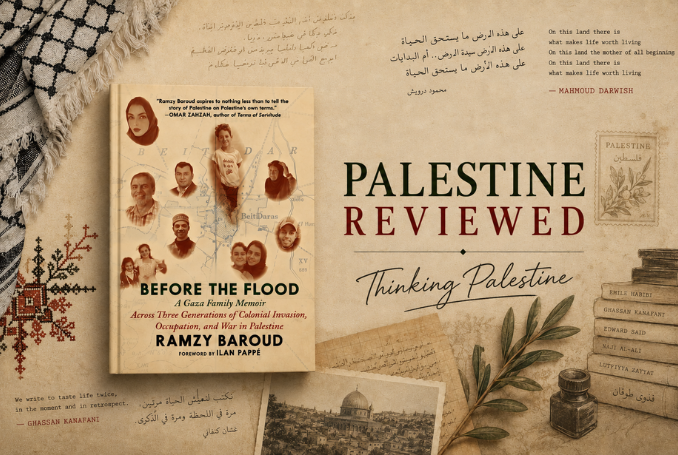
Through the story of one family, Ramzy Baroud recounts the story of Palestine itself. Spanning three generations, Before the Flood combines memoir, people’s history, and historical testimony to trace the enduring impact of dispossession, exile, war, and resistance on Palestinian life.
At a Glance
Title: Before the Flood: A Gaza Family Memoir Across Three Generations of Colonial Invasion, Occupation, and War in Palestine
Author: Ramzy Baroud
Foreword: Ilan Pappé
Publisher: Seven Stories PressISBN: 9781644215289
Publication Date: 2026
Length: 300 pages
The Case for Reading It
At a time when Palestinians are often discussed through the language of geopolitics, statistics, and war, ‘Before the Flood’ restores the human dimension of history. Through one family’s experiences, the book offers a powerful account of how colonial dispossession, exile, occupation, and war have shaped Palestinian lives across generations.
In Brief
Drawing on the experiences of the al-Badrasawi family, Ramzy Baroud traces a journey from life in the village of Beit Daras before the Nakba to the realities of refugeehood, occupation, and repeated wars in Gaza. Blending personal testimony with historical reflection, the book explores how memory, identity, and resistance endure despite decades of upheaval.
Readers’ Guide
Why should I read this book?
Because it offers a deeply personal entry point into Palestinian history. Rather than approaching Palestine through political leaders, diplomatic negotiations, or military campaigns, Baroud tells the story through the lives of ordinary people whose experiences illuminate the broader realities of displacement, survival, and resistance.
Why is this book different?
Unlike conventional histories of Palestine, Before the Flood is built around family memory and oral testimony. Historical events such as the Nakba, refugee exile, military occupation, and the genocidal war are not presented as distant political developments but as lived experiences passed from one generation to the next.
What are the most important themes in this book?
The book explores memory, exile, displacement, refugee life, intergenerational trauma, cultural preservation, resistance, belonging, and historical continuity. At its core is the question of how Palestinians have maintained their identity and connection to their homeland despite decades of colonization, war, and forced displacement.
Meet the Author
Ramzy Baroud
Ramzy Baroud is a Palestinian journalist, historian, author, and editor whose work has focused on recovering Palestinian voices and experiences often absent from conventional historical narratives. Born and raised in Gaza’s Nuseirat refugee camp, Baroud is the author of several books on Palestine, including My Father Was a Freedom Fighter, The Last Earth, and These Chains Will Be Broken. His writing combines people’s history, journalism, and historical analysis to center the experiences of ordinary Palestinians and challenge dominant narratives about Palestine and its people.
The Review
Ramzy Baroud, editor of the Palestine Chronicle, which has been the most reliable English-language news source regarding the conflict in Palestine since before October 7, 2023, and even more so since that date, writes history from the heart.
His stories of families (including his own) and their lives as refugees, freedom fighters, doctors, and more remind the reader that the political history of a people is ultimately the history of people.
In the case of people under fire, under occupation and under constant pressure to deny their culture and therefore their lives by colonial powers convinced that their oppression and repression will defeat those they oppress, Baroud’s words are in themselves weapons of the struggle. His most recent book, titled Before the Flood: A Gaza Family Memoir Across Three Generations of Colonial Invasion, Occupation, and War in Palestine, continues this tradition.
Baroud’s description of the first days and weeks of the genocide brings everything back: the horror, the anger, the frustration and hopelessness. One can feel the fear and despair, the disbelief, followed by a nagging voice in your head reminding you that this has always been the Zionists’ true vision and Washington’s secret hope—to decimate the Palestinian population, destroy the idea of a free Palestine and move on to the business of making the land that is Palestine into a colonialist utopia.
Then, the reader is taken back in time to the genesis of the story being told in these pages. It’s a tale of resistance to colonialism that moves from one generation to the next; one historical moment to the one that follows in the context of a world where the colonizers are primarily of European descent and distinctly related to a perception of the world to its south as something to be dominated.
Baroud’s text begins by locating its origins in Beit Daras, a town in Palestine that was overtaken and destroyed by Zionist militias during the Nakba. The reader is introduced to Madallah, a matriarch whose life is representative of the stories being told; whose abilities include being able to communicate that transcends this dimension. From that beginning, the reader finds themselves in refugee camps and on battlefronts; battlefronts which are all too often the places where people live, work, worship and celebrate.
The profiles Baroud constructs are of real people, people as real as the reader and their friends and family; the circumstances are considerably harsher and more tenuous because of the occupation and its enforcers. In his portrayal of these lives, one meets a young man who becomes a petty criminal and a young woman who dies a freedom fighter, killed by a future prime minister of the Israeli government. The conflict between the occupied and the occupier is not just the common thread that provides a context for all the people and events relayed by the author; it is a fact of life and a reason for living for many, if not most, of those who appear in these pages.
More than just a part of the setting of the history being told, the resistance is a living and genuine protagonist in Before the Flood. From the early battles in the 1930s before the Nakba and the never-ending struggle afterward, the reader finds instruction on the Intifadas, the wars between Tel Aviv and its neighbors, and the recent phase that became an internationally condemned genocide (that continues today hidden behind a fraudulent ceasefire).
Inside the resistance itself, one reads of class differences that have defined approaches taken by the organizations of the resistance—one ultimately favoring accommodation and potential surrender, the other accepting a history that makes it clear that colonizers do not relinquish the lands that they have conquered without a long and often violent struggle. Baroud’s depiction discusses the transition from a mostly secular liberation struggle to one with its foundations in what is ultimately a struggle informed by Islam that originated in the previously existing Muslim Brotherhood. The character of the resistance is a reflection of the Palestinians, from Arafat and Fatah to the PFLP to Hamas. Its continuation through generations is a testament to its necessity and the commitment of its supporters; it is also a reason for its changing tactics and internal struggles.
The current situation in Palestine may be its most difficult yet. The brazenly illegal and colonialist slaughter and destruction of Gaza led by Tel Aviv and Washington continues as it intensifies in the West Bank; the Nakba seems never-ending. Banks and corporations intent on theft and profiteering hover around Donald Trump and his Gaza designs like flies around manure, hoping for a piece of the real estate fantasy he and his son-in-law are hustling to the world.
Netanyahu and his government of homicidal sociopaths demand a world where all Palestinians are either dead or enslaved, living in medium-security prisons disguised as residential zones. Washington and Wall Street eagerly accommodate this desire, lining up investors and corporations whose pursuit of profits determines their morality.
Ramzy Baroud’s Before the Flood reminds us that humanity comes first; that it is this priority that, in the most fundamental way possible, is what drives the Palestinian resistance. It remains for us to remember and repeat this truth.
(The introductory material accompanying this review—including the book information, overview, and readers’ guide—was prepared by the Thinking Palestine editorial team.)
– Ron Jacobs is the author of several books, including Daydream Sunset: Sixties Counterculture in the Seventies published by CounterPunch Books. His latest book, titled Reality, Resistance, Rock and Roll is a collection of book reviews written for Counterpunch over the years and is now available.