
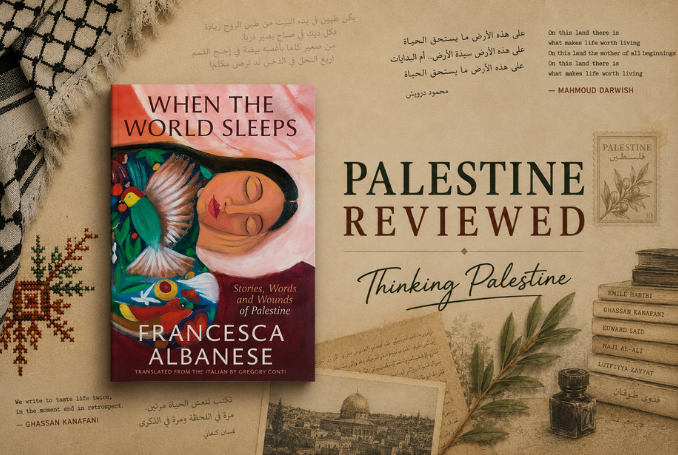
Originally published in Italian as Quando il Mondo Dorme by Feltrinelli, Francesca Albanese’s ‘When the World Sleeps’ brings one of the most influential voices on Palestine to an English-language audience. Through a series of deeply personal encounters, the UN Special Rapporteur explores the human stories, political realities, and moral questions that have shaped her understanding of Palestine and the international system’s failure to protect it.
At a Glance
Title: When the World Sleeps: Stories, Words, and Wounds of Palestine
Author: Francesca Albanese
Translator: Gregory Conti
Publisher: Other Press
ISBN: 9781635426038
Publication Date:2026
Length: 256 pages
The Case for Reading It
At a time when Gaza has become one of the most documented yet politically contested humanitarian catastrophes in modern history, Francesca Albanese offers something increasingly rare: moral clarity. Combining legal analysis, personal reflection, and human testimony, When the World Sleeps examines not only the realities of Palestinian life under occupation but also the international structures that have allowed injustice to persist.
In Brief
Originally published in Italy and now available in English translation, When the World Sleeps is neither a conventional political analysis nor a legal treatise. Instead, Albanese constructs a series of interconnected portraits—of children, artists, booksellers, activists, scholars, and survivors—through which she examines occupation, apartheid, displacement, resistance, and international complicity. The result is both a personal journey and a powerful reflection on the responsibilities of witnessing in an age of genocide.
Readers’ Guide
Why should I read this book?
Because it offers a deeply human entry point into one of the defining political and moral issues of our time. Rather than relying solely on legal arguments or political analysis, Albanese introduces readers to the people behind the headlines, transforming abstract debates into lived human experiences.
Why is this book different?
The book combines personal testimony, legal expertise, political analysis, and moral reflection. Albanese writes not only as a scholar of international law but also as a witness who has spent years listening to Palestinians living under occupation and siege. The result is a work that is simultaneously intimate and political, grounded in individual stories rather than abstract theory.
What are the most important themes in this book?
Occupation, apartheid, colonialism, international law, memory, resistance, cultural survival, trauma, solidarity, and institutional complicity. Throughout the book, Albanese examines how systems of power shape everyday lives while exploring the responsibilities of individuals, governments, and international institutions.
Meet the Author
Francesca Albanese
Francesca Albanese is an international lawyer, scholar, and human rights expert currently serving as the United Nations Special Rapporteur on the Occupied Palestinian Territory. Her work focuses on international law, forced displacement, colonialism, refugee rights, and Palestinian self-determination. Through her reports, public interventions, and scholarly work, she has become one of the most influential international voices documenting Israeli policies toward Palestinians and advocating for accountability under international law.
The Review
Francesca Albanese’s When the World Sleeps (originally published in Italian as Quando il Mondo Dorme) is not just another book on Palestine. It is a profound moral and intellectual intervention at a time when much of the world has chosen to look away from one of the most documented genocides in modern history. As the UN Special Rapporteur on the Occupied Palestinian Territories, Albanese has consistently refused to soften her language or dilute her analysis. This book stands as the culmination of that courage — a work that combines rigorous legal scholarship with deeply personal testimony, forcing readers to confront the human reality behind the statistics.
Structured around ten intimate and political portraits, each chapter revolves around a different individual whose life has shaped Albanese’s understanding of Palestine. These are not abstract case studies. They are windows into the human cost of a decades-long colonial project.
The book opens with the heartbreaking story of six-year-old Hind Rajab, killed by Israeli forces in January 2024 along with her family in Gaza. Albanese uses Hind’s tragedy as a devastating entry point into the reality faced by Palestinian children under occupation. She writes poignantly: “Hind was not collateral damage. She was the target. A six-year-old girl, trapped in a car, begging for help while the world watched and did nothing.” Through Hind, Albanese forces us to confront the moral weight of a system that treats Palestinian children as collateral damage — a generation born into violence, denied childhood, and too often denied life itself.
Subsequent chapters introduce readers to ordinary Palestinians whose resilience shines through unimaginable suffering. One powerful portrait follows Abu Hassan, a tour guide in Jerusalem, revealing the daily humiliations of life under occupation in East Jerusalem — the checkpoints, the constant surveillance, the bureaucratic cruelty designed to make life unbearable. Albanese captures the suffocating reality: “Every day is a negotiation with power — a checkpoint, a permit, a soldier’s whim. This is not life. This is managed existence.”
Another chapter centers on George, a bookstore owner, juxtaposing the vibrant but besieged Palestinian cultural life in East Jerusalem with the false normalcy of West Jerusalem. Albanese reflects: “Culture is resistance. Books are weapons when words are the only things they cannot fully take from you.” These stories humanize the statistics, showing how occupation infiltrates every aspect of daily existence — from movement to memory to simple acts of living.
Albanese also turns her lens toward remarkable Jewish voices who have influenced her thinking. She pays tribute to Eyal Weizman, the forensic architect whose work with Forensic Architecture has exposed Israeli state violence through spatial analysis, revealing how architecture itself becomes a tool of domination. Gabor Maté, the renowned trauma expert, helps Albanese understand the intergenerational wounds of both Palestinians and Israelis, offering profound insights into how trauma is transmitted across generations and how it shapes political behavior. And Alon Confino, the late Holocaust historian, challenges simplistic narratives and insists that the Palestinian case must be treated as a political issue to be resolved through international law, not reduced to a humanitarian crisis.
The book also features Palestinian artists and activists, such as Malak Mattar, whose artwork graces the cover and whose story illustrates the power of creative resistance under siege. Mattar’s journey from a child survivor of multiple wars to an internationally recognized artist becomes a testament to the indomitable Palestinian spirit. Albanese writes of her: “Art is how we refuse to disappear.”
What makes When the World Sleeps particularly devastating is Albanese’s refusal to let the international community off the hook. She documents not only Israeli violations — the apartheid system, the collective punishment, the deliberate destruction of life-sustaining infrastructure — but also the active and passive complicity of Western governments and institutions that have enabled this horror. Her critique of the United Nations itself, the very body she serves, is unflinching. She reveals an institution too often paralyzed by power politics, where the protection of the powerful consistently outweighs the defense of the oppressed. Albanese writes: “The UN was built to prevent the repetition of horrors like the Holocaust. Today, it stands by as another horror unfolds, paralyzed by the very powers that created it.”
Albanese writes with clarity, compassion, and intellectual precision. She does not shy away from the emotional weight of what she has witnessed — the pain of Palestinian mothers, the resilience of children in rubble, the quiet defiance of those who continue to resist. Yet she never allows emotion to replace rigorous legal reasoning. The book is both a personal journey and a political indictment. It forces the reader to confront a simple but devastating question: how long will the world continue to sleep while a genocide unfolds in real time?
In an era when speaking plainly about Israeli crimes can cost careers, reputations, and personal safety, Albanese’s steadfastness is remarkable. She has faced relentless smears, character assassinations, and even U.S. sanctions for simply doing her job. The fact that she continues — undeterred, precise, and morally grounded — makes her work all the more powerful. When the World Sleeps stands as both testimony and warning: silence in the face of genocide is not neutrality — it is complicity.
This is essential reading for anyone seeking to understand not only what is happening in Gaza, but why it has been allowed to happen for so long. Albanese strips away the propaganda, the legal sophistry, and the false equivalences. What remains is the naked face of settler-colonial violence and the moral failure of the international system that enables it.
In a time of carefully calibrated statements and performative concern, Francesca Albanese has chosen clarity over comfort. When the World Sleeps is a powerful reminder that the world may try to sleep, but books like this ensure that the truth refuses to stay buried. It deserves the widest possible readership — not only for what it reveals about Palestine, but for what it demands of all of us.
Read it. Share it. Let it disturb your sleep — because the world has slept for far too long.
(The introductory material accompanying this review—including the book information, overview, and readers’ guide—was prepared by the Thinking Palestine editorial team.)
– Michael Leonardi is an Italy-based journalist. Leonardi is the vice president of the Treewater Initiative, a non-profit dedicated to building sustainability in a Free Palestine for over a decade.