
By Seven Stories Press & TP Editors
Long before Palestine became a fixture of today’s political debates, its poets were writing some of the most powerful literature of resistance in the world. ‘Enemy of the Sun’ returns a landmark anthology to a new generation, tracing the connections between Palestinian liberation and global struggles against racism, colonialism, and oppression.
At a Glance
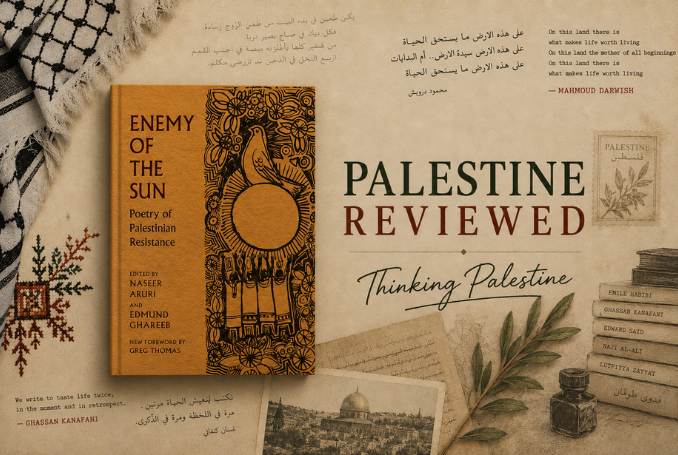
Title: Enemy of the Sun: Poetry of Palestinian Resistance
Editors: Naseer Aruri and Edmund Ghareeb
Foreword: Greg Thomas
Publisher: Seven Stories Press
ISBN: 9781644214558
Publication Date: September 16, 2025
Length: 272 pages
The Case for Reading It
More than fifty years after its original publication in 1970, Enemy of the Sun remains a reminder that Palestinian resistance has always been cultural as well as political. The anthology captures a generation of poets who transformed dispossession, imprisonment, exile, and struggle into a body of literature that continues to resonate far beyond Palestine.
In Brief
First published in 1970, Enemy of the Sun brings together twelve Palestinian poets whose work bears witness to occupation, displacement, imprisonment, and resistance. This updated edition introduces the anthology to contemporary readers while highlighting the enduring relationship between Palestinian liberation and broader struggles for justice around the world.
Readers’ Guide
Why should I read this book?
Because it offers a rare opportunity to encounter Palestinian resistance through poetry rather than political analysis. These poems reveal how ordinary experiences—love, grief, longing, memory, and hope—become inseparable from the struggle for freedom.
Why is this book different?
Part of what makes Enemy of the Sun remarkable is its history. The anthology circulated among activists and liberation movements far beyond Palestine. One of its poems, Sameeh Al-Qassem’s ‘Enemy of the Sun’, was famously found among the books of Black revolutionary George Jackson after he was killed in San Quentin prison, becoming part of a larger story of international solidarity among oppressed peoples.
What are the most important themes in this book?
Exile, imprisonment, homeland, memory, dignity, resistance, survival, solidarity, liberation, and belonging. Throughout the collection, personal experiences are inseparable from collective struggle, creating a body of poetry that is both deeply intimate and profoundly political.
Meet the Editors
Naseer Aruri
Naseer Aruri (1934–2015) was a Palestinian-American scholar, author, and advocate whose work focused on Palestine, international law, and Middle Eastern politics. He played an important role in introducing Palestinian perspectives to English-language audiences and was among the leading Palestinian intellectuals of his generation.
Edmund Ghareeb
Edmund Ghareeb is a Lebanese-American scholar, author, and translator specializing in Middle Eastern politics, media, and culture. His work has helped bring Arabic literature, political thought, and contemporary Palestinian writing to wider audiences.
The Review
Some books survive because they capture a particular historical moment. Others survive because they continue speaking long after that moment has passed. More than half a century after its original publication, ‘Enemy of the Sun’ belongs firmly in the second category.
First published in 1970 by Drum & Spear Press—the publishing arm of the Student Nonviolent Coordinating Committee (SNCC)—the anthology emerged during an era shaped by anti-colonial revolutions, civil rights struggles, Black liberation movements, and resistance to imperial war. Palestine was part of that global conversation, and the poets gathered in this collection understood their struggle as connected to wider battles for freedom unfolding across Africa, Asia, Latin America, and the United States.
That history gives the anthology a distinctive power. Reading these poems today feels less like entering a literary archive than reconnecting with a conversation that never truly ended. The questions that animate the collection—displacement, liberation, identity, dignity, and resistance—remain painfully relevant.
The story behind the anthology’s title captures this continuity particularly well. In 1971, after the killing of Black revolutionary George Jackson inside San Quentin prison, a handwritten copy of Sameeh Al-Qassem’s poem ‘Enemy of the Sun’ was discovered among his belongings. The poem subsequently circulated through Black Panther publications and activist networks, becoming part of a larger tradition of solidarity between Palestinian and Black liberation struggles. Whether intentionally or not, the anthology became a bridge between movements separated by geography but connected through shared experiences of oppression and resistance.
The poems themselves possess remarkable range. They speak of exile and homeland, of prison cells and refugee camps, of grief and longing. Yet they are never defined solely by suffering. Running through the collection is an insistence on life itself: on beauty, love, memory, humor, and the stubborn refusal to surrender humanity under conditions designed to extinguish it.
What emerges most clearly is a literature rooted in collective experience. These poets are writing about themselves, but they are also writing about a people. Personal memory becomes national memory. Individual loss becomes part of a larger historical record. The result is poetry that operates simultaneously as artistic expression, historical testimony, and political intervention.
The anthology also demonstrates the central role of culture within Palestinian resistance. Long before social media, international campaigns, or contemporary debates over representation, Palestinian poets were preserving memory, challenging erasure, and articulating visions of liberation through literature. The poems remind readers that resistance is not only fought on battlefields or negotiated in diplomatic halls; it is also sustained through language, imagination, and storytelling.
What makes the collection especially valuable today is its ability to place contemporary events within a longer historical continuum. Readers encountering Palestine primarily through recent headlines will discover that many of the themes dominating current discussions—displacement, imprisonment, collective punishment, exile, and resilience—have occupied Palestinian writers for generations.
The updated edition further reinforces this relevance through new translations by Edmund Ghareeb and a new foreword by Greg Thomas. Together they help situate the anthology for contemporary audiences while preserving the spirit that made the original collection so influential.
Perhaps the greatest achievement of Enemy of the Sun is that it refuses simplification. These poems contain anger, but also tenderness. They contain political commitment, but also profound emotional complexity. They mourn what has been lost while insisting on the possibility of a different future.
Ultimately, Enemy of the Sun is not simply a collection of poems. It is a record of endurance, a testament to solidarity, and a reminder that literature often carries histories that official narratives seek to erase. More than fifty years after its first appearance, its voice remains urgent, uncompromising, and alive.
(The text for this review was provided by Seven Stories Press and developed by Thinking Palestine Editors.)