
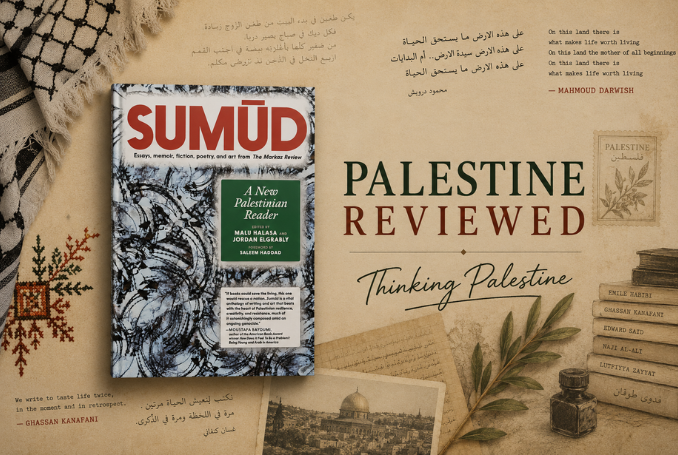
By Seven Stories Press & TP Editors
More than a literary anthology, ‘Sumūd’ is a testament to the enduring power of Palestinian culture. Bringing together writers, poets, artists, scholars, and witnesses from across generations, the collection explores how creativity, memory, and storytelling have become essential forms of resistance.
At a Glance
Title: Sumūd: A New Palestinian Reader
Editors: Malu Halasa and Jordan Elgrably
Publisher: Seven Stories Press
ISBN: 9781644213780
Publication Date: 2024
Length: 320 pages
Illustrations: 25 black-and-white illustrations by Palestinian artists
Contributors: 46 writers, artists, scholars, poets, and cultural figures
The Case for Reading It
‘Sumūd’ reminds readers that culture itself is a site of resistance. Through literature, art, criticism, memoir, and poetry, the anthology demonstrates how Palestinians continue to assert their humanity, identity, and aspirations despite decades of displacement, occupation, and war.
In Brief
Spanning the twentieth and twenty-first centuries, ‘Sumūd’ brings together essays, short stories, memoir, poetry, personal narratives, book reviews, and visual art that reflect the richness of Palestinian cultural life. The collection highlights both established voices and emerging writers, with particular attention to work produced during and after the events of 2021–2024.
Readers’ Guide
Why should I read this book?
Because it offers a broad introduction to contemporary Palestinian thought, literature, and cultural expression. Rather than focusing solely on politics or history, the anthology explores how Palestinians understand themselves, their struggles, and their future through art, storytelling, and intellectual engagement.
Why is this book different?
‘Sumūd’ places culture at the center of Palestinian resistance. It combines multiple genres—including memoir, fiction, criticism, poetry, journalism, and visual art—to create a multidimensional portrait of Palestinian life and creativity.
What are the most important themes in this book?
The anthology explores steadfastness (sumūd), cultural resistance, memory, exile, identity, language, occupation, war, artistic expression, historical continuity, and collective survival. Across its diverse contributions, the collection examines how Palestinians preserve dignity and agency under conditions of ongoing dispossession.
Who are the book contributors?
The anthology features forty-six contributors from across the Palestinian cultural, literary, and intellectual landscape. Among them are:
Hossam Madhoun – playwright and co-founder of Gaza’s Theatre for Everybody
Ahmed Masoud – novelist and playwright
Sara Roy – scholar of Gaza and political economist
Ivar Ekeland – mathematician and public intellectual
Ilan Pappé – historian
Lina Mounzer – essayist and cultural critic
Alongside a wide range of poets, artists, journalists, scholars, and writers representing different generations and perspectives within Palestinian cultural life.
Meet the Editors
Malu Halasa
Malu Halasa is a writer, editor, and journalist whose work focuses on the Middle East, literature, art, and culture. She has edited numerous anthologies and books exploring contemporary Arab thought, creative expression, and political change, and has long been involved in documenting cultural production from the region.
Jordan Elgrably
Jordan Elgrably is a writer, editor, and cultural organizer based in Los Angeles. He is the founder of the Markaz Review and has worked extensively to promote literature, journalism, and cultural dialogue across the Middle East, North Africa, and the broader Mediterranean world.
The Review
The Arabic word Sumūd is often translated as ‘steadfastness’, but its meaning extends beyond simple endurance. It encompasses a way of living, a determination to remain rooted despite displacement, and a refusal to surrender identity in the face of occupation and erasure. It is this idea that forms the foundation of ‘Sumūd: A New Palestinian Reader’, an ambitious anthology that brings together dozens of Palestinian and international voices to explore the relationship between culture and resistance.
Edited by Malu Halasa and Jordan Elgrably, the collection spans more than a century of Palestinian cultural production while placing particular emphasis on writing produced between 2021 and 2024. The result is neither a conventional literary anthology nor a purely political reader. Instead, it occupies a space between literature, history, journalism, criticism, and art, demonstrating how these forms often intersect within Palestinian experience.
One of the anthology’s greatest strengths is its diversity of voices. The contributors include novelists, poets, historians, playwrights, scholars, journalists, artists, and cultural critics. Some pieces emerge directly from Gaza during wartime. Others reflect on decades of displacement, intellectual struggle, and artistic production. Together, they create a mosaic that captures both the richness and complexity of Palestinian life.
The collection’s treatment of culture as a form of resistance is particularly compelling. Rather than presenting resistance solely through the language of politics or armed struggle, ‘Sumūd’ highlights the ways in which storytelling, artistic creation, memory, and intellectual work become acts of survival. The preservation of language, history, and cultural identity emerges as a central theme throughout the volume.
Among the anthology’s most powerful contributions are the dispatches of Hossam Madhoun, co-founder of Gaza’s Theatre for Everybody, who documents life during Israel’s genocide in Gaza starting October 2023. These writings provide readers with an immediate and deeply personal account of survival under extraordinary circumstances. Their inclusion reinforces one of the anthology’s central arguments: that cultural production does not cease during catastrophe but often becomes even more essential.
The collection also demonstrates the remarkable range of contemporary Palestinian writing. Ahmed Masoud’s dystopian short story ‘Application 39’ offers a speculative vision of the future while engaging questions of power, exclusion, and political imagination. Sara Roy and Ivar Ekeland examine the structures that have shaped Gaza’s isolation, while Lina Mounzer interrogates the language used to dehumanize Palestinians in public discourse. Together, these contributions reveal the breadth of intellectual and artistic approaches represented in the anthology.
Poetry occupies a particularly important place within the collection. The anthology highlights a new generation of Palestinian poets working in the shadow of Mahmoud Darwish’s immense legacy. Rather than merely imitating earlier traditions, these writers expand and reinterpret them, demonstrating the continued vitality of Palestinian literary culture.
The inclusion of visual art further enriches the volume. Twenty-five black-and-white illustrations by Palestinian artists remind readers that cultural expression extends beyond the written word. The artwork functions not simply as accompaniment but as an integral part of the anthology’s broader exploration of memory, identity, and resistance.
A recurring theme throughout ‘Sumūd’ is the struggle over narrative itself. Many contributors challenge representations of Palestinians that reduce them to victims, statistics, or political abstractions. Instead, they insist on complexity, individuality, and humanity. The anthology repeatedly returns to the idea that controlling one’s own story is a form of self-determination.
Importantly, the collection balances urgency with historical depth. While many contributions respond directly to contemporary events, the anthology also situates these experiences within a longer history of dispossession, resistance, and cultural production. Readers encounter not only the immediacy of the present moment but also the historical continuity that informs it.
Perhaps the anthology’s greatest achievement is its refusal to separate culture from politics while also refusing to reduce culture to politics. Literature, art, criticism, and personal testimony are presented as essential dimensions of Palestinian life rather than secondary concerns. In doing so, ‘Sumūd’ offers a richer understanding of what resistance means and how it is practiced in everyday life.
Ultimately, ‘Sumūd: A New Palestinian Reader’ is both a literary collection and a cultural statement. It serves as an introduction to contemporary Palestinian writing, a record of a people confronting extraordinary challenges, and a powerful affirmation of the enduring role of culture in sustaining identity, dignity, and hope. For readers seeking to understand Palestine beyond headlines and political rhetoric, this anthology provides an invaluable point of entry.
(The text for this review was provided by Seven Stories Press and developed by Thinking Palestine Editors.)