
By Annie O’Gara
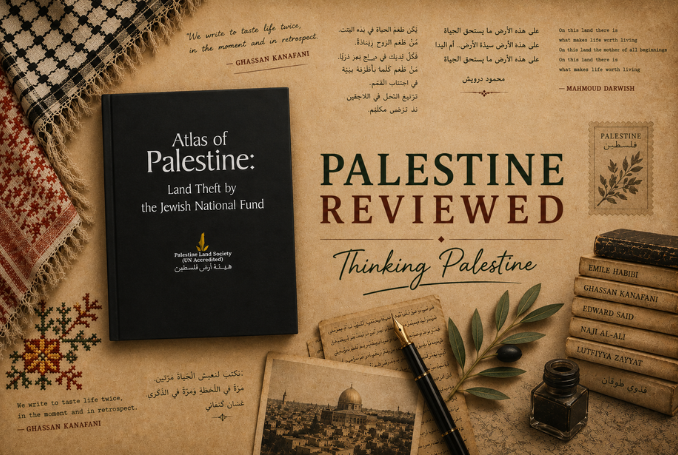
Maps are often presented as neutral instruments of geography. Yet for colonized peoples, maps can also become tools of dispossession, erasure, and control. In Atlas of Palestine: Land Theft by the Jewish National Fund, Salman Abu Sitta reverses that process, restoring erased villages to the map and documenting one of the most systematic projects of land confiscation in modern history.
At a Glance
Title: Atlas of Palestine: Land Theft by the Jewish National Fund
Author: Salman Abu Sitta
Publisher: Palestine Land Society
ISBN: 9780954903480
Publication Date: 2024
Length: 450 pages
The Case for Reading It
Every colonial project depends on controlling not only land but also memory. By documenting the villages buried beneath JNF parks and forests, Abu Sitta transforms cartography into an act of historical recovery, exposing the mechanisms through which dispossession was legitimized and preserving evidence for future generations.
In Brief
Building on his pioneering work mapping Palestine before and after the Nakba, Salman Abu Sitta examines the lands transferred to the Jewish National Fund following the mass displacement of Palestinians in 1948. Through detailed maps, archival research, and village-by-village documentation, the Atlas identifies the Palestinian communities whose lands were confiscated, traces the mechanisms through which ownership was transferred, and records the enduring connection between refugees and their homeland.
Readers’ Guide
Why should I read this book?
Because it provides one of the most comprehensive visual records of Palestinian dispossession available today. The Atlas allows readers to move beyond general discussions of the Nakba and examine, in extraordinary detail, how specific villages, lands, families, and communities were affected by displacement and land confiscation.
Why is this book different?
Unlike most historical studies, Abu Sitta places maps at the center of the narrative. The Atlas combines cartography, archival research, land records, demographic information, and refugee testimony to reconstruct landscapes that have often been physically erased. It is simultaneously a historical work, a legal document, a research tool, and an act of resistance against historical erasure.
What are the most important themes in this book?
Land ownership, the Nakba, forced displacement, cartography, memory, colonialism, historical erasure, refugee rights, the Right of Return, environmental narratives, and the politics of naming. Throughout the Atlas, Abu Sitta demonstrates how maps themselves can become instruments of both dispossession and liberation.
Meet the Author
Hanan Kattan
Salman Abu Sitta is one of the foremost Palestinian historians, cartographers, and researchers of the Nakba and the Palestinian Right of Return. Born in Beersheba in 1937 and displaced during the Nakba, he has spent decades documenting Palestinian geography, land ownership, refugee displacement, and village histories. He is the founder and president of the Palestine Land Society and the author of numerous landmark studies, including the acclaimed Atlas of Palestine series. His work has become indispensable for scholars, activists, and refugees seeking to preserve and recover Palestinian historical memory.
The Review
Dr. Salman Abu Sitta is a magisterial figure in the Palestinian cause, not least because his life’s work illustrates the fact that resistance to Zionism takes many forms.
Arguably among his greatest works are the Atlases of Palestine. Two Atlases, ‘Atlas of Palestine, 1871- 1877 ‘ and ‘Atlas of Palestine 1917-1967 ’, map Palestine before the inception of the Zionist project to ethnically cleanse that land and trace changes after the Nakba up to the Naksa. Most importantly, villages, towns and cities are placed geographically, are given their correct Arabic name, and restored to their rightful position on the land of Palestine.
More recently, the ‘Atlas of Palestine: Land Theft by the Jewish National Fund’ raises the central issues of agency (who stole that land and how did the JNF come to “own” it?) and rightful possession (which villages do those lands belong to, who lived there, and where are the scattered owners now?)
This Atlas will be of special relevance to Palestinian refugees displaced from the 372 villages whose land was allocated to the JNF/KKL in a fictitious land “sale” and subsequently covered in parks and forests, hiding demolished villages and preventing any return. For Palestinians, the names of their villages are resurrected and recorded on the map.
The myriad devices used in the early years of the state of Israel to “legitimize” what was plainly illegitimate are charted in this Atlas with great clarity. Illuminating templates accompany the map of each JNF park, delving into detail: its territorial imposition on Palestinian land, how much land of each affected village was stolen, some of the names of large families, and which refugee camps many of them now inhabit.
Were Dr Abu Sitta a forensic scientist, this Atlas would be a record of JNF crime scenes and of the victims of those crimes, the Palestinian Refugees; of course, as long as the parks continue to exist, they signify ongoing crimes, the thieves still profiting from their loot. The Israeli state has gone to enormous lengths, in particular through JNF greenwashing, to cover up the crime that lies at the heart of the foundation of the state, a crime which constitutes the most fundamental challenge to its founding myth, namely that Palestine was an empty or neglected land.
These maps are a tool for Palestinians to use at some point to reclaim their patrimony. For non-Palestinians, the maps of JNF parks from which some friends and comrades were expelled offer much: captivating detail, the musicality of the Arabic names of the villages, admiration for meticulous forensic detail and not least the very act of naming stolen identities – a form of political resistance of greater significance than might at first be apparent.
Western societies tend to see cartography as a precise, scientific and politically neutral act of correctly charting a land’s contours, rivers, mountains, plains, roads and, of course, place names to find one’s way. But a colonized people know that map-making (like historiography) can be anything but a neutral act, in particular, when the native language is supplanted by that of the colonizer, as in Palestine and Ireland.
Dr. Salman’s latest work triggered many thoughts for this writer on the bonds between Ireland and Palestine. In 1883, Lord Salisbury said that “the most disagreeable part of the three kingdoms is Ireland and therefore Ireland has a splendid map.” The Spring Rice Report of 1824 had given rise to this “splendid” map by identifying the need for a “general survey of Ireland” which would be “proof of the disposition of the legislature to adopt all measures calculated to advance the interests of Ireland.” Carried out by the Royal Engineers, the mapping exercise has not been perceived by everyone as such a benign exercise.
In 1980, at the height of the Troubles, the political significance of the mapping of Ireland by the colonial power was dramatized memorably by the Field Day Theatre Company in Brian Friel’s play “Translations.” The play is fictive, but uses the 19th-century mapping of Ireland by the English crown as a launch pad to explore issues related to colonization: cultural dispossession, land, identity and, of course, language, the vehicle of power which secures the ascendancy of the colonizer over the colonized: “Language has always been the perfect instrument of Empire.”
The mapping of Ireland involved standardizing or regularizing the naming of places by the translation or transliteration of Gaelic names into English. A central character in the play, a local man involved in the process, Owen, describes his job as to “translate the quaint archaic tongue you people persist in speaking into the King’s good English.” Thus, in the play, we see many examples of the deracination of place names through this process of anglicization: Bun na hAbhann becomes Burnfoot and Baile Beag becomes Bally Beg.
The process, as dramatized by Friel, involves a metaphorical erasure of memory and tradition, neatly encapsulated in one anecdote, that of Tobair Vree (“tobair” is Gaelic for a well). Characters discuss the word “Vree”; what does it mean? “Vree,” one of them explains, is a corruption over time of Bhriain (Brian), so the original name meant “Brian’s Well”.
But the name is attached to a crossroads, not a well; the puzzle deepens. Intergenerational oral history supplies the answer to the riddle. Decades before, an elderly local man, the eponymous Brhiain, suffered from a disfiguring facial growth which he believed might be cured by the magical waters of the then-existing well. Daily bathing did not cure him, but he tragically drowned in the same well – hence the name.
Friel’s point is clear: names are more than denotational; they are preservatives of memory and, as such, their surface irregularity means nothing; they hold a deeper significance and potency. The act of supplanting a Gaelic name with an anglicized transliteration or translation is “an eviction of sorts,” an act of cultural imperialism, erasing local history and identity and replacing it with a new, imposed reality.
Dr Salman’s latest Atlas strikes another blow at the cultural tyranny of Israel’s mapping of Palestine. His assertion of the true names of Palestinian towns and villages, his insistence that JNF Parks and Forests are a shadowy (but massively damaging) overlay on the authentic Arabic identity of Palestine, their borders demarcating the extent of their theft, is of great significance to Palestinians. It is also a gift to all colonized peoples who need an Abu Sitta champion and to all of us who work to see Palestine restored and its people given the Right of Return.
However hard the JNF and Zionism work, they will not defeat the assertion of Arabic truth embodied in names, just as in Ireland today Doire/Derry trumps “Londonderry”. And in the words of Seamus Heaney:
“You’ll understand I draw the line
At being robbed of what is mine,
My patria, my deep design
To be at home
In my own place and dwell within
Its proper name.”
(The introductory material accompanying this review—including the book information, overview, and readers’ guide—was prepared by the Thinking Palestine editorial team.)
– Annie O’Gara is an active member of the Palestine Solidarity Campaign and the UK branch of the global Stop The Jewish National Fund Campaign. She is committed to BDS and is a founder of Northern Women for Palestine.