
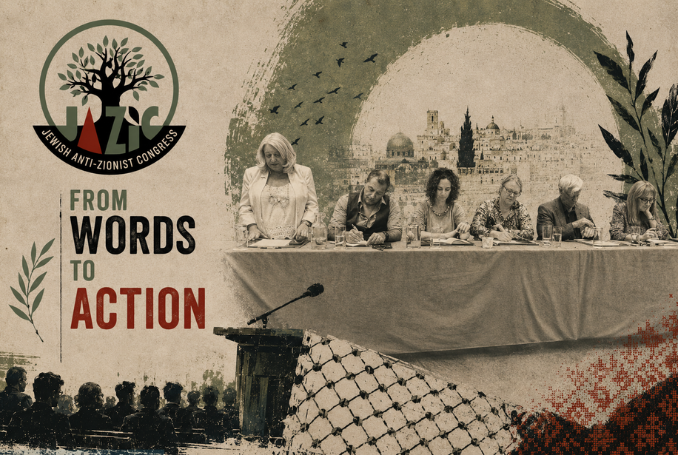
The Second Jewish Anti-Zionist Congress (JAZIC) was held in Dublin from June 25 to 28, 2026.
JAZIC is a growing international initiative that seeks to connect anti-Zionist organizations, academics, civil society actors, and individuals from diverse backgrounds committed to analyzing, debating, organizing, and taking collective action in support of the Palestinian struggle, both in Palestine and across the world.
Building on the momentum of its inaugural gathering in 2025 in Vienna, the second congress focused on transforming shared ideas, solidarity, and purpose into concrete action. It brought together a broad coalition of predominantly Jewish anti-Zionist voices, alongside Palestinian activists and solidarity movements from around the world, creating a unique space for dialogue, strategy, and collaboration.
The congress attracted hundreds of committed activists, intellectuals, politicians, journalists, and media professionals, reflecting the growing reach and significance of the movement.
This edition of Thinking Palestine is dedicated to the congress and many of its speakers. Through their voices, we hope to introduce readers to this emerging yet increasingly influential movement, as well as the ideas, debates, and visions shaping its future.
Below is a report summarizing the outcome of JAZIC’S inaugural press conference on June 24, 2026.
As Israel’s genocide in Gaza entered yet another devastating phase, the opening press conference of the Second Jewish Anti-Zionist (JAZIC) Congress in Dublin on Thursday focused not only on ending the ongoing genocide, but also on what speakers described as a profound political, legal, and moral transformation already reshaping global attitudes toward Palestine.
The Congress took place in Dublin, Ireland, from Friday, June 25, to Sunday, June 28.
Bringing together anti-Zionist Jewish activists, Irish lawmakers and Palestinian intellectuals, the event examined the changing international landscape, the responsibilities of European governments, the future of anti-Zionist Jewish organizing, and the growing momentum behind Palestinian solidarity movements worldwide.
Opening the conference, trade unionist Patricia McKeown, Chair of Trade Union Friends of Palestine, said the Congress itself reflected the growing visibility of anti-Zionist Jewish voices around the world.
Recalling the first congress in Vienna, McKeown noted that organizers had expected around 400 participants but more than 1,000 ultimately attended.
“That speaks volumes,” she said, arguing that anti-Zionist Jewish voices had long been marginalized but are now increasingly challenging dominant political narratives.
“They are speaking truth to power, and they are beginning to change that narrative in a very serious way,” she said.
McKeown also suggested that accusations equating anti-Zionism with antisemitism are beginning to lose their effectiveness, particularly within parts of Ireland’s labour movement.
“There were far fewer attempts this year to dismiss people by saying, ‘You’re antisemitic because you’re promoting an anti-Zionist agenda,’” she stated.
Ireland’s ‘Occupied Territories Bill’
Much of the discussion focused on Ireland’s long-delayed ‘Occupied Territories Bill’, legislation first introduced by Senator Francis Black in 2018 to prohibit trade with Israel’s illegal settlements.
Reflecting on the eight-year effort to advance the legislation, Black contrasted the government’s repeated delays with the worsening situation in Palestine.
“In those eight years, we have watched an illegal occupation become a horrific genocide,” she said. “We have watched settlements continue to expand across stolen Palestinian land. We have watched children killed in their homes, in their schools and in hospitals.”
Although the government has now introduced its own version of the legislation, Black argued that it falls well short of Ireland’s obligations under international law because it excludes services while covering only goods.
Describing the omission as a political decision rather than a legal necessity, she pointed to online platforms such as Airbnb as an example of how businesses continue profiting from illegal settlements.
“Tonight, I could go onto the Airbnb website, book accommodation located inside an illegal Israeli settlement built on stolen Palestinian land, and under this bill that transaction would remain perfectly legal,” she said.
“That is precisely what excluding services means,” the senator concluded.
She argued that Ireland should move beyond limited measures and adopt broader sanctions against Israel.
“Half a ban is not a ban,” Black said, adding that what is ultimately needed is “comprehensive sanctions” and “a full implementation of BDS.”
Finance, Investment and International Law
Expanding the discussion beyond settlement goods, Irish Senator Alice-Mary Higgins argued that Ireland also bears responsibility through its financial system.
Referring to the International Court of Justice’s 2024 Advisory Opinion, Higgins said states now have a clear obligation not only to avoid supporting Israel’s occupation directly but also to prevent trade and investment that help sustain it.
“It confirmed that all states have a positive obligation to prevent trade and investment that contributes to maintaining Israel’s illegal occupation,” she said.
Higgins highlighted Ireland’s role in approving Israeli government bonds sold throughout Europe, arguing that financial investment had become another mechanism through which occupation is sustained.
“There is a danger that investment becomes another instrument of colonial expansion,” she warned.
‘Judaism Has Been Occupied by Zionism’
UK-based Israeli Professor Haim Bresheeth-Žabner shifted the discussion from legal questions to ideology, arguing that the struggle is not only about ending Israel’s occupation of Palestine but also about reclaiming Judaism itself from Zionism.
“Judaism has been occupied by Zionism,” he said, arguing that the religion had been fundamentally transformed over recent decades.
Bresheeth-Žabner, whose parents survived Auschwitz while much of his extended family perished during the Holocaust, rejected the assumption that Jewish history somehow obliges support for Israel.
“I’m supposed to support a genocide,” he said. Instead, he argued that anti-Zionist Jews must confront Zionism within Jewish communities around the world.
“For two thousand years, Jews were victims of genocide. They were never participants in genocide,” he said, contending that Jewish institutions throughout the diaspora had become central pillars sustaining Israel’s colonial project.
Europe Already Has the Legal Tools
For Lynn Boylan, Chair of the European Parliament’s Delegation for Relations with Palestine, the central issue is not the absence of legal mechanisms but the absence of political will.
Boylan, who has herself been deported by Israel and barred from entering the country for five years, argued that European institutions already possess all the legal authority necessary to act.
“We now have the ICJ Advisory Opinion on the settlements, the rulings concerning humanitarian access, provisional measures relating to genocide and ICC arrest warrants,” she said. “No further evidence is required.”
Instead, she accused European leaders of hiding behind procedural arguments while continuing to shield Israel from accountability.
“Nobody is asking European governments to become pro-Palestinian,” Boylan said. “We are asking them to apply international law to Israel in exactly the same way they apply it to Russia.”
She also criticized the European Union’s refusal to suspend the EU-Israel Association Agreement, its failure to seek compensation for more than 1,000 EU-funded structures destroyed by Israel, and its continued cooperation with Israel on research funding and data protection.
“If they fail to do so,” Boylan warned, “the European Union loses all credibility.”
‘The Palestinian People Are Already Dismantling Zionism’
Delivering the final address, Palestinian journalist and author Ramzy Baroud argued that the international conversation on Palestine had already entered a new era.
While welcoming growing anti-Zionist Jewish activism, Baroud respectfully challenged one of the conference’s opening remarks, suggesting that Jewish communities would dismantle Zionism.
“It is the Palestinian people who are already dismantling Zionism,” he said, crediting Palestinian steadfastness and resistance with fundamentally altering global perceptions of Israel.
Baroud also rejected the idea that genocide represents a recent deviation in Israeli policy.
“Israel was built through genocide and ethnic cleansing from its very inception,” he argued.
Despite the horrors unfolding in Gaza, Baroud maintained that global public opinion has undergone a profound transformation.
“I believe we have already entered a period of paradigm shift,” he said, pointing to international polling—including recent surveys in the United States—showing growing sympathy for Palestinians.
‘The Rats Are Eating Our Children Alive’
The most emotional moment of the press conference came when Baroud described conversations with relatives living in Gaza before traveling to Dublin.
He said he had asked family members to speak with displaced Palestinians and ask them what message they wanted conveyed abroad.
Rather than discussing political solutions or future negotiations, Baroud said they spoke about the immediate realities of survival.
“I expected them to speak about the right of return. I expected them to speak about one state or two states,” he recalled.
“Instead, they said: ‘The rats. The rats are eating our children alive.’”
Baroud said those conversations illustrate why ending the genocide must remain the movement’s immediate priority before broader political debates could even begin.
Preventing Zionism’s Reinvention
While expressing optimism about shifting public opinion, Baroud also warned that efforts are already underway to rehabilitate Zionism by presenting the current catastrophe as the product of Benjamin Netanyahu alone.
“If you read Israeli newspapers today, you find article after article asking, ‘How do we repair Israel’s image?’” he said.
The problem, Baroud argued, is not simply public relations but an unwillingness to confront the deeper structures that have produced the genocide.
“Notice the language,” he said. “Not: ‘How do we repair the moral catastrophe?’ Simply: ‘How do we improve our public relations?’”
He warned that the international community must not allow Israel to repeat the post-Oslo strategy of reinventing itself as the victim while portraying Palestinians as obstacles to peace.
Centering Palestinian Voices
In response to a question from The Palestine Chronicle about how journalists and activists can genuinely center Palestinian voices rather than merely report about Palestinians, Baroud argued that the dramatic shift in global perceptions over the past two years has not been driven by corporate media but by independent journalism and Palestinians themselves reclaiming their own narrative.
“Corporate media exist to serve corporate interests,” he said, arguing that the transformation in public opinion did not happen because major Western newspapers changed their editorial approach.
“The transformation we have witnessed over the past two years did not happen because The New York Times or The Washington Post changed,” Baroud said, crediting independent media, social media platforms, and Palestinian storytellers with fundamentally reshaping the global conversation.
Rather than speaking on behalf of Palestinians, journalists should create platforms that allow Palestinians to articulate their own experiences and political aspirations.
“We do not need to speak on behalf of the Palestinian people,” Baroud said. “We need to create platforms that allow them to speak for themselves.”
From Grassroots Mobilization to Political Change
Responding to a second question from The Palestine Chronicle about how growing grassroots solidarity—including the actions of dockworkers, students and mass movements across Europe—can be translated into institutional change, speakers pointed to sustained public pressure as the key driver of political transformation.
Black drew parallels with Ireland’s anti-apartheid movement, recalling the role played by the Dunnes Stores workers’ boycott of South African goods as an example of how grassroots campaigns can eventually force governments to change course.
“The same thing can happen,” she said, expressing confidence that public mobilization would ultimately produce political results despite the pace of change.
“There is definitely a shift coming,” Black added. “It is slow. It is far too slow. But people have not stopped.”
Boylan echoed that assessment, arguing that a widening gap now exists between European governments and their own societies over Palestine.
“I think Zionism is dying,” she said, while warning that supporters of Israel are already seeking to rebuild political support by reshaping the narrative surrounding the current war.