
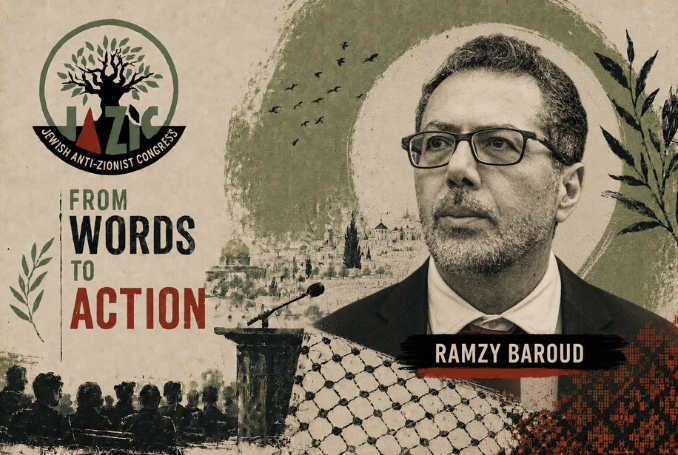
In his final remarks, Ramzy Baroud argued Palestinian liberation must prioritize ending genocide before debating future political arrangements.
At the Second Jewish Anti-Zionist Congress in Dublin, Palestinian author and journalist Ramzy Baroud delivered one of the most forceful interventions of the gathering, warning that debates over future political formulas for Palestine must not eclipse the immediate reality of genocide, displacement and resistance.
“It is very important for Palestinians—especially those from Gaza, but all Palestinians—to tell you what we think our priorities are right now,” he said.
For Baroud, the question was not whether visions such as decolonization, a single democratic state or restorative justice matter. Rather, it was whether such discussions can remain meaningful while Palestinians are being killed, starved and erased in real time.
“There is a quite painful irony,” he said, “in designing the zoning laws of a house while its foundations are actively being pulled apart, and while our families are being buried beneath the rubble.”
Against ‘Solutionism’
Baroud warned against what he called the long history of “solutionism” in Palestine — the repeated production of diplomatic plans, political frameworks and intellectual blueprints that have failed to halt Palestinian dispossession.
“They’ve been talking about it for a very, very long time,” he said. “We keep talking, and we keep being pushed out; we keep talking, and we keep losing.”
From the British Mandate to the Nakba, from 1967 to Oslo, Baroud argued that every major diplomatic process presented as a path to peace ultimately left Palestinians in a worse position.
“This is not a new phenomenon where we just need to give the Palestinians a break because they are starving in Gaza,” he said. “No, this is the story of the Palestinian struggle against Zionism, and we are not going to play that game anymore.”
The Problem with Oslo
A central part of Baroud’s critique was directed at the Palestinian Authority, which he described as an instrument of occupation rather than liberation.
“The Palestinian Authority is a policeman for the Israeli occupation,” he said. He argued that the PA has suppressed resistance in the West Bank and helped preserve the post-Oslo political order, which he said created a small class of beneficiaries while the majority of Palestinians continued to face occupation, siege and exile.
“Oslo did not achieve a single tenet of actual liberation,” Baroud said. “Instead, it created an insulated, localized subculture of wealth.”
For that reason, he urged activists and intellectuals not to treat the PA as a legitimate representative of the Palestinian struggle.
“Do not talk to them, do not validate them, and do not include them on your side as if they are on our side,” he said.
Liberation, Return, Resistance
Baroud insisted that any legitimate political vision must emerge from the language and priorities of Palestinians themselves.
“If you listen closely to the language of the people on the land,” he said, “they do not speak in the abstract jargon of Western political science.”
Instead, he said, Palestinians speak of Tahrir — liberation; Al-Awda — the Right of Return; and Muqawama — resistance.
“If we want our discourse to be truly well-researched and impactful,” he said, “we must align our theories with their practice, rather than expecting them to conform to our academic language.”
Dismantling Zionism
Baroud’s speech placed de-Zionization at the center of any future discussion of Palestine.
He argued that distinctions within Zionism — between left and right, religious and secular, liberal and nationalist — may matter internally to Israeli society, but have made little material difference to Palestinians living under occupation, siege and bombardment.
“To a family in a refugee camp, to a mother enduring aerial bombardment, or to a prisoner held without trial, the political affiliation of the pilot or the bureaucrat is completely irrelevant,” he said.
For Baroud, Zionism itself is the obstacle. “It cannot be modernized or reformed,” he said. “It cannot simply be managed or adjusted; it must be completely dismantled as a system of power.”
A Warning against Rebranding
Baroud also warned that Zionism, as a system deeply tied to global capitalism, militarism and geopolitical interests, would attempt to adapt in order to survive.
As Israel’s global image suffers unprecedented damage due to the genocide in Gaza, he said, the system will likely try to present itself in softer or more liberal terms.
“We must remain profoundly vigilant against this mutation,” he warned. “We cannot content ourselves with a rebranded version of the old status quo.”
The task, he argued, is not cosmetic reform but the “total structural dissolution of Zionism.”
A Future Built on Equality
Once that structure is dismantled, Baroud said, the precise constitutional form of the future becomes less important than the principle on which it is built.
“Whether the people choose a single unitary state, a bi-national federation, or another democratic model,” he said, “the system will naturally succeed once it is built on a foundation of absolute equality.”
He rejected the idea that coexistence in Palestine is a utopian fantasy, describing it instead as part of the land’s long history before modern colonialism and Zionism.
“For centuries,” he said, “Jews, Christians, and Muslims lived, traded, and built a shared society on that very land without the need for apartheid walls, separate legal systems, or segregated highways.”
From the Margins to the Front Lines
In his closing remarks, Baroud addressed Jewish anti-Zionist activists directly. While acknowledging the importance of the slogan “not in my name,” he argued that the moment now demands something more.
“We need to go from that ‘not in my name’ stance into defining ourselves as part and parcel of the Palestinian solidarity and liberation movement globally,” he said.
He urged them to move “from the margins to the front lines” of the struggle for a free Palestine.
Baroud also called for unity within the movement, warning against distractions and divisions at a moment of historic urgency.
“We will disagree on a lot of things,” he said, “but we agree on one single principled value: the freedom of Palestine and the Palestinian people.”
Centering the Palestinian Struggle
Finally, Baroud cautioned that “centering Palestinians” must not mean elevating any Palestinian voice regardless of whom they represent.
He warned that even Zionist institutions have learned to promote Palestinians who serve their narrative, including the Palestinian Authority and collaborators.
For Baroud, the representative Palestinian is not found in diplomatic halls or elite institutions, but in the lived struggle of the people.
He named Dr. Hussam Abu Safiya as one such figure.
And then he offered another image: “A small child right now, somewhere in Gaza in the displacement camps, carrying twice, if not three times his weight in barely drinkable water to help his family survive in a tent.”
“That child,” Baroud said, “also represents me.”
For Baroud, the message was clear: the future of Palestine cannot be built by bypassing the Palestinian people. It must begin with their suffering, their resistance, their language and their right to liberation.