
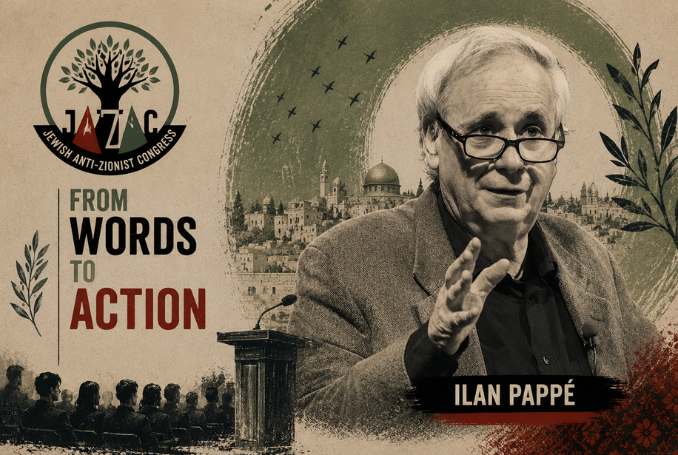
In his final remarks, Ilan Pappé urged supporters to move beyond solidarity, transforming anti-Zionist principles into organized political action.
In his final remarks at the Second Jewish Anti-Zionist Congress in Dublin, Israeli historian Ilan Pappé challenged participants to move “from words into action”, arguing that the global movement for Palestine has reached a stage where declarations of solidarity are no longer sufficient. The challenge now, he suggested, is to translate principles such as decolonization, liberation, and de-Zionization into concrete political action.
“I think one of the things we wanted to do in this second conference,” Pappé told attendees, “is to translate slogans into action.”
“It is not enough to say, ‘I want to de-Zionize, I want to decolonize, I want to liberate,” he continued.
Throughout his remarks, Pappé intertwined political analysis with personal reflection, explaining how his own biography—as an Israeli Jew born and raised in Haifa—has shaped his understanding of Palestine’s future.
Beyond Solidarity
Pappé began by reflecting on the unusual position he has occupied throughout much of his adult life.
Having spent decades opposing Zionism while living inside Israeli society, he described feeling isolated from the dominant political consensus around him.
“All my adult life,” he said, “I lived in a society where my imagination about the future was exactly the opposite of the imagination of most of the people who were my family, my friends, my peers, my colleagues at the university, and my society at large.”
Today, he said, that isolation has been replaced by a sense of belonging within a growing international movement that shares a common vision for Palestine.
“I feel very fortunate,” he explained. “My own individual aspirations… are no different, as far as I can understand, from the aspirations and vision of most of my Palestinian friends.”
What is Jewish Action?
While emphasizing that Palestinian liberation must remain led by Palestinians themselves, Pappé argued that Jewish anti-Zionists have a distinct responsibility that extends beyond expressions of solidarity.
Drawing attention to the British direct-action movement Palestine Action, he challenged participants to consider whether a comparable framework for organized Jewish anti-colonial action should emerge.
“What is the Jewish action for liberation?” he asked. He acknowledged that he had not yet reached a definitive answer but insisted that the question itself had become increasingly urgent.
“We need to claim back our Judaism,” he said, arguing that Jewish identity has been “taken hostage” to justify the continued colonization of Palestine.
Rather than waiting for future conferences, Pappé urged activists to spend the coming year developing practical forms of Jewish anti-Zionist organizing.
“We should focus between this conference and the next one… to think about what Jewish action means in Dublin, in London, in Berlin.”
A Long Process of Decolonization
The second part of Pappé’s address drew heavily on his work as a historian. Recalling conversations with friends in Gaza during Israel’s genocidal war, he acknowledged that discussions about political arrangements after liberation understandably feel remote for many Palestinians struggling simply to survive.
“When we tried to organize a webinar on one democratic state,” he recalled, “our friends in Gaza said, ‘Not today.'”
He described that response as entirely understandable.
Nevertheless, Pappé argued that political movements must distinguish between immediate crises and longer historical processes. “It’s still important… to recognize the difference between short-term developments and long-term processes.”
For Pappé, decolonization is not solely the result of resistance from the colonized. Colonial systems, he argued, also begin to collapse under the weight of their own contradictions.
“The Foundation is Crumbling”
One of the central arguments of Pappé’s speech was that Israel’s military power should not obscure what he views as deeper structural weaknesses within Israeli society.
Responding to those who point to Israel’s technological, military and diplomatic strength, he offered a striking metaphor.
“People say to me, ‘Israel is so powerful,'” he said.
“Yes,” he replied, “but this is the upper floors of the building. The foundation is crumbling.”
He argued that Israeli society is increasingly divided internally, describing what he characterized as an ongoing process of political fragmentation, military exhaustion, demographic decline and international isolation.
“There is a rot at the foundation of the State of Israel,” he said. “There are extensive cracks in its foundation.”
These developments, he suggested, should encourage activists rather than discourage them.
“If you understand that these processes are taking place,” he said, “you know better where to focus your energy.”
Keeping Hope Alive
Pappé also pointed to changing public opinion beyond Palestine, particularly among younger generations. He highlighted the growing support for Palestinian rights among young American Jews, arguing that civil society is increasingly diverging from the positions of political elites.
“The numbers of young American Jews who would populate a convention hall to show solidarity with Palestine,” he observed, “is growing exponentially.”
Taken individually, he cautioned, none of these developments would transform the political reality. Together, however, they form what he described as converging historical processes with the potential to produce a transformative moment.
“We are in a process,” he said, “that has the potential of bringing an end to Zionism and colonialism.”
Imagining a Shared Future
Pappé concluded by looking beyond the present war toward a post-colonial future. He acknowledged that questions surrounding the approximately eight million Jewish Israelis living in historic Palestine will eventually have to be addressed.
Yet, he stressed, their acceptance of decolonization cannot become a prerequisite for Palestinian liberation: “Their position is not a precondition for liberation and decolonization.”
At the same time, he argued that the Palestinian national movement will eventually confront difficult questions about citizenship, coexistence and reconstruction.
Drawing from his recent book ‘Israel on the Brink’, Pappé described an imagined conversation with a future grandchild in a liberated Haifa.
Asked why the Jews who once lived on their street had disappeared, his fictional older self replies that many chose to leave because they could not imagine living in a society no longer organized around apartheid.
“I did all I could to persuade them,” he says in the imagined exchange, “that it’s much better to live in a non-apartheid state, but I failed.”
Restoring “Normal Life”
Pappé ended where much of his historical work has long begun: with the memory of a multi-religious Palestine that existed before political Zionism.
Rather than presenting coexistence as an abstract aspiration, he argued that it represents a historical reality interrupted by colonization.
He described a Palestine where Muslims, Christians and Jews “genuinely coexisted” and suggested that liberation should seek not only to end violence but to restore the possibility of ordinary human life.
“Decolonize Palestine, de-Zionize it, liberate it,” he concluded.
“But more than anything else, make it a normal human place—something the Zionist project wrote the Palestinians out of for the last 120 years.”