
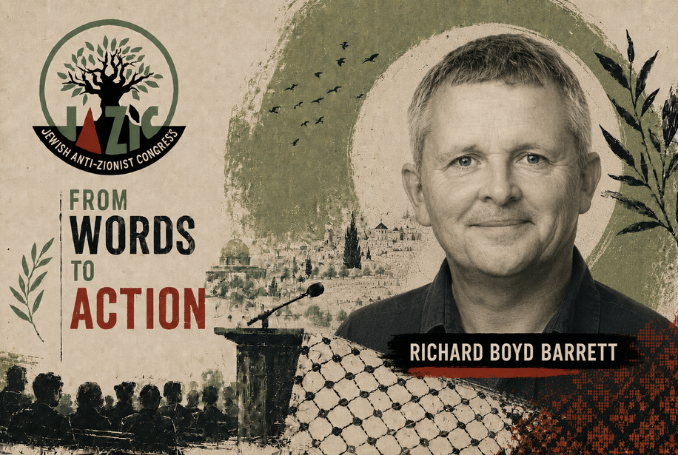
At the Second Jewish Anti-Zionist Congress, Richard Boyd Barrett argued Palestine has become the defining global struggle against militarism, colonialism and authoritarianism.
For Irish parliamentarian Richard Boyd Barrett, Palestine is no longer simply a foreign policy issue or a humanitarian crisis unfolding thousands of miles away.
It has become the defining political and moral struggle of our time—a struggle whose outcome will shape not only the future of the Palestinian people but the future of democracy, international law and social justice across the world.
Speaking at the Second Jewish Anti-Zionist Congress in Dublin, Boyd Barrett argued that Israel’s genocidal war on Gaza has exposed the willingness of Western governments to normalize genocide while expanding militarism, silencing dissent and protecting the political structures that made such crimes possible.
“If they get away with genocide against the Palestinian people,” he warned, “they’re coming for us next. That is absolutely the truth.”
Challenging the Dominant Narrative
Boyd Barrett began by paying tribute to the organizers of the congress and to former U.S. State Department official Josh Paul, whose resignation over American military support for Israel became one of the earliest public acts of dissent following Israel’s genocidal war on Gaza.
Both, he argued, had helped expose one of the central myths sustaining Western support for Israel: the claim that opposition to Zionism is synonymous with anti-Semitism.
That narrative, he said, continues to shield governments from taking meaningful action despite the devastation in Gaza.
“It is still being used as an excuse not to take action over the genocide,” Boyd Barrett said.
The congress itself offered a powerful rebuttal. Here were Jewish scholars, activists and organizers from across the world openly rejecting Zionism and standing alongside the Palestinian struggle.
Yet, he noted, their voices received virtually no attention from the mainstream press.
“When actual Jewish people come here from all over the world and say the Israeli state does not speak in our name,” he observed, “not a dicky bird of coverage.”
For Boyd Barrett, the silence was revealing. The problem, he suggested, is not a lack of Jewish voices challenging Zionism but the unwillingness of political and media institutions to amplify them.
Ireland’s Contradiction
Boyd Barrett also challenged Ireland’s international image as one of Europe’s strongest supporters of Palestinian rights.
Although successive Irish governments have adopted increasingly critical rhetoric toward Israeli policies, he argued that those words have rarely translated into meaningful economic or political action.
He pointed to parliamentary debates over sanctions legislation that, in his view, had been diluted to the point of becoming largely symbolic, while broader proposals aimed at imposing comprehensive sanctions on Israel were rejected.
More striking, he said, was the justification repeatedly offered against stronger measures.
According to Boyd Barrett, ministers argued that imposing sanctions on Israel would somehow be “unfair on the Jewish people.”
“It is a terrible, terrible lie,” he said. “But it is still being used to justify doing absolutely nothing.”
For Boyd Barrett, this demonstrated precisely why Jewish anti-Zionist organizing has become so politically significant.
It undermines attempts to equate criticism of Zionism with hostility toward Jewish people and strips governments of what he regards as one of their last remaining excuses for inaction.
Colonialism, Not Religion
Throughout his speech, Boyd Barrett insisted that Palestine must be understood through the lens of colonialism rather than religious conflict.
Western governments, he argued, continue portraying the issue as an ancient ethnic or religious dispute because acknowledging its colonial character would require confronting their own historical and ongoing responsibility.
“If they can’t characterize this as irrational hatred against Jewish people,” he said, “then they would actually have to admit what it really is.”
For Boyd Barrett, what is unfolding in Palestine is not an inevitable clash between two peoples.
“It is about the West sponsoring an extremist racist movement,” he argued, “to dominate and control the entire Middle East.”
That analysis, he suggested, explains the remarkable consistency of Western support for Israel despite overwhelming documentation of civilian deaths and destruction in Gaza.
Beyond Netanyahu
Boyd Barrett cautioned against interpreting the current crisis as the product of a handful of extremist Israeli politicians. He argued that many Western governments are already preparing a familiar strategy: isolate a few individuals, preserve the system that produced them and eventually restore Israel’s international legitimacy.
“They are going to try and hang out to dry a few of the criminals at the top of this,” he said, referring to Prime Minister Benjamin Netanyahu and senior members of his government.
For Boyd Barrett, however, removing individual leaders would leave the underlying political project intact.
“Netanyahu, Smotrich and Ben-Gvir are not a small gang of extremists,” he said. “They are the logical expression of Zionism.”
That distinction, he argued, is crucial. Without confronting Zionism itself rather than only its current leadership, any future political settlement risks reproducing the same structures that have defined Palestinian dispossession for generations.
Palestine and the Future of Europe
Perhaps the most far-reaching part of Boyd Barrett’s address was his insistence that Palestine should not be treated as a separate humanitarian issue competing with domestic concerns.
Instead, he argued, the struggle for Palestine is inseparable from the broader political direction of Europe itself. He pointed to rapidly increasing military budgets, shrinking investment in public services and the growing influence of the arms industry across European politics.
“The money that’s now going into arms and weapons,” he warned, “will be money that’s not going into housing and health and education.”
The same governments defending Israel’s actions, he suggested, are simultaneously promoting militarization at home while asking ordinary people to accept declining public services and growing economic inequality.
For Boyd Barrett, these developments are connected rather than coincidental. The struggle against colonialism abroad and the struggle for social justice at home increasingly form part of the same political conflict.
A Struggle for Humanity
Boyd Barrett concluded by urging activists to resist viewing Palestine as a single-issue campaign. Its significance, he argued, extends far beyond the borders of historic Palestine.
“When we say Palestine is the front line in the battle of humanity against barbarism,” he said, “that’s not rhetoric. It is actually a struggle against barbarism and for a better world.”
For Boyd Barrett, Israel’s genocide in Gaza has become a defining test of the international system itself. If governments succeed in normalizing genocide, suppressing dissent and protecting those responsible from accountability, the consequences will not remain confined to Palestine.
The precedents established today, he warned, will shape the political future everywhere.
That is why, in his view, solidarity with Palestine is no longer simply an act of international solidarity. It is part of a broader struggle over whether the world moves toward greater militarism, colonial domination and authoritarianism—or toward a future grounded in equality, justice and universal human dignity.