
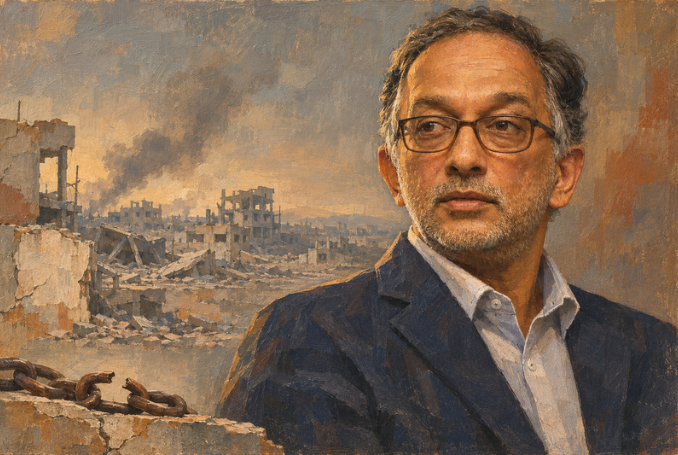
Na’eem Jeenah examines how Gaza’s genocide awakened global solidarity while exposing international law’s failures and demanding action beyond the streets.
Al-Aqsa Flood and the three years of genocide thereafter reawakened the conscience of the world. Simultaneously, it heralded the unraveling of international law and a (further) descent into global lawlessness.
Three years after Israel launched the first genocide of this century, the sea of Gaza maintains its rhythm against a shore on which have been etched the memories of hundreds of thousands of destroyed lives. But the Resistance lives, and Gaza’s sea has transformed into an ocean of human beings around the world.
Al-Aqsa Flood has changed the world. From Cape Town to Sana’a, from Jakarta to Los Angeles, streets are regularly filled with people; human beings who refused to look away: students, dockworkers, grandmothers, doctors. A collective global conscience was stirred such that no ceasefire, no political statement can lull it back to sleep. No normal human being doubts anymore that Palestine is the moral question of the day, the test of whether one supports justice or oppression, brutality, and genocide. The measure of our humanity.
That transformation on the streets is not matched by political elites whose complicity with genocide will be remembered, who, in their support of genocide, have ignored and then destroyed a tenuous international law regime. A regime that was never meant to protect Palestinians or formerly colonized people – because, demonstrating the definition of racism, the darker nations of the world were never regarded as fully human.
When South Africa carried the charge of genocide to The Hague, it disrupted this system: an action by a formerly colonized nation against a remaining colonial state, whose genocide was supported by former colonial powers. The Courts issued provisional orders, prosecutors sought warrants, and UN investigators released their findings. Each was a lantern raised in the darkness of racism and injustice.
The orders went unheeded, the warrants unserved, and the powerful shielded the powerful. Gaza revealed the system of international law celebrated for the past seven decades as a house with doors firmly shut for the oppressed. Laws and rules were bent to the strength of the powerful – and if that didn’t work, they were rubbished. The strong do what they can; the weak suffer what they must.
But a storm took over the cities of the world, ensuring the impossibility of ignorance. Never has a catastrophe been so witnessed: filmed on cracked phones, narrated by poets, children and journalists who became the archive. No one may say, in the years to come, they did not know.
The question arising through this genocide is not about Gaza; it is about us. Will we raise the awakened conscience from the street into decision-making chambers? Will we ensure the rebuilding of law as a promise to the oppressed and powerless rather than a privilege of the powerful? Will we strengthen our support for the Palestinian resistance that has shown us the promise of a better world? Will the global flood one day wash against a Gazan shore that is allowed to live again?
The sea of Gaza keeps its rhythm. We decide what it carries.
a’eem Jeenah is Senior Researcher: Humanity at the Mapungubwe Institute for Strategic Reflection (MISTRA) and former Executive Director of the Afro-Middle East Centre (AMEC). He is also a Research Associate with the Department of Politics and International Relations at the University of Johannesburg.