
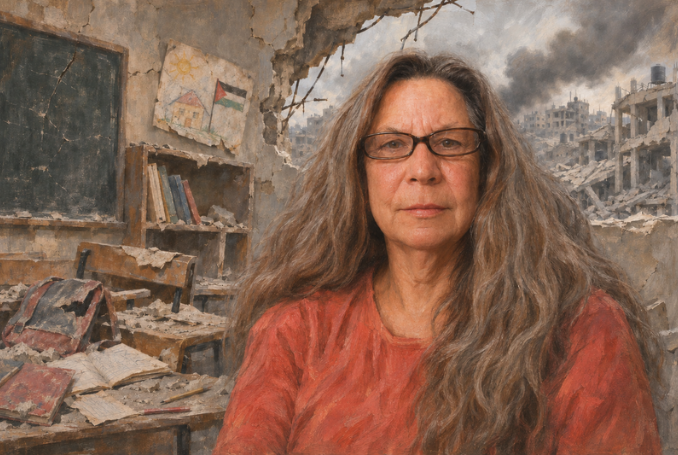
By Benay Blend
Benay Blend explores how Palestinian writers sustain dignity, hope and Refaat Alareer’s legacy through storytelling amid Israel’s genocide in Gaza.
Since Al-Aqsa Flood, there has been an upsurge of books about Palestine from those who explore the ramifications of October 7.
These analyses are important, but equally so are the voices of Palestinians who are telling their own stories from Gaza. All have become increasingly significant for understanding what it means to maintain dignity and hope in the wake of Israel’s genocide.
There were similar collections before October 7. In his anthology, Gaza Writes Back: Short Stories from Young Writers in Gaza, Palestine (2014), the late Refaat Alareer explained that his students’ stories embodied “acts of defiance, proclaiming the endurance of Palestinians and the continuing resilience and creativity of our culture in the face of ongoing obstacles and attempts to silence us” (p. 6). This remains true today.
Alareer added that the internet had enabled these writers to interact with Palestinians beyond Gaza’s borders (p. 11). Since Israel has repeatedly bombed the infrastructure in Gaza with increased intensity, access to technology is more uncertain. Still, journalists, writers, children, medics and others continue to use the medium to share their message, and the world increasingly listens.
As Romana Rubeo notes in Gaza Rising: Voices from the Rubble (2026), communication became precarious after October 7. In addition to unpredictable internet connections, most people are displaced, forced to search out safe havens that in the end do not exist (“’This Generation Will Not Leave Gaza’: Diaries of a Fallen Journalist,” in Gaza Rising, Ramzy Baroud, Ilan Pappé, and Romana Rubeo, editors, p. 12).
Attesting to this fact, Susan Abulhawa entered Gaza twice in 2024, primarily to carry aid but also to provide writing workshops to people under siege. These meetings were held “under the constant buzzing of drones and frequent sounds of distant bombs” (Gaza in the Time of Genocide: Every Moment is a Life, Abulhawa and Huzama Habayeh, editors, 2024, p. xiii), yet participants walked many miles to attend.
“These writers were not only refining their craft,” Abulhawa writes, “but also locating power in their stories as Indigenous sons and daughters of the land in a time of colonial genocide” (p. xiii).
Filmmakers, too, have increasingly crafted films that use the storytelling form to relate Palestinian history.
All That’s Left of You (2025), for example, directed by Cherien Dabis, “bears witness to history not through politics alone, but through the texture of a family’s survival.” Spanning eight decades of Palestinian life, Dabis does not shy away from the horrors inflicted by Israel on her subjects but takes care to show them in their full humanity. Through displacement, loss, diaspora, and “quiet acts of resistance,” all that “remains is held in memory, in name, in the threads of a story passed from one generation to the next.”
Israeli forces assassinated Alareer in December 2023. Very little of Islamic University of Gaza (IUG) remains. Yet his legacy lives on in the words of former students and others who continue to put their stories down on paper.
– Benay Blend earned her doctorate in American Studies from the University of New Mexico. Her scholarly works include Douglas Vakoch and Sam Mickey, Eds. (2017), “’Neither Homeland Nor Exile are Words’: ‘Situated Knowledge’ in the Works of Palestinian and Native American Writers”.