
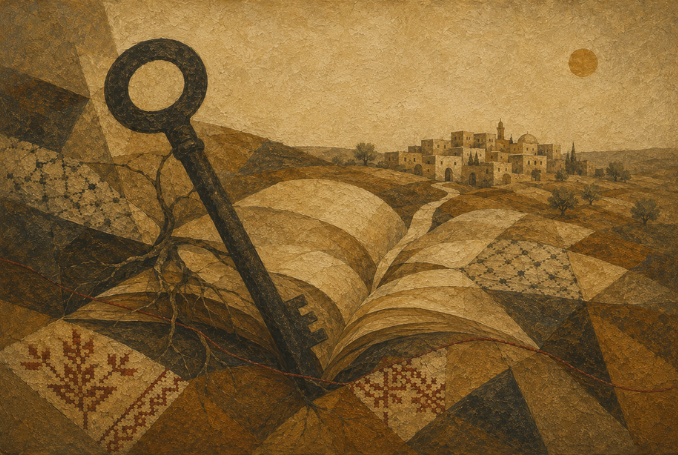
By Tahrir Hamdi
Drawing on anti-colonial thinkers and Palestine’s revolutionary history, Tahrir Hamdi argues that armed, cultural and economic resistance remain inseparable from liberation and return.
How does one resist dispossession and displacement, ongoing genocide, culturicide, scholasticide and epistemicide, and all forms of erasure of a people’s past, present and future? The answer: Resist by all available means—armed resistance, cultural resistance, and economic resistance; this is a legal right recognized under international law, but before that, it is morally legitimate, justified, and necessary. Israel is a brutal settler colony that was made possible by two main strategies: the expulsion of the Palestinian people from their indigenous land (historic Palestine) and ongoing genocide that is now 78 years old.
Armed resistance, as theorized by anti-colonial theorists such as Frantz Fanon, Aimé Césaire, Amílcar Cabral, Ghassan Kanafani, and Edward Said, is an essential part of the anti-colonial struggle for the liberation of colonized minds and lands. In his book The Wretched of the Earth (1963), Frantz Fanon, a psychiatrist by training, forcefully argued for anti-colonial armed resistance, stating precisely because colonization is such a violent and dehumanizing process, “decolonization is always a violent phenomenon” (35). For Fanon, colonization always dehumanizes the colonized; therefore, the colonized must use violence against the colonizer to allow for the rehumanization of the colonized because revolutionary violence is meant to end the oppression, colonization and dehumanization of the colonized population (94).
The revolutionary thinker Amilcar Cabral argued in his speech titled “The Weapon of Theory, (1966)”: “the only effective way of definitively fulfilling the aspirations of the peoples, that is to say of attaining national liberation, is by armed struggle.” In his essay titled “National Liberation and Culture,” Cabral argues that the colonizer seeks to physically destroy a significant proportion of the dominated or colonized population; accordingly, the colonizer, in addition to resorting to mass killing and genocide, will always target the culture of the colonized. It is precisely for this reason that the preservation and continuation of people’s culture and their knowledge systems are essential to national liberation. Thus, cultural resistance and armed resistance go hand in hand.
The revolutionary Palestinian theorist and activist (who also wrote intellectual and theoretical pieces for the Arab Nationalist Movement and the Popular Front for the Liberation of Palestine), Ghassan Kanafani, like Fanon and Cabral, emphasized the absolute importance of cultural and armed resistance. Kanafani argued for a vibrant culture of resistance that would enable the armed struggle for liberation. This is why Kanafani wrote stories of Palestinian resistance. In a novella titled Returning to Haifa, Kanafani makes it clear, through his character Said, that any genuine return to Palestine required a successful armed struggle, a war. Kanafani also emphasized the absolute importance of the unity of armed resistance organizations. In his essay titled “Towards a Constructive Dialogue on Palestinian National Unity,” Kanafani writes: “Any setback to any active fida’i organization, whether militarily or fundamentally, cannot be limited to that organization, but rather is immediately reflected on all other organizations” (262). Kanafani was well aware that divisions do not just weaken one Palestinian organization, but the Palestinian struggle for liberation as a whole.
Echoing Kanafani’s and other anti-colonial theorists’ position on armed struggle, the Palestinian American intellectual Edward Said told Tim Sebastian on the BBC’s “Hardtalk” program in 2002 that he is “for any kind of violence that would resist occupation and apartheid […] occupation and apartheid have to be resisted by whatever means bring about their end.” Thus, Zionist settler colonialism must be resisted “by whatever means bring[s] about [its] end” or in the words of Fanon, by the “use of all means, and that of force first and foremost” (61). As Said was nearing the end of his life, he wrote about the absolute refusal to surrender, which he theorized in his book published posthumously, titled On Late Style (2006). The inevitable link between armed resistance and the culture of resistance is of great importance—it is this link that guarantees the continuation of resistance to oppression and brutal Zionist settler colonialism.
There has always been Palestinian resistance to colonization, which in the early 20th century began with popular uprisings led by Izzidin Al Qassam against the brutal rule of the British Mandate, a colonial authority in Palestine that (through the infamous Balfour Declaration in 1917) promised the Zionist British banker Lionel Walter Rothschild, a Jewish homeland in historic Palestine, the land of the Indigenous Palestinians. The Balfour Declaration set in motion the attempted physical destruction of a significant part of the Palestinian population, their culture and their continued displacement.
After the 1948 Nakba and ethnic cleansing of Palestine, which resulted in the expulsion of more than 750,000 Palestinians and the destruction of 536 (Abu- Lughod and Sa’di, 2007: 3) Palestinian towns and villages in addition to tens of massacres in different Palestinian villages, Palestinians found themselves as refugees both inside occupied Palestine—in Gaza and what is now erroneously termed the “West Bank,” which the Palestinian poet Mourid Barghouti calls verbicide, meant to erase history and memory by renaming, and across neighboring Arab countries—such as Lebanon, Jordan, Syria and other countries. As Ramzy Baroud points out in his article titled “Outsmarting the Sky,” Palestinian armed resistance began almost at the very point of rupture—immediately after the 1948 Nakba with Palestinian fida’iyeen (specifically the peasantry, the fellahin in Arabic) in Gaza that would cross the border into the newly established Zionist settler colony for fida’i operations against enemy army positions.
However, perhaps more organized armed resistance began with the official birth of armed Palestinian organizations; the first among them was the left-leaning Arab Nationalist Movement (ANM) in the early 1950s, which was founded by George Habash, Wadie Haddad, and others. The slogan raised by the ANM was “Unity, Liberation, Revenge, and the Recovery of Palestine” (Hamdi Matar). One of these young men was my late father, Khalil Hamdi, who spent his young adult life organizing for the ANM, gathering community support for the idea of Palestinian resistance and liberation in the Palestinian refugee camps in Jordan and traveling to Beirut for meetings with other members like Habash and Haddad, where future plans would be made.
Of course, these activities also included organizing armed fida’i groups and various fida’i operations. Under the influence of the political climate of the 1950s with the rise of the charismatic leader of Egypt, Gamal Abdel Nasser, it was the belief of the founding members of the ANM that Arab nations would unite against the expansionist, Zionist settler colony, and this would then lead to the liberation of Palestine. Unfortunately for the ANM and the Palestinian cause, the claws of colonialism in the Arab region were as deep then as they are now. All members of the ANM, including my own father, were imprisoned and tortured. Zionist settler colonialism and American and British imperialism, along with Arab reaction/reactionary regimes, united against the freedom aims of the nascent Arab Nationalist Movement that envisioned Arab unity, social and political reform, and a free, liberated Palestine.
After the devastating Arab defeat in 1967 and the loss of more Arab land to “Israel,” George Habash along with Wadie Haddad, Abu Ali Mustapha and others from the ANM went on to form the Marxist-Leninist Popular Front for the Liberation of Palestine (PFLP), which, as we learned from Ramzy Baroud’s above mentioned article, found tremendous support amongst the young fida’i movement in Gaza at that time. Of course, Yasser Arafat’s secular Palestine Liberation Organization had already been formed a few years earlier in 1964. Palestinian armed resistance continues to this day, however, with a more Islamic (but still very Palestinian nationalist minded) framework; the Palestinian Islamic Jihad (PIJ) was formed in 1981 by Fathi Shaqaqi, inspired by the Islamic Revolution in Iran in 1979 and a few years later, Hamas, under the leadership of Sheikh Ahmed Yassin, was formed in 1987.
As can be readily observed from the different Palestinian armed resistance movements over the decades, Palestinian resistance has had radically different ideological visions—ranging from secular, to leftist, Marxist-Leninist to Islamic, but all have one goal: the liberation of historic Palestine and social and political reform by means of anti-colonial struggle—whether this resistance is armed, cultural or economic—freedom, dignity, the liberation and return to Palestine is the aim that unites all Palestinians in their different cultures of exile. Until there is a free Palestine, and in the words of the Palestinian poet Mahmoud Darwish from his long poem “Mural,”—the “return of the wandering soul as if nothing had happened,” the resistance will continue. Perhaps the most fitting description of Palestinian resilience is best expressed by Darwish himself in his tribute to Gaza in a poem titled “Silence for Gaza” (1973):
What is beautiful about Gaza is that our voices do not reach it. Nothing distracts it; nothing takes its fist away from the enemy’s face. Not the forms of the Palestinian state we will establish whether on the eastern side of the moon, or the western side of Mars when it is explored. Gaza is devoted to rejection… hunger and rejection, thirst and rejection, displacement and rejection, torture and rejection, siege and rejection, death and rejection. (…)
(Enemies) might implant tanks on the insides of its children and women. They might throw it into the sea, sand, or blood.
But it will not repeat lies and say “Yes” to invaders.
It will continue to explode.
It is neither death, nor suicide. It is Gaza’s way of declaring that it deserves to live. It will continue to explode.
References
Abu-Lughod, Lila and Sa’di, Ahmad. (2007). Nakba: Palestine, 1948 and the Claims of Memory. New York: Columbia University Press.
Barghouti, Mourid. (2003). “Verbicide.” New Internationalist.
Baroud, Ramzy. (2026). “Outsmarting the Sky: The Secret History of Gaza’s Subterranean Resistance.”
Cabral, Amilcar. (1966) “The Weapon of Theory.” https://www.marxists.org/subject/africa/cabral/1966/weapon-theory.htm
Cabral, Amilcar. (1970). “National Liberation and Culture.” https://www.marxists.org/subject/africa/cabral/1970/cabral-nat-lib-culture.htm
Darwish, Mahmoud. (2003) “Mural.” In Unfortunately, It Was Paradise. Antoon, Sinan and El-Zein, Amira (eds.). Akash, Munir and Forche, Carolyn (trans.). Berkeley, CA: University of California.
Darwish, Mahmoud. (1973, 2012) “Silence for Gaza.” Mondoweiss. https://mondoweiss.net/2012/11/mahmoud-darwish-silence-for-gaza/
Fanon, Frantz. (1963). The Wretched of the Earth. Farrington, Constance (trans.) New York: Grove Press.
Kanafani, Ghassan. (2000). Palestine’s Children: Returning to Haifa and Other Stories.
Kanafani, Ghassan. (2024). Ghassan Kanafani: Selected Political Writings. Brehony, Louis and Hamdi, Tahrir (eds.). London: Pluto Press.
Matar, Hamdi. Palestine Remembered. https://www.palestineremembered.com/Jerusalem/Qalunya/Story9138.html
Said, Edward. Hardtalk: Interview with Tim Sebastian.
Said, Edward. On Late Style: Music and Literature Against the Grain. (2006). New York: Vintage.
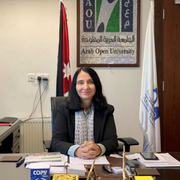
– Tahrir Hamdi is a professor of postcolonial literature at Arab Open University in Jordan. Her work explores resistance literature, anticolonial theory, geography, exile and Palestinian national identity.