
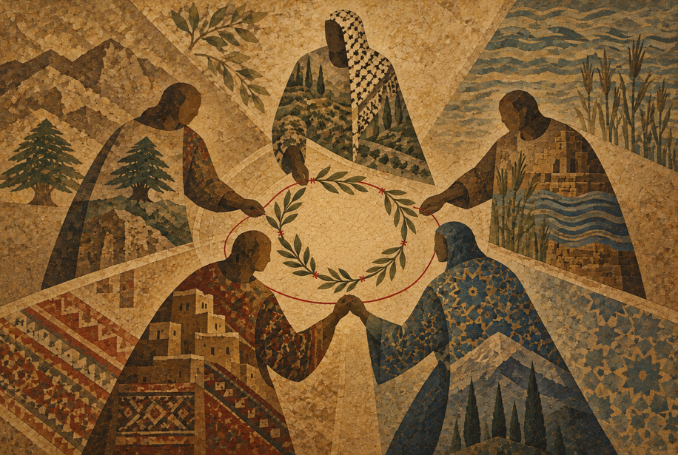
Robert Inlakesh traces the Axis of Resistance’s indigenous roots, showing how shared opposition to Zionism and imperial domination forged an alliance across national and sectarian lines.
In an attempt to divide the region, separate West Asia from the historic Global South bloc, and to deter the support of natural allies on the Left, Islamic Resistance groups – chiefly responsible for battling imperialism and settler colonialism – have been deliberately misrepresented and even portrayed as a foreign-imposed reality.
Today’s regional resistance is known as the ‘Axis of Resistance’. Washington-based pro-Israel think-tanks have for decades framed this alliance – consisting of the Palestinian Resistance, Iran’s Islamic Revolutionary Guard Corps (IRGC), Iraqi resistance groups, Hezbollah and more recently Yemen’s Ansarallah – as consisting of Iran and its “proxies”.
“The Shia Crescent” is another phrase, first used back in 2004 by the Hashemite ruler of Jordan, King Abdullah II, that has been embraced as a means of framing the regional resistance bloc as a sectarian alliance. Although the Jordanian Monarch later clarified that he hadn’t meant it as a warning of an emerging sectarian threat, this is very much how his words have been employed by Western Imperialists and Israel.
This language is very much calculated to discredit the regional resistance, to frame it as foreign, motivated at its core by sectarianism, or to suggest that movements like Hamas or Palestinian Islamic Jihad lack autonomy in a wider chess game controlled by the Islamic Republic aimed at carving out a new Persian Empire.
There have therefore been two primary components to a decades-long campaign aimed at discrediting the Axis of Resistance:
- A localized campaign seeking to deter concepts of pan-Arab/pan-Islamic unity.
- A global campaign that seeks to paint the alliance as an enemy of the Left and Enlightenment values.
Both have, to a large extent, succeeded in isolating the Axis. A number of factors evidently contribute to the victory of Israeli-US-led propaganda campaigns like these, which include the failure of the Axis of Resistance itself to properly capture the imaginations of target audiences.
Chiefly amongst a multitude of factors are also the concerted efforts of US-allied Persian Gulf Arab Monarchies to use their immense wealth in order to saturate the airways with propaganda that inadvertently promotes their own state ideologies, including Wahhabism and Madkhalism, and to spread disinformation of all kinds about Iran. The wars in both Iraq and Syria have aided this propaganda greatly, two wars that both saw the outbreak of significant sectarian violence.
From Arab Nationalism to Islamic Resistance
Major ideological shifts have taken place inside the confines of occupied Palestine’s borders and beyond in a struggle that has lasted over 100 years, in opposition to foreign-imposed domination and settler colonialism.
In Palestine, the national resistance movement drew on influences ranging from local semi-feudal leaders to Communists, Socialists, Arab Nationalists, Greater Syria advocates, and, evidently, Islamic movements. The first real resistance cadres that were formed in occupied Palestine under the British Mandate – beyond those peasant workers who participated in a series of revolts in the 1920s – were the armed resistance cells who worked under Sheikh Izz al-Din al-Qassam. The Syrian cleric was responsible for forming what was known as al-Kaff al-Aswad (The Black Hand) and promoted an Islamic platform.
There were also leaders like the Grand Mufti of Jerusalem, Hajj Amin al-Husseini, who convened the 1931 Jerusalem Congress and made attempts to bring about pan-Islamic Unity, centered around the issue of Al-Aqsa Mosque. He also made strides towards bringing attention to the issue of the Third Holiest site in the Islamic faith.
Yet, at the same time, inside occupied Palestine there were the Muslim-Christian Associations, significant intellectual contributions from the Urban Palestinian elites, and also major influences from Arab Nationalist commanders and movements throughout the region. All of which were integral to the story of the national resistance.
Following the Nakba (the Catastrophe), much of the Arab World fixated their attention on the Egyptian leader Gamal Abdul Nasser and his brand of Arab Nationalism. President Nasser managed to survive a Tripartite invasion of Egypt launched by Britain, France, and Israel in 1956, a conflict which resulted in the withdrawal of all occupying forces from his nation’s territory. Combined with Cairo’s effective cultural influence through its media machine, the 1956 victory afforded enormous political capital to the Egyptian leader and what would become known as Nasserism.
In 1951, the Arab Nationalist Movement (ANM) emerged, becoming one of the leading organizations fighting for the Palestinian cause and aligning itself with Nasser. In 1957, the Fatah movement was also born, itself being a nationalist organization. It suffices to say that Arab Nationalism, in its different strains, was the uncontested popular ideology of the time, until the historic defeat of the 1967 war.
The June 1967 War collapsed the image of Egyptian President Gamal Abdul-Nasser. Israel had launched a surprise attack that resulted in the occupation of the Egyptian Sinai Peninsula, Syrian Golan Heights, East Jerusalem, West Bank and Gaza. Around 350,000 people were expelled from their homes; in the years afterward, tens of thousands more were still being ethnically cleansed, particularly from the occupied West Bank into Jordan.
The ANM’s top leadership decided to go another route, forming the Popular Front for the Liberation of Palestine (PFLP) and adopting a Marxist-Leninist doctrine. Across the Arab world, resistance groups and parties emerged, as a period of soul-searching began after the fall of Nasserism and the death of the Egyptian leader only years later. One of the saving graces of Arab Nationalism in the Palestinian liberation struggle also came in March of 1968, when Fatah fighters engaged in an armed clash with the Israeli military known as the Battle of Karameh.
Israel had assaulted a town in Jordan, seeking to destroy bases belonging to the Fatah Party, using around 15,000 soldiers. Fighting alongside the Jordanian Armed Forces, Palestinian Fedayeen managed to engage in a 15-hour-long battle that inflicted considerable losses on the Israeli military. Although the Jordanians and Palestinians lost more men, the battle demonstrated to the Arab World that Israel was not invincible and confirmed in the minds of the masses that a military option was still viable.
The Palestine Liberation Organization (PLO), under which the various resistance movements operated, based itself out of Jordan and began to grow in strength. Their presence was interpreted as a threat by King Hussein, and evidently a great threat to Israel. These fears ended up resulting in a crackdown on the Palestinian resistance in September of 1970. In October of that same year, the Jordanian Monarch and PLO Chairman Yasser Arafat signed an agreement to withdraw resistance fighters from the country.
As a result, the PLO relocated to Lebanon, from which they engaged in clashes with the Israeli military, leading to Israel repeatedly invading southern Lebanese villages and cities. During the 1970s, Iranian revolutionaries from across the political spectrum – Marxists, Islamic-Socialists, and followers of Imam Ruhollah Khomeini – traveled to Lebanon and South Yemen to receive training in PLO camps. This military experience not only helped the 1979 revolution overthrow the US-backed Shah of Iran, but also gave key leaders who would form the Islamic Revolutionary Guard Corps (IRGC) military know-how through the PLO.
Even post 1979, PLO personnel traveled to Iran in order to aid in training the IRGC. Yasser Arafat was in fact the very first foreign leader to not only endorse the Islamic Republic, but personally travel to Tehran in order to demonstrate the extent of the alliance between the two. These relations would later sour during the Iran-Iraq War, due to the close relationship between the PLO and Iraq’s Saddam Hussein.
By 1982, the Israelis used an incident that was unrelated to the PLO in order to invade the country once more. They occupied southern Lebanon once again, but this time pushed all the way through to Beirut and fought the Palestinian resistance, along with their allies, to a standstill.
The result was the killing of up to 20,000 Palestinians and Lebanese, eventually leading to a surrender deal, whereby the PLO agreed to withdraw its leadership and 14,000 fighters to Tunisia.
Following this and with the resistance fighters absent, the Israeli army presided over a number of massacres against helpless Palestinian refugees, allowing their Fascist Lebanese allied militias. The worst being the mass murder of around 3,500 civilians in the Sabra neighborhood and Shatila Refugee Camp, most of whom were women and children. Both Shia Lebanese and Palestinians were the victims of these mass murder campaigns.
The Rise of Hezbollah, Hamas and Islamic Jihad
Israel then decided to remain an occupying force in southern Lebanon, officially setting up its illegal occupation of the south in 1985 with the help of its South Lebanon Army (SLA) proxy. In reaction to the occupation of the majority Shia Muslim south, many members of the Shia Political Party called Amal would go on to form an Islamic resistance front that operated outside the confines of the movement.
In 1985, and with the help of Iran’s IRGC, this breakaway faction declared the birth of Hezbollah. The new Party, an organic Lebanese movement that was formed with the intention of resisting Israel and would begin carrying out costly operations against the occupation forces.
What also began happening during this period was that the Palestinians themselves began a period of soul-searching, having been dealt yet another blow to their morale and seeking a new way forward. In the Gaza Strip, the PFLP was the fiercest resistance faction, yet the exiled Fatah Party was the leading movement within the PLO.
Already, in the 1970s, a Palestinian offshoot of the Muslim Brotherhood in Egypt, the Mujamma al-Islamiyya, was limited to the social sector and opposed violence. Yet, this movement began to build up what ended up becoming known as the Islamic Civil Society sector and, due to its charitable work, health clinics, and the founding of the Islamic University in Gaza, began attracting many followers.
Meanwhile, another organization was also in the making in the late 1970s, Palestinian Islamic Jihad (PIJ). In contrast to the Mujamma, PIJ openly advocated armed struggle as an individual duty. It quickly took to launching armed attacks using grenades and rifles in the early 1980s. Following the PLO’s defeat in 1982, PIJ quickly began recruiting former Fatah members seeking a new way forward in the fight against occupation. Unlike the other Palestinian movements that had formed since 1948, the Islamic groups sprang out from inside the borders of occupied Palestine, specifically the Gaza Strip.
By 1987, the first Intifada had erupted from the Gaza Strip, beginning in the Jabaliya Refugee Camp. PIJ, which had focused its efforts on armed resistance and whose leaders were originally inspired by the Islamic Revolution in Iran, had attracted a particular base of followers amongst the Gazan working class, but its size was limited. In contrast, when Harakat Al-Muqowemeh al-Islamiyya (HAMAS) announced its formation during the initial phase of the Intifada, it had already built a large base of support through its civil society sector.
Another blow came to the PLO leadership based in North Africa, which had gone to great lengths to lead the Intifada, when Iraq’s Saddam Hussein decided to invade Kuwait in 1990. The Fatah Party had decided to make statements in support of the Iraqi President before taking a more neutral stance later on. This mistake cost them an enormous loss in financial support from the Persian Gulf Arab Monarchies and even the expulsion of Palestinians from Kuwaiti territory.
Between 1993-5 the PLO would go on to sign the Oslo Accords with Israel, relocating themselves to the Gaza Strip and West Bank. Yet, this agreement, under which they recognized Israel’s existence on 82% of their homeland, came during a time of severe duress. The US-Israeli alliance had capitalized on the weakness of the PLO in order to have them sign an agreement that would end the burden of the Intifada. They now allowed the creation of a Palestinian Authority (PA) in the occupied territories, which would take the task of security and civil administrative duties off the hands of the Israelis.
After Yasser Arafat’s death under siege in 2004, during the Second Intifada that had erupted following a collapse of the so-called “Oslo peace process”, the Islamic Resistance factions would slowly become all that was left in the way of any serious resistance. In 2002, the Palestinian resistance factions and decentralized leadership of the Palestinian Authority Security forces were subjected to enormous Israeli crackdowns. Operation Protective Shield was launched that year, resulting in the defeat of the Palestinian resistance factions who had dug themselves in in the Jenin Refugee Camp and other locations in the northern West Bank.
The US then forced Arafat to begin reforming the Palestinian Authority in 2003, which created the position of PA Prime Minister. By 2005, the US-picked former leader of the PA, Mahmoud Abbas, would then implement laws to consolidate the factions of the Palestinian Security Forces under a centralized leadership. He would then go on to consolidate power in every sector throughout the years, beginning a US-backed process to turn the PA’s Security Forces into a subcontractor of the Israeli military, beginning in 2007.
Hamas had meanwhile won a democratic election in a landslide in 2006, then defeated a US-backed coup attempt, continuing their armed resistance against the Israelis out of the besieged Gaza Strip.
How a Regional Axis Took Shape
Syria had for some time been a crucial link in the regional resistance, as it allowed for weapons transfers to movements resisting Israel, helped train their forces in some instances, created weapons especially for these groups, and housed their leadership. For example, former Hamas politburo leader Khaled Meshaal was based out of Damascus until he left for Qatar following the outbreak of the Syrian War. Even then, PIJ and, to a lesser extent, the PFLP had both established a significant presence there and remained.
The Syrian leadership under Hafez al-Assad and then Bashar had supported the Palestinian resistance groups, but had always sought to control the direction of the movements. When the Syrian Ba’ath Party was founded – the Party of the Assad rulers – it also established a Palestinian branch called Al-Sa’iqa and later the PFLP-General Command (GC). Although the Assad era was one where there was a clear attempt to use their support for Hezbollah and the Palestinian resistance to their benefit, Syria did undoubtedly play a crucial role in the fight against Israel. Iran would later fight to maintain this land bridge and strategic ally before the regime change effort succeeded in installing a US-backed leadership in Damascus in December of 2024.
The Iranians naturally maintained close ties within the majority Shia population of neighboring Iraq after the US illegal invasion in 2003. With the government toppled, mass outbursts of sectarian bloodshed at the hands of Al-Qaeda affiliated groups, and a corrupt US-built system installed, the IRGC Quds Force became present inside the country. By 2014, when Daesh launched its offensive and began committing enormous civilian massacres throughout Iraq, the IRGC decided to help form a series of militia groups in order to quash the hostile takeover that was threatening to reach their borders also. This gave birth to the Popular Mobilization Units (PMU), or Hashd al-Shaabi, who became the resistance factions that would defeat Daesh on the ground inside Iraq.
Ansarallah in Yemen is also a separate story. A movement originally started by a Zaydi Muslim revivalist scholar, Hussein al-Houthi, who began giving sermons in opposition to the aggressive promotion of Wahhabism in Yemen that was being pushed by Saudi Arabia. In the 1990s, the group started as a small movement based in the northern Sa’adah area, later being subjected to a violent crackdown by former Yemeni dictator Ali Abdullah Saleh after he aligned himself with the US “War on Terror” campaign in the early 2000s.
Hussein al-Houthi was actually very critical of the Islamic Republic of Iran, a trend that ended when he was killed by the regime during an arrest raid, and his brother Abdul-Malik al-Houthi took over the movement. In 2011, during the Arab Spring, the rebel movement from the north became involved in the popular uprising to overthrow their dictator, and by 2015 they took over the capital city of Sana’a.
Beyond Sectarianism: The Case for a United Resistance Front
Whether you oppose these movements on the basis of ideology or their actions, or oppose the Iranian government on whatever basis, none of the regional elements making up the Axis of Resistance are inorganic. While covering every nuance is beyond the scope of this piece, it is important to consider that today’s resistance alliance is indigenous to the region.
In fact, the Axis of Resistance has far less foreign influence on it than the Nationalist and Socialist movements that came before it. The Soviet Union, Non-aligned Movement, and People’s Republic of China, which played an enormous role in the region’s resistance and ideologies of the past, did not originate in West Asia and North Africa. Noting this is not intended to argue a movement’s ideological origins or backers make it valid or invalid; instead, it is purely to note that the propaganda portraying the Axis of Resistance as a foreign imposter in the Arab World is nonsensical.
Especially considering that we are now looking at a series of Islamic resistance factions and governments across the region, it is not all that surprising that Iran has played a major role. Historically speaking, Persians have made enormous contributions to Islamic thought and civilization – pre and post their mass conversion to Shia doctrine during the early Safavid Dynasty. In fact, most of the prominent Sunni Hadith (sayings of the Prophet Muhammad) compilers like Imam al-Bukhari, Imam Muslim and Abu Dawud were of Persian descent, had Persian ancestry and/or lived within the boundaries of Iran.
It can be easily demonstrated that the Axis of Resistance exists for two reasons – it is an alliance that is both mutually beneficial and is strung together around an ideological commitment to resisting imperial domination. While the Iraqi and Lebanese resistance factions may be predominantly Twelver Shia, making them ideologically close to Iran, the Palestinians and Yemeni Armed Forces are not.
Historically speaking, there are no examples of a total absence of Classism, Tribalism, Xenophobia, Rights Abuses, Sectarianism and Sexism within such broad alliances. These issues should never be ignored nor undermined, but instead should be understood as hurdles for any movement resisting imperialism and belligerent occupation.
Oftentimes, Western attempts – even those made by well-meaning Leftists – to disparage support of national liberation movements and anti-imperialist leaderships, due to issues of the abovementioned nature, end up veering into depending upon deep-seated Orientalist and Islamophobic narratives themselves. It is to throw the baby out with the bathwater, romanticizing past resistance struggles which themselves battled with various issues at an organizational and/or societal level, in order to provide purity tests to current ones.
If the Axis of Resistance is defeated, the battle against Israel and US imperialism would quite frankly be lost for generations to come. After the Gaza Genocide and US-Israeli illegal war of aggression against Iran, the regional resistance alliance is the only thing standing in the path of a total foreign-imposed tyranny. This is not to argue that one should do away with all criticism of the resistance, but instead to aim that criticism in the correct direction and to prevent oneself from falling into the trap of providing cover for the Greater Israel Project and the tyranny that is Washington, D.C.’s foreign policy establishment.
– Robert Inlakesh is a journalist, writer, and documentary filmmaker. He focuses on the Middle East, specializing in Palestine.