
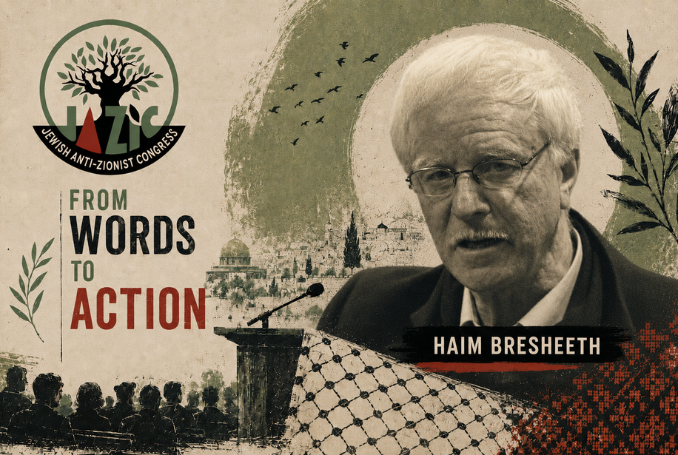
Israeli anti-Zionist scholar Haim Bresheeth-Žabner argues that only a single democratic state—not partition—can deliver justice, equality and decolonization in Palestine.
For decades, the two-state solution has dominated international discussions on Palestine. At the Second Jewish Anti-Zionist Congress in Dublin, Israeli anti-Zionist scholar Haim Bresheeth-Žabner dismissed the framework altogether, arguing that it is neither viable nor desirable.
Instead, he urged audiences to abandon what he described as an obsolete political paradigm and return to a solution that, he argued, Palestinians themselves have advocated since the earliest years of the conflict: a single democratic state across historic Palestine.
“The solution has to come from the Palestinians,” Bresheeth-Žabner declared at the outset of his keynote address. “The Palestinians have already worked on that solution in 1947.”
For Bresheeth-Zabner, the conversation should no longer revolve around rescuing the two-state formula. Comparing Palestine to other anti-colonial struggles, he argued that liberation movements in places like South Africa and Northern Ireland never accepted permanent political separation as the basis for justice.
“We never talked about a two-state solution in South Africa,” he said. “We didn’t say, ‘Let’s have a Black state and a white state.’ We didn’t, in Northern Ireland, say, ‘Let’s have a Catholic state and a Protestant state.'”
He contended that continued discussion of partition ultimately serves to preserve Zionism rather than challenge it.
“Our reason not to talk about it is that it’s a way of preserving Zionism,” he said. “None of us here is interested in preserving Zionism.”
Returning to 1947
Bresheeth-Žabner grounded much of his argument in the debates surrounding the United Nations partition proposal of 1947.
While the UN ultimately endorsed partition, he reminded the audience that another proposal—a unitary democratic state—had also been discussed. “There were two proposals,” he explained. “To divide Palestine… or not to divide.”
From his perspective, partition represented both a political and moral failure. He argued that it allocated the larger share of the land to the Zionist movement despite Jews constituting roughly one-third of Palestine’s population at the time.
“When you have a third and two-thirds,” he asked, “you give the third two-thirds of the country?”
He further argued that the violence associated with the Nakba began immediately after the adoption of the UN partition resolution rather than after the formal declaration of the State of Israel in May 1948.
“The war didn’t start on the 14th of May,” he said. “It started on the first of December 1947.”
A Palestinian Proposal
Central to Bresheeth-Žabner’s speech was his insistence that Palestinians have consistently offered an inclusive political vision rather than one based on ethnic exclusion.
Rejecting portrayals of Palestinian liberation as incompatible with coexistence, he described Palestinians as having shown extraordinary political generosity.
“It’s not normal, and it’s not obvious,” he said, “that a population under colonial control says to the colonizers: ‘Stay with us. You will be citizens like us in the state of Palestine.'”
To illustrate the point, he drew parallels with Algeria’s anti-colonial struggle.
Before the Algerian war reached its bloodiest stages, he noted, the National Liberation Front (FLN) envisioned a democratic Algeria in which French settlers could remain as equal citizens if they accepted the country’s independence.
“What happens before a genocide and what happens after a genocide is very different,” Bresheeth-Žabner observed, arguing that mass violence fundamentally alters the political possibilities available to an oppressed people.
The One Democratic State
Bresheeth-Zabner also reflected on his own involvement in the One Democratic State Initiative alongside Palestinian intellectuals and fellow Israeli anti-Zionists, including historian Ilan Pappé and physician and author Ghada Karmi.
The group drafted a model constitution envisioning a secular democratic state where citizenship would be based on equality rather than religion or ethnicity.
“What we wanted,” he explained, “was one democratic state, which is basically a secular state. Religions don’t have distinct political rights… everyone is an individual in that state.”
He acknowledged that this vision remains politically distant but argued that it continues to provide the most coherent framework for a just future.
Gaza Has Changed the Conversation
While reaffirming his long-standing commitment to a single democratic state, Bresheeth-Zabner argued that Israel’s ongoing assault on Gaza has fundamentally altered the immediate priorities facing Palestinians.
“We know that the one state is the only democratic, just and practical solution,” he recalled hearing from young Palestinians.
“But at the moment… our problem is not to establish one democratic state. Our problem is to survive the colonial attack on us.”
He argued that the destruction in Gaza has made discussions about future constitutional arrangements secondary to the immediate struggle against what he repeatedly characterized as genocide and colonial violence.
“We cannot actually, at the moment, even talk about it,” he said, “without first resolving the fact that Zionism is in existence.”
For that reason, he concluded, “we need to end Zionism. This is my priority.”
Decolonization and Accountability
Looking beyond the current war, Bresheeth-Žabner envisioned a future Palestinian state built through decolonization rather than partition.
“Palestine should be liberated,” he declared. “Palestine should be decolonized. Palestine should be de-Zionized.”
He also argued that accountability for crimes committed during the war must accompany any future political settlement.
“We will not do a Nuremberg,” he said. “We will do a Genocide Convention future in Palestine.”
A Personal Journey
In his closing remarks, Bresheeth-Žabner moved away from political theory and spoke about his own life. “I was born in a refugee camp in Rome after the Second World War,” he told the audience. “My parents were stateless, and so was I.”
Recalling his childhood among Palestinian communities, he described growing up in an environment where Hebrew- and Arabic-speaking children lived and played together without perceiving one another as enemies.
“The first thing that happened to me is that I became a Palestinian,” he said.
He ended with a historical vision that reached back to medieval Al-Andalus, invoking the concept of convivencia—the coexistence of Muslims, Christians and Jews—as both a historical precedent and a political aspiration.
“Let no one tell you that we can’t live together peacefully,” he said.
His final appeal framed Palestinian liberation not only as the liberation of Palestinians themselves, but also as the liberation of Israeli Jews from Zionism.
“We shall achieve it,” he concluded, “by liberating Palestine and liberating Jews from Zionism.”