
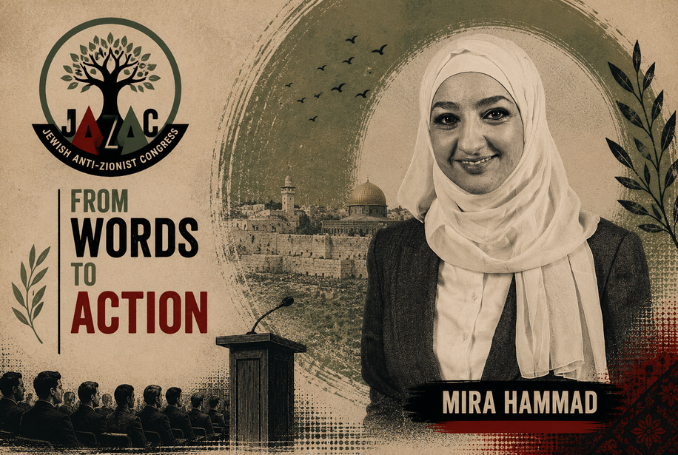
At the Second Jewish Anti-Zionist Congress, barrister Mira Hammad argued Britain’s legal system increasingly criminalizes conscience while shielding state complicity.
For barrister Mira Hammad, the courtroom has become another front in the struggle over Palestine. Speaking during the panel “Freedom is a Verb: Taking Action Without Seeking Permission” at the Second Jewish Anti-Zionist Congress in Dublin, Hammad offered a rare perspective from inside Britain’s legal system, arguing that the law increasingly functions not as a neutral arbiter of justice but as a tool for preserving political power.
Drawing on years of defending Palestine Action activists, challenging British arms exports to Israel and representing protesters accused under terrorism legislation, Hammad painted a picture of a legal system undergoing a profound transformation.
“The law was never a system that was set up to defend the rights of the oppressed,” she said. “It was a system that was set up to maintain the order and to maintain the status quo.”
A Childhood Faith in Justice
Hammad’s relationship with the law began long before she entered a courtroom. Like many Palestinian families displaced from their homes, her grandfather kept the key and title deeds to the house from which he had been expelled.
When she was deciding what to study, it was her grandfather—not her parents—who persuaded her to become a lawyer. “He said, ‘Take these papers to the UN, show them to the UN, and we’ll get our house back.'”
At sixteen, she admitted with a smile, the task sounded remarkably straightforward. “I thought, ‘This sounds like a simple task. I’ll do it.'”
The experience of studying international law, however, quickly challenged that youthful optimism.
“I discovered,” she said, “that the administration of the law is not quite the same as the administration of justice.”
Why Become a Lawyer?
Ironically, Hammad almost abandoned the profession before it began. It was not Palestine that ultimately convinced her to remain in law, but another long struggle for justice—the Hillsborough disaster in Liverpool.
Working as a paralegal during the Hillsborough inquests, she encountered decades of painstaking work undertaken by Anne Williams, whose fifteen-year-old son Kevin was among the victims.
Williams had spent twenty-five years investigating her son’s death herself, assembling files, interviews and evidence after official institutions repeatedly failed grieving families.
“People like Anne Williams have no other recourse,” Hammad reflected. “They are going through that system whether or not we want them to be.”
That realization transformed her understanding of legal practice.
Rather than believing courts naturally produce justice, she came to see lawyers as people who stand beside those forced to navigate unjust systems.
“My motivation,” she said, “is to stand with people.”
From Criminal Damage to Terrorism
One of the central themes of Hammad’s address was the extraordinary speed with which Britain’s legal response to Palestine solidarity has escalated.
She recalled representing some of the earliest Palestine Action defendants in 2021, when activists occupying an Elbit Systems facility largely faced criminal damage charges that, even if unsuccessful, would likely result in fines or community orders.
Just a few years later, she said, the landscape has changed dramatically.
Today, activists are prosecuted under terrorism legislation and receive prison sentences measured not in months but years.
One of her clients, she noted, received a six-year sentence accompanied by a terrorism designation that significantly extends the actual period of imprisonment.
“That’s how far the law has shifted,” Hammad said. “And it’s been only within five years.”
When Conscience Becomes an Aggravating Factor
Perhaps Hammad’s most striking observation concerned how courts now interpret political motivation. Traditionally, she explained, acting from conscience often served as a mitigating factor during sentencing.
That logic, she argued, has effectively been reversed. “What used to be a mitigating factor… has become an aggravating factor.”
“If you break the law to save lives for conscientious motives,” she said, “you get a harsher sentence than if you break the law because you’re greedy.”
To Hammad, that reversal reflects a broader political transformation rather than merely a legal one.
The Illusion of Neutrality
Although courts frequently insist they are deciding only narrow legal questions, Hammad argued that politics permeates judicial reasoning.
She pointed to rulings limiting protest defenses and to litigation challenging Britain’s continued participation in the F-35 fighter jet program, components of which are manufactured in the United Kingdom.
Evidence concerning Gaza, she noted, often disappears into footnotes while courts simultaneously insist that the underlying political questions are irrelevant.
“On the surface,” she said, “all of these judgments are saying… the underlying issues don’t belong in a court of law. But when you then read through the judgments, they are political.”
Law and Justice
Despite her sweeping critique of Britain’s legal system, Hammad did not argue for abandoning legal struggle altogether. Instead, she distinguished between law as an institution and justice as a political objective.
Legal proceedings remain important, she suggested, because people confronting state power have little choice but to engage with them. But accountability itself is unlikely to originate there.
“I don’t think accountability is going to come in the courts,” she concluded. “If it does, it will be so late that Palestinians will be a memory by then.”
Beyond the Courtroom
For Hammad, meaningful accountability ultimately lies elsewhere. “We don’t need the International Court of Justice,” she said, “to tell us that there is a genocide. We’ve seen it with our own eyes.”
That conviction shaped the broader message of her address. The courtroom remains an important arena of struggle—not because it reliably delivers justice, but because it reveals the political character of legal systems that often claim neutrality.
As governments across Europe increasingly prosecute anti-war activists under ever harsher legislation, Hammad argued that lawyers have an obligation not merely to defend individual clients but to expose the structures of power operating behind legal doctrine.
In that sense, the legal battle over Palestine is no longer simply about winning cases. It is about revealing what the law protects—and whom it leaves unprotected.