
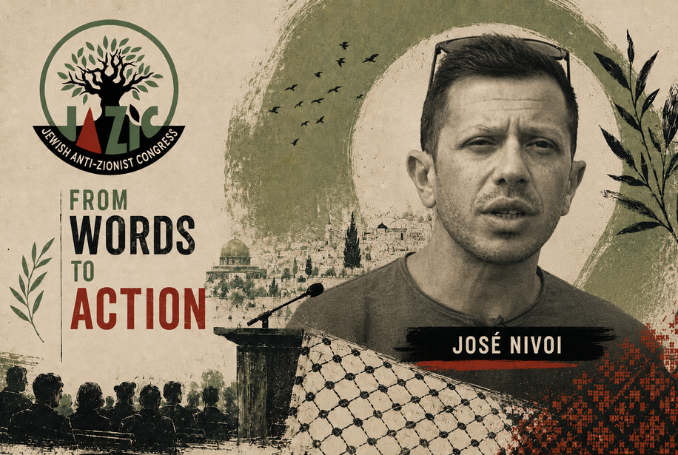
At the Second Jewish Anti-Zionist Congress, Italian dockworker José Nivoi argued workers can disrupt war by refusing complicity in military supply chains.
For Italian dockworker José Nivoi, solidarity with Palestine does not begin in parliaments or courtrooms. It begins at the docks.
Speaking during the panel “Freedom is a Verb: Taking Action Without Seeking Permission” at the Second Jewish Anti-Zionist Congress in Dublin, Nivoi argued that workers possess a form of political power that governments cannot easily ignore: the ability to interrupt the flow of weapons, military equipment and the global economy that sustains war.
“We don’t want to beg politicians,” he said. “We are trying to find legal, economic mechanisms to make that reality happen.”
“If workers refuse to collaborate with Israel, the institutions will be forced to stop collaborating with Israel,” Nivoi stated.
A Tradition of Resistance
Nivoi’s activism, he explained, is rooted in the political culture of Genoa, a northern Italian city with a long history of labor organizing and anti-war action.
He recalled how dockworkers in the 1970s refused to load weapons destined for the Vietnam War, choosing instead to send food and medicine. They also supported workers resisting Greece’s military dictatorship.
Rather than seeing today’s Palestine solidarity movement as something new, Nivoi described it as the continuation of that legacy.
“We basically decided to take up the legacy of the dock workers of the 1970s,” he said, after what he called “a black hole of twenty years” in which such activism had largely disappeared.
The People Help the People
For Nivoi, trade unionism is inseparable from internationalism. He invoked the Italian concept of popolo—the people understood not simply as individuals but as a collective community responsible for one another.
“There is this Italian word, popolo,” he explained, “which is really the people as a collective.”
That philosophy shaped campaigns ranging from strikes against weapons shipments to participation in the Gaza Freedom Flotilla and efforts to coordinate dockworkers across the Mediterranean.
His goal now is even broader: building an international network of dockworkers capable of acting together against military logistics.
“The dock workers don’t work for war and don’t work for genocide,” he said, describing the slogan uniting coordinated actions across ports in the region.
Using the Law Against the State
Unlike many activists who see civil disobedience as operating outside legal frameworks, Nivoi emphasized that many of their actions are grounded in existing law.
He pointed to Italy’s Law 185 of 1990, which prohibits the transfer of weapons to countries engaged in war, as well as Article 11 of the Italian Constitution, under which Italy rejects war as an instrument of international policy.
“Our actions are actually grounded in law,” he said.
Yet he described a profound contradiction. “We are trying to have the government respect our own law,” he observed, “and the government is using the law against us.”
That contradiction, he argued, demonstrates why workers cannot rely solely on governments to uphold international obligations.
The Workplace as a Political Space
Nivoi urged activists to think beyond ports and shipping terminals. His vision extends to universities, research institutions and workplaces throughout Europe.
He pointed to collaborations between Italian universities and Leonardo, the defense company involved in Israel’s military-industrial supply chain, arguing that researchers should enjoy the same legal protections to refuse participation that doctors possess when declining to perform procedures on grounds of conscience.
“What we are trying to do,” he explained, “is give workers the opportunity to refuse to collaborate with Israel.”
For Nivoi, refusing complicity should become a recognized workplace right rather than an act of individual sacrifice.
Building Pressure from Below
Central to Nivoi’s strategy is the belief that meaningful political change rarely begins with elected leaders. Instead of lobbying governments in the hope of persuading them, he advocates building pressure that leaves governments with little alternative.
“We don’t want to beg politicians,” he repeated. “You are not begging them, but you are forcing them to do something.”
He recalled earlier campaigns in Genoa that connected local residents to the dangers posed by military cargo passing through their city.
By demonstrating that weapons shipments threatened not only distant populations but local communities as well, activists broadened public support for direct action.
The same approach, he suggested, is increasingly possible regarding Palestine as public awareness continues to grow.
Isolating the System
For Nivoi, Israel’s military campaign cannot be understood in isolation from the economic and political networks that sustain it. He described Israel as a deeply neoliberal project whose survival depends on international partnerships, commercial relationships and uninterrupted logistical support.
“Our struggle has to be in our countries,” he said. “We have to disconnect this bond between our governments and Israel.”
That objective, he argued, extends beyond humanitarian solidarity. It is about dismantling the infrastructure of impunity itself.
A Politics of Action
Nivoi repeatedly returned to one simple principle. Governments have failed to uphold both domestic and international law. Workers therefore have a responsibility to act where political institutions refuse.
“We are trying to do politics in its literal sense,” he said. “Trying to fill the gaps of inactivity from the governments and trying to do what is the right thing to do.”
For Nivoi, the struggle for Palestine is not only about diplomacy or declarations. It is about who controls the everyday machinery of war—and whether ordinary workers are willing to stop it.