
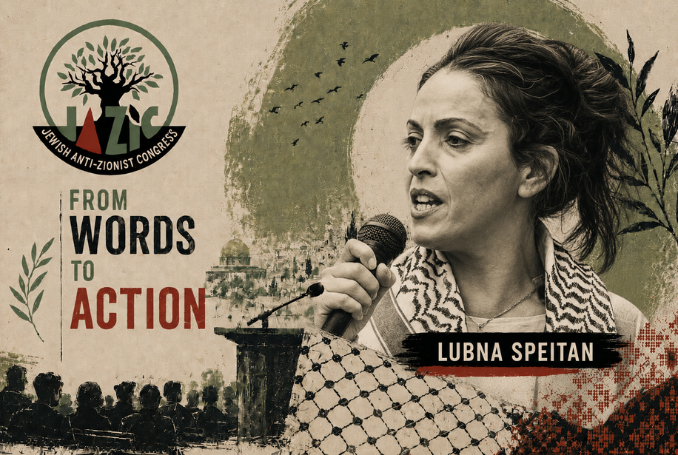
In her remarks, Lubna Speitan urged activists to transform solidarity into political organization led by Palestinian voices and rights.
At the Second Jewish Anti-Zionist Congress in Dublin, British-Palestinian activist Lubna Speitan argued that solidarity with Palestine must move beyond protest and into political organization.
“We’ve done the marches, we’ve done the petitions,” she told attendees. “We as Palestinians have pled for decades.”
Her keynote combined deeply personal reflections on growing up in the Palestinian diaspora with a practical account of organizing inside Britain’s political system, culminating in what she described as a historic anti-Zionist motion introduced within the Green Party.
Speaking as a Palestinian
Speitan opened her remarks with biting irony. “Do you want me to present myself as defined by the Zionists?” she asked. “I’m your ‘Palestinian, anti-Semitic, Hamas terrorist.'”
The audience laughed, but the point was serious. She argued that accusations of anti-Semitism are increasingly deployed not to protect Jewish communities from discrimination but to shield Israel from accountability.
“The conflation,” she said, “is designed not to protect Jews from discrimination for being Jewish, but to protect a racist, pariah, genocidal apartheid state from criticism.”
Throughout her speech, Speitan repeatedly insisted that Palestinians must reclaim the authority to define their own political future rather than having it dictated by outside actors.
“It is time for the Palestinians to speak,” she declared. “Our voice has been denied and deprived for so long.”
A Life Shaped by Exile
The activist traced her political consciousness back to her own family history. The daughter of a Palestinian father who, like many Palestinians, was prevented from returning to his homeland, Speitan described herself as “a child of the diaspora who would love nothing more than to go back home.”
She spoke movingly about relatives killed, imprisoned or displaced over successive decades, recalling the torture endured by her father and the grief of a grandmother who died longing to return to Palestine.
“There is no PTSD (Post Traumatic Stress Disorder – TP),” she said. “As we know, it’s never ‘post.’ This is continuous trauma.”
For Speitan, that experience creates not only pain but responsibility. “We sit here as children of the diaspora,” she said, “holding the torch for the next generation.”
From Protest to Politics
Unlike many speakers who focused primarily on political theory, Speitan devoted much of her address to grassroots organizing.
She recounted campaigns challenging investments connected to Israel, work within trade unions to revive support for the Boycott, Divestment and Sanctions (BDS) movement, and her decision to engage directly with party politics through Britain’s Green Party.
Her objective, she explained, was simple: if a political party acknowledges that Israel is committing apartheid and genocide, its policies should reflect that conclusion.
“If this party recognizes that Israel is an apartheid state committing genocide,” she asked, “where does it then stand?”
For Speitan, continuing to endorse a two-state framework under those circumstances represented a contradiction.
“We aren’t even given the right to decide,” she said, criticizing political formulas that, in her view, place Palestinians’ right to self-determination on equal footing with the policies of the state occupying them.
Drafting an Anti-Zionist Platform
Speitan described helping draft what she called an explicitly Palestinian political motion within the Green Party, developed with contributions from Palestinian activists and Jewish anti-Zionist allies.
The proposal calls for the party to declare itself anti-Zionist, reject the use of definitions of anti-Semitism that activists argue suppress criticism of Israel, support full implementation of BDS measures, recognize the Right of Return, endorse a single democratic state throughout historic Palestine, and demand accountability and reparations for Israeli crimes.
“We came together and asked,” she recalled, “‘What is it that we want? Let us now speak.'”
The proposal, she noted, attracted what she described as a record number of supporters inside the party. “The tide is turning,” she said.
Refusing to Retreat
Speitan acknowledged that the initiative immediately attracted fierce opposition.
Legal challenges, media criticism and organized campaigns by pro-Israel organizations followed, she said, drawing comparisons with the treatment of former Labour Party leader Jeremy Corbyn.
Yet rather than viewing those attacks as setbacks, she presented them as lessons for the wider movement. “The one important thing that we’ve learned,” she said, “is what not to do. Do not capitulate, and do not cower.”
“We will not apologize for being Palestinian or for calling for equal rights,” she note.
Speitan argued that future campaigns should avoid repeating what she described as earlier political mistakes by refusing to retreat under pressure.
A Blueprint beyond One Party
Although much of her presentation centered on developments inside the Green Party, Speitan insisted that the initiative was never intended to remain confined there.
“If it doesn’t pass in the Greens today,” she said, “it will be introduced in another party tomorrow.”
“It is the beginning, a seed, but it’s certainly not the end,” she said.
Speitan encouraged supporters to adapt the proposal for use in trade unions, political organizations and civil society groups elsewhere. “Put this motion forward in your own parties, your unions, or your own groups,” she urged. “Set it on fire.”
Palestinian Leadership, Shared Struggle
In her closing remarks, Speitan returned to a theme that ran throughout her address: Palestinian leadership coupled with broad international solidarity.
She praised Jewish anti-Zionist activists working alongside Palestinians and rejected attempts to equate criticism of Israel with hostility toward Judaism. “There are Jewish siblings of ours,” she said, “who have set up anti-Zionist synagogues… These are our allies.”
While emphasizing the importance of solidarity, she insisted that Palestinians themselves must remain at the center of the movement.
“It shouldn’t be the job of Palestinians alone to do this,” she concluded. “But it is for the Palestinians to lead our movement and to be the voices that have been denied for so long.”