
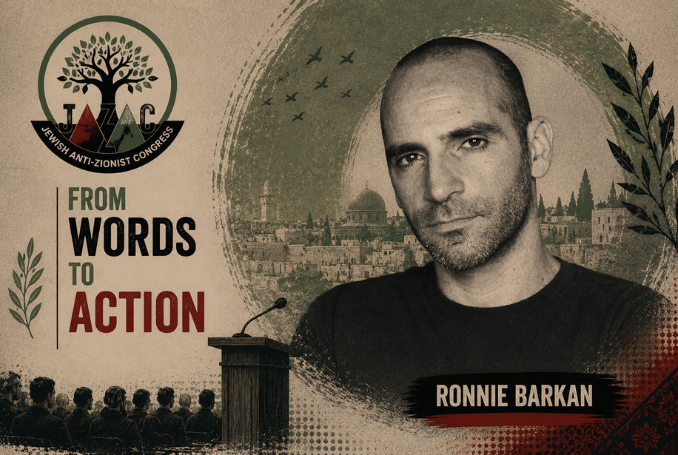
At the Second Jewish Anti-Zionist Congress, Ronnie Barkan argued direct action becomes a moral duty when governments enable injustice and criminalize resistance.
For Israeli anti-Zionist activist Ronnie Barkan, solidarity with Palestine cannot remain confined to statements, conferences or symbolic gestures.
Moderating the panel “Freedom is a Verb: Taking Action Without Seeking Permission” at the Second Jewish Anti-Zionist Congress in Dublin, Barkan repeatedly returned to one central idea: when governments become complicit in injustice, meaningful political action inevitably moves outside conventional institutions.
The panel brought together lawyer Mira Hammad, Italian dockworker José Nivoi and anti-arms trade researcher Andrew Feinstein. Yet Barkan’s own interventions provided the thread connecting them all—a sustained defense of direct action as both a moral necessity and a historical responsibility.
Following the White Rose
Introducing Clara Tatlow Devally, whose brother Daniel is one of the activists known as the Ulm Five, Barkan drew a striking historical parallel.
He compared the group’s alleged sabotage of an Elbit Systems factory in Germany to the actions of the ‘Ulm2’ – siblings Hans and Sophie Scholl who grew up in Ulm and were later active in Munich.
“The Ulm Five,” he said, “are following that legacy.” Describing their alleged actions against Elbit as “quite literally putting the wrench in the machinery of death, destruction and genocide,” Barkan suggested that resistance should be judged not by its legality under existing laws but by the injustice it seeks to confront.
Criminalizing Resistance
Throughout the discussion, Barkan repeatedly highlighted what he described as an inversion of justice taking place across Europe. Those attempting to halt weapons production or expose complicity in Israel’s war on Gaza, he argued, increasingly face prosecution under terrorism legislation, while governments facilitating military support enjoy impunity.
“The ones who are branded as criminals,” he observed, “are actually the ones who are upholding the law.”
Meanwhile, he said, “the criminals are the ones who are legislating and violating it with whatever impunity.” His comments echoed one of the panel’s recurring themes: that international law has been turned against those seeking to enforce it.
A Law Not Built for Activists
Reflecting on his own experience as a defendant in direct-action cases, Barkan argued that legal systems are fundamentally designed around the assumption that defendants regret breaking the law.
Activists, he suggested, rarely fit that model. “As far as I noticed,” he said, “the law is not built for activists.”
He pointed specifically to the expectation of remorse during criminal proceedings. “Activists don’t have remorse,” he explained. “They stand behind their actions.”
He also noted how legal defenses previously available to protesters have gradually disappeared.
“When we took action… we still had defenses in the law,” he recalled. “By the time we had the trial… we had no defenses left for us.”
Economic Pressure
Barkan also emphasized the strategic importance of disrupting the economic infrastructure sustaining Israel’s military industry.
Recalling a statement by former Israeli Prime Minister Shimon Peres, he argued that Israel’s dependence on international trade creates a significant point of vulnerability.
Peres, Barkan recalled, had once warned that if Israeli ships could no longer be loaded or unloaded in foreign ports, “this will be the end for Israel.”
“I think he was an arch-criminal,” Barkan remarked, “but he was not stupid.” For Barkan, that observation underscored the growing importance of campaigns targeting arms manufacturers, shipping networks and logistical supply chains.
Building a Movement
Although the panel focused heavily on legal repression, labor organizing and the global arms trade, Barkan repeatedly returned to the broader movement that has emerged around Palestine.
Speaking about activists who had opened their homes to defendants placed under house arrest, he described a community built across religious, political and national differences.
“I met really wonderful people,” he said, “of all sectors, of all ages, of all religions and no religion… acting beautifully together.”For him, that solidarity represents an essential counterweight to the expanding criminalization of pro-Palestinian activism.
Freedom as Action
The title of the panel—Freedom is a Verb—ultimately reflected Barkan’s own political philosophy.
Freedom, in his view, is not merely an aspiration but something expressed through action, particularly when existing political institutions fail to uphold justice.
Rather than asking permission to resist, the activists discussed throughout the session—from the Ulm Five to Palestine Action campaigners and dockworkers refusing to handle military cargo—illustrate what Barkan sees as a growing international movement prepared to confront complicity directly.
If governments refuse to enforce international law, the panel suggested, ordinary people increasingly believe they have a responsibility to act themselves.
For Barkan, that responsibility is no longer theoretical. It has become a practice.