
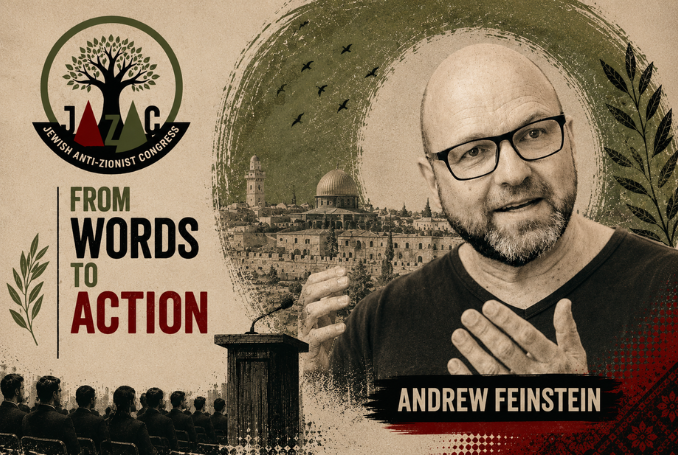
At the Second Jewish Anti-Zionist Congress, Andrew Feinstein argued Western governments enable Israel’s genocide by design, making direct action indispensable.
When people accuse Western governments of failing to stop Israel’s genocidal war on Gaza, Andrew Feinstein offers a provocative correction. “They haven’t failed,” he said. “I think a politician like Keir Starmer has done exactly what he was supposed to do.”
Speaking during the panel Freedom is a Verb: Taking Action Without Seeking Permission at the Second Jewish Anti-Zionist Congress in Dublin, the South African-born author, former parliamentarian and founder of Shadow World Investigations argued that what many perceive as political failure is, in fact, the successful functioning of a system built to protect wealth, militarism and corporate interests rather than democratic accountability.
“Our political systems are broken,” Feinstein said. But that breakdown, he suggested, is not accidental. “It is exactly because our politicians are doing exactly what is intended.”
‘Never Again’ Means Everyone
Feinstein began on a deeply personal note. The son of a Holocaust survivor, he described how his mother spent years hidden in a coal cellar in Vienna before eventually emigrating to apartheid South Africa, where she immediately recognized disturbing similarities between the persecution she had survived and the treatment of Black South Africans.
“My mother quickly made the observation that she felt Black South Africans were treated much like the Jews of Europe had been treated during the Second World War,” he recalled.
Her understanding of “never again,” he explained, shaped his own political life.
“‘Never again’ wasn’t about Jews,” Feinstein said. “It wasn’t just about Europeans… It was about all humanity.”
“If it has any meaning, then it has to apply to all humanity.”
That principle eventually led him from the anti-apartheid struggle in South Africa to decades of investigating the global arms trade.
The Business of War
For the past twenty-five years, Feinstein has documented how governments and corporations profit from armed conflict through what he describes as one of the world’s least accountable industries.
His latest research, he noted, examines how Western governments and private companies have benefited financially from wars in both Gaza and Yemen.
For Feinstein, however, the arms trade is more than a commercial enterprise. “I think,” he said, “it is probably at the center of the authoritarianism, the repression, and the basic slaughter that we’re experiencing in the world.”
Why Direct Action Works
If political institutions are functioning exactly as intended, Feinstein argued, meaningful change is unlikely to originate from within them.
“The only way to respond,” he said, “is through direct action.”
Rather than portraying acts of civil resistance as symbolic protests, he described them as effective precisely because they threaten established systems of power.
“Our governments would not be labeling them—and us—as anti-Semites and terrorists,” he observed, “if we weren’t being successful.”
For Feinstein, escalating repression should therefore be understood not as evidence of failure but as evidence that the movement is becoming increasingly difficult to ignore.
Facts Against Power
Although a longtime advocate of direct action, Feinstein insisted that activism alone is not enough. Successful campaigns, he argued, depend upon rigorous investigation and careful documentation.
“For our direct action to be successful,” he said, “it needs to be grounded… in investigative research.”
Activists, he noted, know exactly why they target particular companies, factories or supply chains because they have already traced those institutions’ role within the machinery of war.
“We know exactly what we’re talking about,” he said. “We know exactly why we are doing what we are doing.”
That commitment to evidence has become increasingly important, he suggested, in what he described as an era of political dishonesty.
“I remember a time when, as a politician, if you lied, that would be the end of your career,” he said. “Today, it seems that unless you are a remarkably proficient liar, you cannot even consider a career in politics.”
Accountability beyond Elections
Asked whether Western political leaders could ever be held accountable for supporting Israel’s war, Feinstein proposed a broader understanding of accountability itself.
Electoral politics, he suggested, is only one avenue. He pointed to consumer boycotts, tax resistance, mass political mobilization and the growing loss of public legitimacy suffered by governments that continue supporting Israel despite widespread public opposition.
“We have effectively discredited our politicians,” Feinstein argued.
The Palestine solidarity movement, he said, has exposed an unprecedented gap between political elites and the societies they claim to represent.
The Gaza Effect
Feinstein reserved particular criticism for British Prime Minister Keir Starmer, against whom he stood as an independent candidate during the 2024 general election.
He argued that Starmer’s political decline cannot be understood without reference to Britain’s support for Israel’s war on Gaza.
“The reason Keir Starmer hasn’t even lasted two years in office,” Feinstein said, “is because—not his support for, not his complicity in, but his active participation in the genocide in Gaza.”
Whether or not political leaders acknowledge it, he suggested, Palestine has become one of the defining moral questions shaping contemporary public life.
A Movement Built on Integrity
Despite describing the present political moment as exceptionally dark, Feinstein ended on an unexpectedly hopeful note. What gives him confidence, he said, is not the behavior of governments but the character of those resisting them.
“I think a very important scintilla of light amidst this darkness,” he reflected, “is the integrity, the intellectual capacity, and the honesty of our movement.”
For Feinstein, those qualities distinguish today’s Palestine solidarity movement from the political establishments it challenges.
One side relies increasingly on repression, censorship and misinformation. The other, he argued, depends on evidence, conscience and collective action.
In an era when democratic institutions appear increasingly unable—or unwilling—to restrain state violence, Feinstein’s conclusion was both stark and optimistic.
If governments are functioning exactly as designed, then meaningful political change will not begin inside them. It will begin with those prepared to challenge them from the outside.