
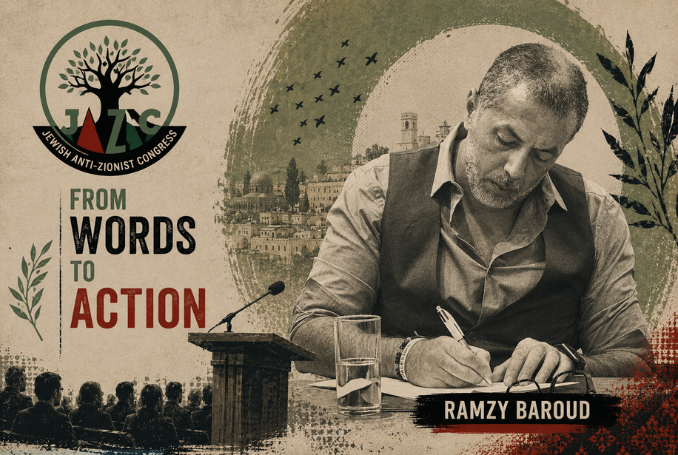
Addressing the Second Jewish Anti-Zionist Congress, Ramzy Baroud argued that Gaza has fundamentally reshaped the world’s political and moral landscape.
Addressing the opening day of the Second Jewish Anti-Zionist Congress in Dublin, Palestinian journalist, author and The Palestine Chronicle editor Ramzy Baroud argued that Israel’s ongoing genocide in Gaza has produced an irreversible moment of political and moral clarity, exposing both the violent logic of Zionism and the failure of the international system that has sustained it for decades.
The End of Ambiguity
Speaking before hundreds of activists, academics, trade unionists and anti-Zionist Jewish organizers gathered in the Irish capital, Baroud described the current moment as one in which “the veil has not just been lifted—it has been torn to shreds,” leaving “no more excuses of ignorance,” and no remaining ambiguity about the reality confronting the Palestinian people.
For Baroud, the genocide in Gaza has transformed what many governments continued to describe as a geopolitical conflict into something impossible to conceal.
The systematic destruction of hospitals, schools, and entire residential neighborhoods, the assassination of doctors, journalists and academics, the weaponization of starvation and the erasure of entire Palestinian families from the civil registry have, he argued, exposed Zionism “in its purest, most violent essence” as a settler-colonial project whose survival depends on eliminating the Indigenous population.
“This is no longer a theoretical debate for academic journals,” Baroud said. “It is a livestreamed, industrialized atrocity.”
But while Gaza has revealed the reality of Zionism, Baroud argued that it has also exposed something much broader: the collapse of the Western liberal order.
For decades, Western governments presented themselves as defenders of democracy, international law, and universal human rights. Yet throughout the genocide, Baroud said, those same governments became “the active financiers, logistical suppliers and diplomatic shield of genocide,” demonstrating that the principles they invoke are applied selectively rather than universally.
The result, he argued, has been a profound rupture in the way much of the world now views Western institutions.
“We have witnessed the complete and unmitigated collapse of Western liberal values,” he said, arguing that international treaties had been transformed into “political weapons, selectively wielded against enemies and discarded entirely when protecting an imperial outpost.”
He was equally critical of international organizations, accusing many of responding to the destruction of Gaza with bureaucratic caution while Palestinians continued to die beneath the rubble.
“We watched international institutions stutter, delay and hide behind procedural language while children were being pulled from the rubble piece by piece,” he said.
Yet Baroud insisted that the defining story of Gaza is not Israel’s violence, but the extraordinary resilience of the Palestinian people.
Rejecting attempts to qualify or sanitize Palestinian resistance, he said he deliberately speaks of resistance “not to offend, and not to protect the sensibilities of any audience anywhere.”
Instead, he described Palestinians emerging from collapsed buildings, sharing the little food that remained, rescuing one another, and documenting the names of the dead as expressions of a collective steadfastness that “defies the very laws of physics and human endurance.”
For Baroud, even faith has acquired a revolutionary meaning in Gaza.
Rather than offering escape from suffering, he argued, faith has become “an active, revolutionary anchor” that enables Palestinians to continue resisting despite overwhelming military force.
“The impossible,” he said, “has been to survive. To exist. To remain. To fight.”
Palestine Redraws the World’s Moral Map
Throughout the address, Baroud repeatedly returned to one central argument: that Palestine has fundamentally changed the moral geography of the world.
For decades, he said, Zionism attempted to isolate Palestine by presenting it as an exceptional Middle Eastern conflict detached from wider struggles against colonialism and racism.
Instead, Gaza has connected Palestine to a global anti-colonial consciousness.
“Palestine broke through those cages and redrew the moral geography of the world,” Baroud said, arguing that a new international alignment has emerged “not from governments, but from moral consciousness.”
He pointed to South Africa’s genocide case before the International Court of Justice as one of the clearest examples of that transformation, describing Pretoria’s intervention as the action of “a nation that carries the intimate scars of apartheid” and therefore refused to remain silent while another people experienced a similar system of racial domination.
Baroud also praised countries including Algeria, Colombia, and Bolivia, while reserving particular attention for Ireland.
Calling Dublin an appropriate venue for the Congress, he argued that Ireland’s own history of colonial domination explains why the country has become one of the strongest voices for Palestine within Europe.
“Ireland understands the anatomy of occupation,” he said, noting that the Irish experience of land confiscation, famine, cultural suppression and colonial rule continues to shape its solidarity with Palestinians today.
That solidarity, Baroud argued, has also taken on new forms over the past two years.
Rather than limiting itself to symbolic expressions of support, he said the Palestine movement has increasingly embraced forms of direct action capable of disrupting the political and economic structures sustaining Israel’s war.
He pointed to university encampments demanding divestment, academics resisting institutional censorship, trade unions and civil society organizations, but reserved particular praise for dockworkers who have refused to handle military cargo destined for Israel.
“This is not solidarity as a hobby,” Baroud said, arguing that solidarity had become “tangible, disruptive and material” because it was now rooted in “shared risk and collective defiance.”
The growing strength of that movement, he argued, is reflected not only in demonstrations but also in public opinion itself.
Citing recent polling showing that approximately 67 percent of global public opinion now stands with Palestine, Baroud said the movement had reached a historic turning point despite decades of political pressure, corporate media narratives and vast spending on pro-Israel advocacy.
“We are witnessing a fundamental transformation,” he said, arguing that “the hegemony of the colonial narrative is dying” as “the moral center of gravity has shifted permanently toward Palestine.”
From Moral Clarity to Collective Action
Baroud cautioned that the coming period would not be linear.
Supporters of Israel, he predicted, would intensify efforts to criminalize dissent, rehabilitate Zionism’s international image and suppress solidarity movements.
At the same time, he said, new Freedom Flotillas, expanding boycott campaigns, growing labor action and larger university mobilizations would continue challenging Israel’s isolation from below rather than through governments.
Ultimately, however, Baroud argued that the decisive factor would remain the Palestinians themselves.
“The question before us is no longer whether Palestinians will continue to hold the line,” he said, noting that they had already answered that question “through their blood, their sacrifice, their survival and their unwavering will.”
The challenge now belongs to the global solidarity movement.
“What will we do with the clarity we now possess?” Baroud asked, urging activists to transform the unprecedented moral consensus created by Gaza into an organized international movement capable of overcoming institutional rivalries and political fragmentation.
If that unity could be achieved, he concluded, history would not simply be observed—it would be remade.
Together with “the unmatched resilience of the Palestinian people,” Baroud said, the movement would “not merely witness history” but “rewrite it,” leading ultimately to “the liberation of Gaza,” “the defeat of Zionism,” and “the beautiful freedom of Palestine—from the river to the sea.”