
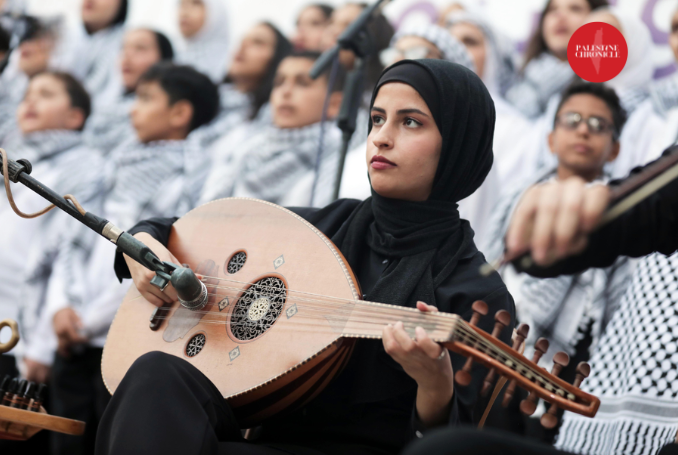
The concept of sumud (steadfastness), the philosophical backbone of Palestinian identity, manifests in the songs as an active willingness to self-sacrifice in the pursuit of justice.
Throughout the course of its occupation and indeed very existence, Israel has always harshly suppressed any form of (violent or non-violent) Palestinian resistance, with the aim of counteracting every attempt to fight back against occupation, ethnic cleansing, and genocide.
This is attested to by various historical examples, including the long-standing criminalization of Palestinian flags and symbols, the legal and police repression of Nakba commemorations, and the systematic use of curfews, mass arrests, and beatings to suppress largely unarmed popular resistance during the First Intifada.
Well before the consolidation of Zionist settler-colonial control in Palestine, and during the early phases of organized Zionist settlement under British imperial administration, Palestinians resisted in various ways, including through peaceful protests and mass strikes, as in the Nebi Musa protests of 1920 and the 1936–39 Arab General Strike.
Although academics have identified various forms of Palestinian resistance, they most frequently discuss armed resistance, historically defined by guerrilla warfare and more recently by tunnel networks. However, as Mazin has previously shown (in his book Popular Resistance in Palestine: A History of Hope and Empowerment), resistance extends beyond the battlefield and the calculations of military strategy (also see Qumsiyeh, 2010). Jamal Nabulsi’s work on ‘affective sovereignty’ develops this point to show that cultural and symbolic resistance—whether through art, poetry, and/or music—can also be vital to decolonizing emotions and asserting identity (Nabulsi, 2025). Music, to take one example, can be a ‘sonic fortress’ that preserves collective memory when physical structures are demolished.
In doing so, this article examines how Palestinian resistance music contributes to the production and preservation of Palestinian national identity under occupation. It achieves this by analyzing three pivotal Palestinian songs to demonstrate how lyrical concepts contribute to a unified national identity and an unwavering ethos of resistance.
The Conceptual Framework of Palestinian Resistance Music
To understand how music contributes to identity, it is necessary to identify and map recurring concepts found in cultural products, such as songs and song lyrics. The following table categorizes the prominent themes extracted from three songs (‘Yalla Imshu Ma’ana ‘a Filastin’ (‘Let’s Walk Together to Palestine’), ‘Falasteen Biladi’ (‘Palestine is my Country’), and ‘Rajeen’ (‘We are Returning’).
These songs are selected because they emerged after the Gaza genocide, reflecting how contemporary Palestinian cultural production responds to extreme violence by rearticulating collective memory, territorial claims, and an enduring ethos of resistance.
Geographies of the Heart: Naming the Homeland
Naming is one of the most powerful ways Palestinian music challenges the occupation, with explicit allusions to cities like Quds, Gaza, Jenin, Yafa, and Akka, reconstructing a map the occupation seeks to erase. In the words of ‘Falasteen Biladi’: ‘We are Jerusalem, Acre and Jaffa… We are in Gaza and in the heart of Jenin.’ Far more than a mere list of locations, this is an assertion of geographical totality that collapses the artificial borders created by checkpoints and walls while linking refugee camps and Galilee residents.
In directly opposing a Zionist project predicated on the myth of ‘a land without a people’ (Garfinkle, 1991), the songs instead proffer a ‘people with a map’. When ‘Yalla Imshu’ claims ‘the land above and the land below’, it invokes a non-negotiable identity rooted in a deep ancestral ownership. Thus, geographical naming becomes a form of “cultural mapping” that preserves the pre-1948 territorial inheritance in the minds of children who have never seen their ancestral villages.
Sumud and the Metaphysics of Return
The concept of sumud (steadfastness), the philosophical backbone of Palestinian identity, manifests in the songs as an active willingness to self-sacrifice in the pursuit of justice, including in ‘Falasteen Biladi’, where it presents through ritualistic repetition: ‘We won’t be silent, we won’t surrender, no!’ The framing of presence on the land as enduring ‘until the Day of Judgment’ removes the ‘conflict’ from the realm of temporary politics before abruptly inserting it into the realm of eternal existence.
In the songs, sumud links into al-awda (right of return), most notably in ‘Rajeen’s centering of the house key metaphor: ‘The key to my home remains in my heart/And I’m returning with my children in my hands.’ This is a profound identity marker, with the key no longer just a metal object but symbolizing property rights, belonging, and the refusal to accept the Nakba as a finished event.
Here, return is not a romantic hope but rather a ‘faith’ and even ‘certainty’, leveraged in the clear understanding that Israel’s demographic ‘threat’ is, for Palestinians, the only possible way of resolving their misery.
The Collective Voice
Palestinian resistance music is a critical mechanism for organizational unity, shifting the narrative from isolated individual actions to a formalized, legitimate institutional framework. By utilizing concepts such as ‘national councils’ and ‘border committees’, its compositions frame resistance as a disciplined and coordinated force guided by a unified strategic vision, rather than a series of random occurrences. Presenting liberation as a religious obligation also transforms struggle into a spiritual necessity, thereby solidifying participants’ loyalty and commitment. Ultimately, it constructs a unified ideological umbrella that consolidates the community into a resilient collective capable of maintaining an unyielding stance vis-à-vis structures of occupation.
It also addresses the global context of resistance and struggle, most notably in ‘Rajeen’s’ biting critique of international hypocrisy: ‘Sorry that I’m not from Ukraine / Sorry that my skin is not white.’ Here, Palestinian identity is conscious of its place in the Global South, fighting not just a local occupier but a systemic double standard. But Arab leaders are by no means spared criticism— ‘Where are the Arab rulers?’ (in ‘Rajeen’), far from innocent enquiry, is instead a scathing critique of internal betrayal, an incipient appeal to transnational solidarity that transcends corrupt leadership.
In the songs, the culture of martyrdom becomes an educational principle, with ‘Yalla Imshu’ expounding how Palestinians are ‘raised on martyrdom’. In its hands, the ‘martyr’ (shahid) is the ultimate witness to the truth, a symbol crystallizing innocence and defiance. The tragedy of loss is a ‘noble trust’, and the blood of the fallen is the future homeland’s ‘water for the soil’.
In the three songs, Palestinian music is more than an aesthetic expression; instead, it presents a dynamic site of identity construction that weaves together geographical claims, the metaphysics of return, and the legitimacy of organized resistance to produce a Palestinian identity inherently resistant to erasure. For as long as it exists, the occupation is confronted by the disconcerting realization that Palestinian will cannot be broken by military might alone.
To adapt and apply a well-known Palestinian (cultural and political) saying: If the occupation is a storm attempting to uproot the trees of a nation, the songs are roots that grow deeper with every strike. In the face of walls that divide Palestinian land, the melody and message of al-awda and sumud are indivisible, echoing across time (from the past into an inevitable future of freedom) and space (from the river to the sea).
Music proves that while an army can occupy a territory, it can never govern the ‘affective sovereignty’ of those who sing their way back to their homes.
Sources
Garfinkle, A. M. (1991). On the origin, meaning, use and abuse of a phrase. Middle Eastern Studies, 27(4), 539–550. https://doi.org/10.1080/00263209108700876
Nabulsi, J. (2025). Affective sovereignty: A decolonising politics of emotion in Palestine. Review of International Studies, 1–23. https://doi.org/10.1017/S0260210525100880
Qumsiyeh, M. B. (2010). Popular Resistance in Palestine: A History of Hope and Empowerment (1st ed.). Pluto Press. https://doi.org/10.2307/j.ctt183p294
Mehmet Rakipoğlu is an Assistant Professor in the Department of Political Science at Mardin Artuklu University and a Postdoctoral Researcher at the Institute of Arab and Islamic Studies at the University of Exeter. His research focuses on Turkish foreign policy, Gulf countries, Palestine Studies, and Islamic movements. He serves as Book Review Editor at Insight Turkey and has worked at research centers in Turkey, Syria, and Yemen. He has authored and edited books on the Muslim Brotherhood, the Israel–Palestine conflict, and Saudi foreign policy.