
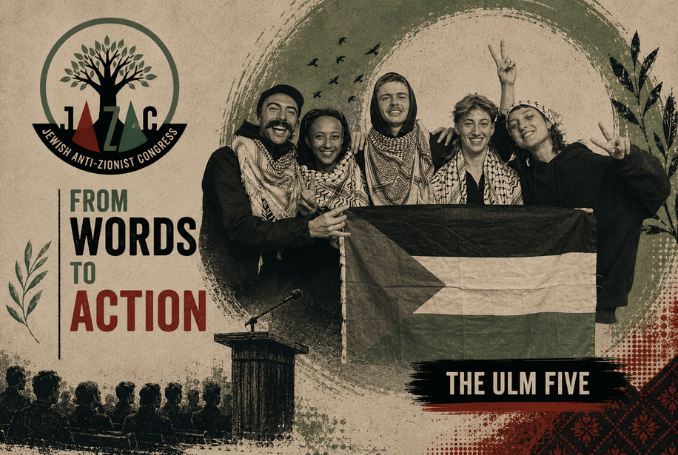
At the Second Jewish Anti-Zionist Congress, Clara Tatlow Devally argued Europe’s legal systems criminalize anti-genocide activists while protecting complicity in atrocities.
When Clara Tatlow Devally watched the video of her brother’s arrest, she had no idea what she was about to witness. Standing in the kitchen of her family’s home, she saw Daniel Tatlow Devally and four fellow activists calmly waiting for police after entering an Elbit Systems facility in southern Germany, damaging equipment they believed was helping sustain Israel’s war on Gaza.
“I couldn’t help but feel a bit heartbroken,” she recalled. “I was watching my brother on my phone screen as they sacrificed their freedom for a greater cause, taking action against genocide.”
Speaking at the Second Jewish Anti-Zionist Congress in Dublin, Tatlow Devally transformed what might have been a personal account into a broader indictment of a legal and political order that, she argued, criminalizes those seeking to prevent atrocity while protecting those who facilitate it.
From Protest to Direct Action
According to Tatlow Devally, the five activists—coming from Ireland, Germany, Spain and Britain—did not begin their political journey with alleged acts of sabotage. Like thousands across Europe, they marched, organized community events, raised funds and joined demonstrations opposing Israel’s genocidal war on Gaza.
But eventually, she said, they confronted a question that peaceful protest alone could no longer answer. “How can they act within the law,” she asked, “when they’re living in a country that’s failing to uphold it?”
For the group, Germany’s continued military relationship with Israel fundamentally altered the meaning of legality itself.
“The Genocide Convention demands of states that they act to prevent genocide,” she noted. “Yet Germany delivers weapons to a state that’s committing it.”
‘Complicity in Genocide’
Tatlow Devally shared excerpts from Daniel’s courtroom statement, in which he explained that the action targeted Elbit Systems because of the company’s role in supplying military technology to Israel.
“My actions at the Elbit facility… were motivated exclusively by urgent humanitarian considerations,” he told the court, adding: “By damaging the arms production facilities of Elbit Systems… the aim was to stop, to the greatest extent possible, their material support for the crimes being committed in Gaza, for such support constitutes complicity in genocide.”
Daniel also rejected the prosecution’s attempt to characterize the defendants as antisemitic.
“It is disgraceful,” he declared, “to characterize resistance against occupation and mass murder as anti-Semitism.”
For his sister, those words reflected the character of someone she described as compassionate, intellectually curious and deeply principled.
“Daniel’s an exceptional person,” she said. “They are creative and sensitive… We are proud of them, and we miss them every day.”
A Trial on Trial
Yet Tatlow Devally argued that the proceedings themselves have become part of the story. She said defense lawyers have described the case as a “show trial,” condemning repeated violations of fair trial standards while prosecutors seek to portray the defendants as dangerous criminals despite the absence of allegations that they harmed or threatened anyone.
“The court is determined to characterize the M5 (Ulm Five) as dangerous,” she said.
She also criticized the silence of the Irish government, noting that despite Ireland’s recognition of Palestine and repeated statements expressing concern over Gaza, officials have not monitored the trial of one of their own citizens.
“So far,” she said, “we’ve been met with silence.”
Beyond One Courtroom
Tatlow Devally concluded by urging supporters not simply to follow the trial but to intervene politically. She called on people to contact elected representatives and ask why Ireland is failing to observe proceedings in which, she argued, one of its citizens faces the loss of fundamental rights for attempting to prevent genocide.
Her appeal ultimately reached beyond the fate of five defendants in a German courtroom.
It raised a broader question increasingly confronting activists across Europe: what happens when international law obliges states to prevent genocide, but those who attempt to act on that obligation are the ones placed on trial?
For Tatlow Devally, that contradiction lies at the heart of the Ulm Five case—and may ultimately define how this period is remembered.